Microsoft Tells IT Admins How to Fix Broken Exchange Web Services Apps After Default Disabling

Microsoft has provided instructions for IT administrators looking to temporarily re-enable the retired Exchange Web Services (EWS) API in Exchange Online, allowing organizations to restore functionality to dependent applications that have suddenly stopped working.
The API, widely known as EWS, is a foundational programming interface designed for developers to build applications capable of accessing Exchange mailbox items. Through this interface, software can interact directly with email messages, calendar meetings, and contacts stored within both Exchange Online and on-premises Exchange servers. Over the years, EWS has become deeply integrated into a wide variety of software solutions, including Outlook desktop add-ins, legacy versions of Outlook for Windows, the native Apple Mail and Calendar applications on macOS, and numerous third-party productivity and management tools.
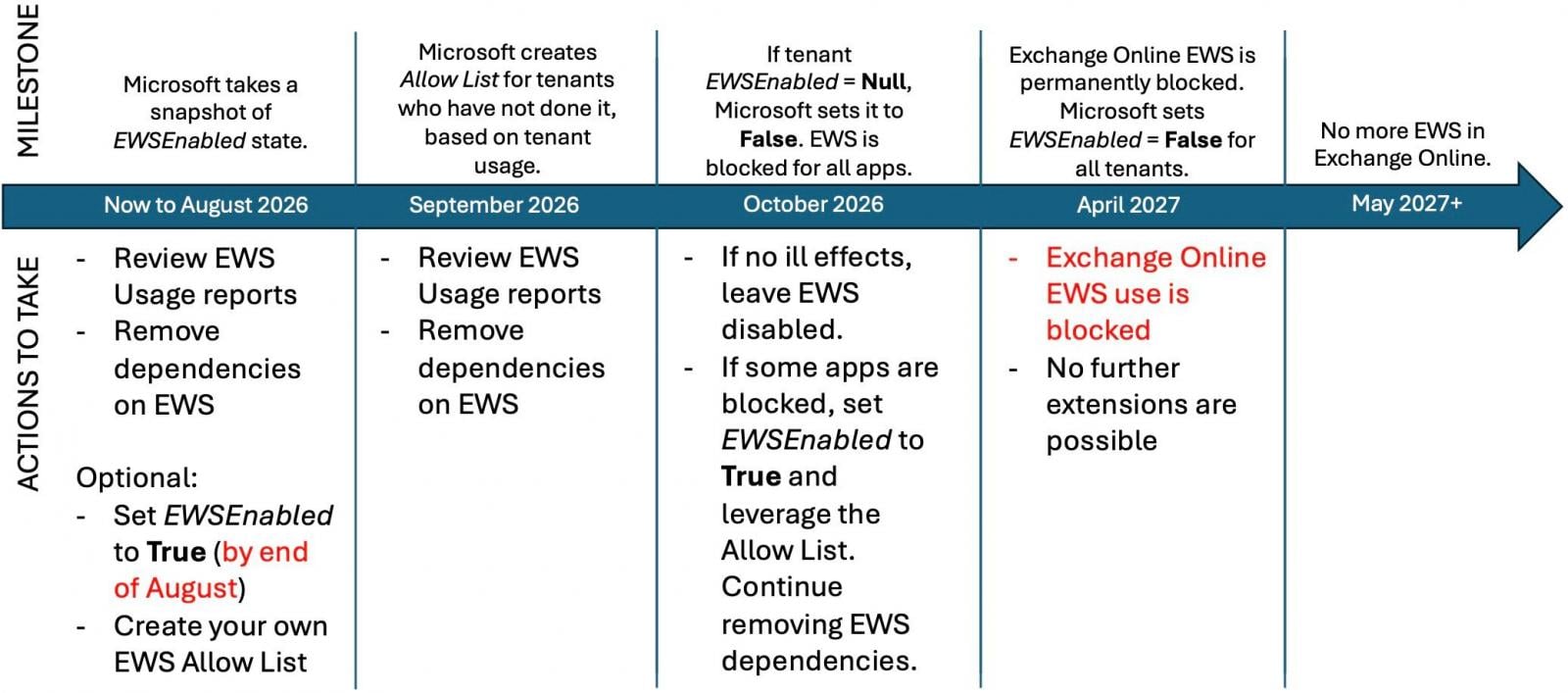
The recent disruptions are part of Microsoft’s phased retirement plan for the aging technology. Earlier this year, the company announced that it would begin blocking the EWS API by default starting October 1, 2026. However, to give organizations a brief transitional buffer, Microsoft built a mechanism allowing IT administrators to temporarily maintain access via an app allowlist until the absolute final shutdown arrives on April 1, 2027.

When organizations hit this transitional hurdle and find EWS disabled, the impact is immediately visible to end users. Affected applications begin throwing a variety of errors, ranging from explicit alerts warning that the EWS protocol is unavailable to frustrating, repeated prompts demanding that users re-enter their usernames and passwords because authentication requests are failing.
To resolve these unexpected issues and bring broken EWS applications back to life, Microsoft explained that tenant administrators can take immediate corrective action. Administrators can re-enable EWS directly through the Microsoft 365 admin center by navigating to the Baseline Security Mode page and unchecking the option that blocks the entire organization from using EWS. Alternatively, technical teams can utilize Exchange Online PowerShell to execute a specific organizational configuration command, which re-enables the protocol across the tenant within a few hours.
Microsoft emphasized that the industry is currently navigating the first stage of the EWS disablement schedule, a window where customers still retain the technical capability to manually turn the protocol back on if critical workflows depend on it. However, the company reiterated that this workaround has an expiration date, noting that re-enabling EWS will cease to function entirely when the permanent cutoff arrives in April 2027.
Addressing the long-term outlook, Microsoft stressed that simply flipping the protocol back on is only a temporary band-aid. The ultimate resolution requires organizations to systematically update their software portfolio to newer application versions that no longer rely on EWS. Administrators have been advised to reach out directly to their third-party application vendors to secure updated releases, or, in the case of custom-built internal tools, to rewrite the underlying code to eliminate any dependency on the legacy interface.
For developers still working with the aging architecture, Microsoft has strongly advised transitioning to the Microsoft Graph API well before the final EWS shutdown date. The Graph API offers near-complete feature parity with EWS across the vast majority of enterprise operational scenarios, making it the designated modern standard for cloud-based messaging and collaboration integrations.
It is worth noting for enterprise infrastructure managers that the EWS retirement process is strictly limited to Microsoft 365 and Exchange Online environments. The API will continue to function normally in on-premises Exchange Server installations, where cloud deprecation timelines do not apply.
This ongoing retirement process represents the culmination of a multi-year deprecation roadmap. The announcement of the ultimate shutdown followed a warning issued all the way back in 2018, during which Microsoft declared that EWS would no longer receive functional updates. That foundational warning was followed by a formal announcement in September 2023 detailing plans to begin winding down and shutting off the EWS API in October 2026.
Security considerations have also played a major role in the gradual phasing out of the interface. In October 2021, Microsoft revealed that it had deprecated the twenty-five least-used EWS Exchange Online APIs, swiftly removing support for them in March 2022 to tighten the security posture of cloud environments and reduce the overall attack surface.

Related News