Live updates: Bitcoin slumps below $82,000 as markets go risk off on AI selloff, oil surge
‘Demand Is Parabolic’: Blackstone’s Jon Gray Pushes Back on AI Bubble Talk
Amid the tech sector selloff, Blackstone President Jon Gray pushed back strongly against growing fears of an artificial intelligence bubble. Speaking in an interview, Gray contrasted historical market bubbles driven by speculative overcapacity with the current environment for generative AI.
When people think about a bubble, they typically think of building massive infrastructural capacity first and simply hoping that demand will eventually materialize to meet it. According to Gray, the exact opposite is happening with artificial intelligence today. Companies are building out capacity as fast as humanly possible, yet they are continually struggling to keep pace with relentless consumer and enterprise adoption.
Gray pointed to Ode, an artificial intelligence consulting company formed as a joint venture between Blackstone and Anthropic, noting that customer demand has reached levels that can only be described as parabolic. He emphasized that the primary bottleneck in the AI ecosystem is not a lack of interest or end-user demand, but rather the sheer physical and logistical limits of scaling infrastructure quickly enough.
That perspective found support in recent industry developments, even as semiconductor stocks experienced sharp declines. Lam Research shares fell roughly 10% during the trading session. However, the drop was driven not by weak revenue figures or a deterioration in market demand for advanced chipmaking equipment, but rather by severe supply chain constraints. Analysts noted that these logistical bottlenecks threaten to cap production and limit how many systems equipment manufacturers can successfully deliver to clients in the upcoming quarter, reinforcing Gray’s argument that demand continues to outstrip the industry’s physical capacity to supply it.
Geopolitical Friction and Energy Markets Fuel Equity Decline
The broader market decline was further exacerbated by rising geopolitical tensions in the Middle East. Overnight air strikes and ongoing hostilities sent crude oil prices surging by more than 3%, inflicting immediate pressure on global equity indexes.
The spike in energy costs caught the attention of policymakers, with U.S. President Donald Trump taking to social media to lash out against what he characterized as deliberate election meddling by Iran. Writing on Truth Social, the president claimed that Tehran was doing everything within its power to drive up global oil prices ahead of the upcoming U.S. midterm elections. He asserted that reports of disruptions, mine threats, and military encounters in the crucial Hormuz Strait were fabricated, noting that oil volumes moving through the passage currently exceed levels seen even before the onset of the current conflict.
The energy shock and subsequent equity market selloff unfolded against a politically charged domestic backdrop, with the U.S. midterm elections just under two weeks away. Prediction markets on Polymarket showed the implied probability of a Democratic sweep of both houses of Congress holding near contract highs of 67%, adding an extra layer of policy uncertainty for investors already grappling with macroeconomic headwinds.
U.S. Treasury Yields Dip Below 5% as Safe-Haven Flows Accelerate
The combination of surging oil prices, dropping equity valuations, and renewed fears of an escalating European debt crisis triggered a massive flight to safety, sending capital pouring into government debt securities.
The benchmark U.S. 10-year Treasury yield dropped by 15 basis points during the session, dipping below the psychologically important 5% threshold for the first time in a month. Short-term yields also saw significant downward pressure, reflecting a profound shift in monetary policy expectations.
In Europe, borrowing costs told a starkly different and more troubled story. French 10-year government bond yields climbed by another 9 basis points to reach 5.08%, driven by mounting political instability, persistent concerns over public finances, and inflationary pressures linked to the conflict involving Iran. The widening spread between French and German 10-year paper ballooned to 174 basis points, marking a 15-year high and recalling earlier sovereign debt anxieties within the eurozone. By the end of the session, France’s 10-year OAT yield pushed even higher to 5.126%, with 30-year yields touching 5.550%.
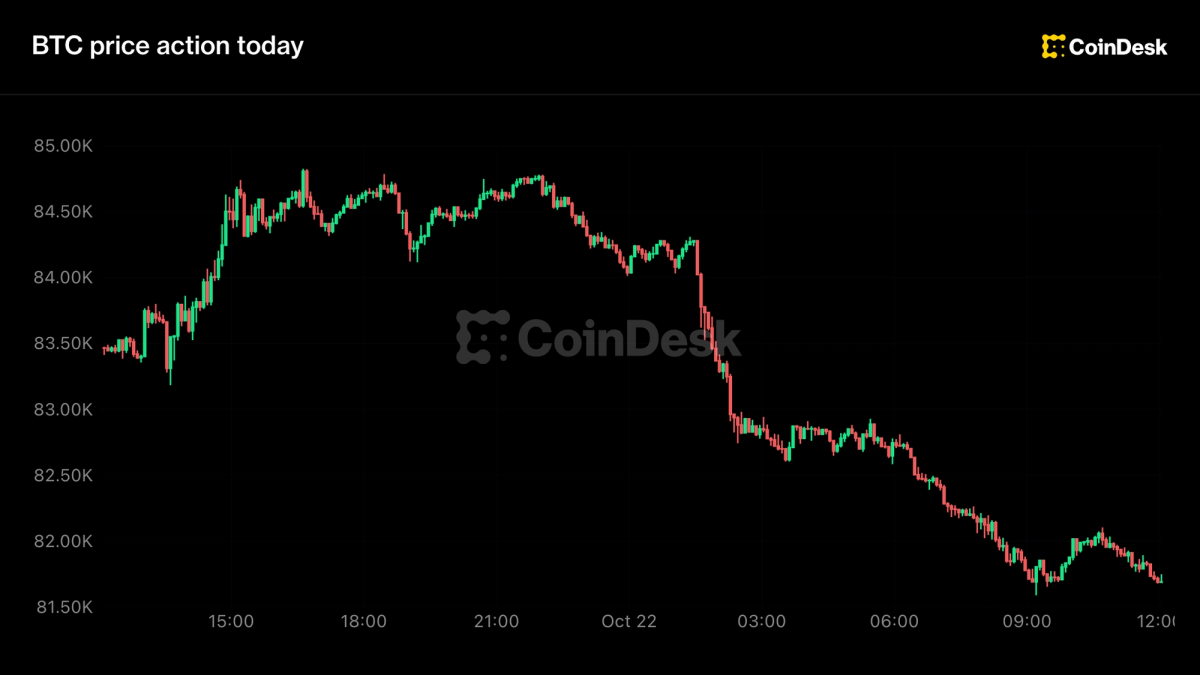
The turmoil in equities and European debt markets quickly bled into digital assets. Bitcoin traded down near session lows around $81,500, shedding roughly 3.3% over a 24-hour window, while the Nasdaq hovered near session lows with a 2.2% loss.
Fed Rate Hike Expectations Evaporate Amid Market Stress
The sharp deterioration in risk appetite and the steep decline in Treasury yields fundamentally altered expectations for Federal Reserve monetary policy. Just days after hotter inflation readings and soaring oil prices had market participants bracing for further tightening, the macroeconomic narrative shifted decisively.
According to the CME FedWatch Tool, the implied probability of the Federal Reserve implementing an interest rate hike at its upcoming policy meeting plummeted to just 8%, down from 16% the previous day and 28% just one week prior. Traders also began actively paring back bets on a subsequent rate hike at the Fed’s December meeting, even though a succession of central bank officials had recently insisted that at least one more rate increase would be necessary before the end of the year. Consequently, the probability that the central bank would hold interest rates steady through the conclusion of the year climbed to 16%.
This sudden dovish repricing occurred despite resilient domestic economic data. U.S. initial jobless claims released during the week fell to a historically low level of 194,000, coming in below market forecasts of 200,000 and pointing to continued robust health in the domestic labor market. The four-week moving average also ticked down to 197,750. Nevertheless, the strong employment figures failed to halt the slide in bond yields, as fixed-income investors remained entirely focused on the steep equity selloff and broader systemic risk indicators.
Crypto-Related Equities and Digital Assets Under Pressure
Cryptocurrency markets faced broad-based downward pressure as risk-off sentiment dominated global exchanges. Bitcoin traded near $81,500, representing a 2.4% decline over a 24-hour period, with major alternative tokens including Ether, Solana, and XRP experiencing comparable losses.
Equities tied to the digital asset ecosystem suffered even steeper pullbacks in early trading. MicroStrategy shares dropped 5.6%, MARA Holdings fell 4.2%, Circle declined 4.6%, and Coinbase lost 4%.
The volatile price action created massive liquidations across derivatives markets. Over a 24-hour period, approximately $431 million in leveraged positions were forcibly wiped out by exchanges. During an initial push that drove Bitcoin close to $85,000, roughly $173 million in short positions were liquidated. However, as the asset sharply reversed course and dropped back toward $81,800, bullish long positions bore the brunt of the damage, accounting for $210 million of the total liquidations over the final 12 hours of the swing. The single largest liquidation casualty was an $11.8 million Bitcoin long position on Binance that was automatically closed near the $83,500 mark.
Regional currency dynamics also played a role in digital asset pricing. The Japanese yen appreciated notably against major fiat currencies, driven by technical chart patterns, short covering, and growing market expectations that the Bank of Japan could raise interest rates at its December meeting. The surging yen caused the bitFlyer-listed Bitcoin-to-yen trading pair to drop 3%, outpacing the roughly 2.5% declines observed in Western Bitcoin-to-dollar pairs.
Institutional Shifts and On-Chain Movements
Beyond immediate market pricing, the broader digital asset industry continued to navigate structural headwinds. Venture capital heavyweight Andreessen Horowitz decided to drop the word "crypto" from the name of its flagship blockchain fund, rebranding the vehicle as a16z frontier. The rebranding was accompanied by leadership adjustments, including the departure of partner Ali Yahya, while crypto lead Chris Dixon remained with the firm to oversee the strategy. Market observers interpreted the move as another reflection of the challenging macro environment facing venture investments in the sector.
Meanwhile, on-chain intelligence firm Arkham Intelligence reported significant activity linked to the historical exploit of Drift Protocol, a Solana-based perpetuals exchange that had been drained of approximately $278 million to $285 million on April 1. According to on-chain data, the exploiter moved roughly $122.3 million worth of Ether into privacy mixer Tornado Cash across 520 separate transactions over a two-day period. The vast majority of the transfers consisted of repeated 100-Ether increments, representing the single largest round of mixing activity tied to a crypto hacker in the past two years, following months of relative dormancy for the involved wallet addresses.

Related News