Why You Should Distrust the News: Leading Statistician Sir David Spiegelhalter on the Illusion of Certainty
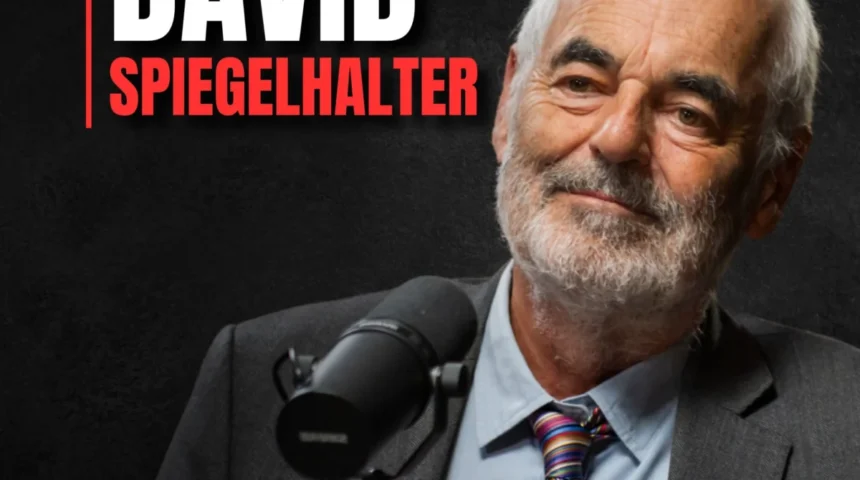
In an era defined by endless data streams, rolling news cycles, and algorithmic predictions, society has grown increasingly obsessed with quantifying risk. Yet, according to one of the world’s leading statisticians, the public is being systematically misled by the very numbers designed to inform them. Sir David Spiegelhalter, Chair of the Winton Centre for Risk and Evidence Communication at Cambridge University and author of The Art of Uncertainty, has spent decades analyzing how data is used—and frequently abused—in modern society. Having served on high-profile public inquiries into mass murder, such as the case of serial killer Harold Shipman, as well as systemic healthcare failures, Spiegelhalter brings a sobering, empirical perspective to the ways information is manipulated.
In a wide-ranging discussion, Spiegelhalter breaks down the mechanics of numerical manipulation in the media, dismantles the flawed concept of "objective truth," and explores actionable ways individuals can protect themselves against confirmation bias. From the dark reality of how mathematical algorithms helped catch Britain’s most prolific serial killer to the psychological frameworks that separate mediocre forecasters from super-forecasters, the conversation offers a rare, behind-the-scenes look at the architecture of human judgment.
The Illusion of Objectivity and the Mechanics of Manipulation
Spiegelhalter opens with a striking premise: individuals should immediately distrust almost any statistic encountered casually in the news. This skepticism is not born of cynicism, but of a deep understanding of how language and presentation shape human perception. Identical statistical facts can be framed using simple linguistic tricks to sound either utterly terrifying or deeply reassuring, depending on the narrative a publisher wishes to drive. Spiegelhalter demonstrates that objective truth is frequently an elusive concept in public discourse, where numbers are rarely presented in a vacuum. Instead, they are deployed by institutions, governments, and media outlets to evoke specific emotional responses.
This manipulation relies heavily on human psychology. Rather than forcing a false narrative, bad actors often let confirmation bias do the heavy lifting. When presented with numbers that align with pre-existing beliefs, individuals drop their critical defenses, accepting flawed methodologies without question. This tendency toward selective belief has profound implications for public safety, policymaking, and societal trust.
Lessons from Public Inquiries: From Harold Shipman to Healthcare Failures
Spiegelhalter’s extensive background in examining institutional breakdowns provides a grim window into the real-world consequences of ignored or mismanaged data. His work on public inquiries, notably the case of Harold Shipman—the British general practitioner who murdered hundreds of his patients—highlights both the failures and the latent power of statistical monitoring. The discussion reveals how advanced mathematical algorithms and pattern recognition could have exposed Shipman’s horrific crimes years earlier had the medical establishment properly analyzed mortality data.
These investigative experiences underscore a recurring theme in Spiegelhalter’s career: the vital importance of transparency and humility in institutional data collection. When systems fail to account for uncertainty, or when they actively obscure uncomfortable realities to protect institutional reputations, the human cost can be catastrophic.
Navigating the COVID-19 Era and the Perils of Simplistic Messaging
The COVID-19 pandemic served as an unprecedented stress test for the communication of scientific uncertainty. Reflecting on the turbulent years of the pandemic, Spiegelhalter discusses the immense challenges of sitting squarely in the middle of a polarized scientific and political argument. He points out critical missteps in how public health messaging was handled, noting that the ubiquitous government mantra declaring vaccines to be "safe and effective" was ultimately the wrong message. While well-intentioned, such absolute terminology left no room for nuance, individual risk assessment, or acknowledgment of rare adverse events.
This lack of nuance ultimately eroded public trust. When complex, evolving scientific experiments involving thousands of participants were reduced to blunt slogans, the public was left ill-equipped to weigh the actual data regarding lockdowns, transmission risks, and vaccine efficacy. Spiegelhalter expresses particular concern over what he views as unpardonable fear-mongering by authorities, noting that data consistently showed that certain demographics, particularly children, have statistically never been safer. When governments threw their political weight around to enforce compliance rather than fostering genuine comprehension, they inadvertently damaged the credibility of public health institutions for years to come.
Trustworthiness, Productivity, and the Modern Data Landscape
Moving beyond the pandemic, Spiegelhalter examines how institutional data collection continues to falter in unexpected areas, citing systemic errors in national productivity figures that misrepresent economic realities. He contrasts the concept of being "trusted"—often a matter of PR and institutional branding—with being genuinely "trustworthy," which requires a rigorous, transparent commitment to acknowledging what is unknown.
The conversation also touches on lighter applications of probability, such as predicting crowd attendance at Real Bedford football matches, illustrating that statistical thinking applies just as readily to everyday events as it does to global crises. Yet, as the world advances into an era dominated by artificial intelligence, the stakes surrounding data interpretation are higher than ever.
The Rise of AI, "Black Boxes," and the Hedgehog vs. Fox Framework
As algorithms and machine learning models increasingly infiltrate healthcare, business forecasting, and meteorology, Spiegelhalter addresses the growing dominance of AI "black boxes." These opaque systems can predict complex outcomes—ranging from business metrics to complex life-and-death health trajectories—with startling accuracy, yet they often obscure the underlying logic from human operators. Evaluating Elon Musk’s famously speculative prognostications, Spiegelhalter weighs the probabilities of rapid technological transformation against the historical realities of mathematical forecasting.
To understand what makes some forecasters consistently better than others, Spiegelhalter invokes the classic mental framework of "hedgehogs vs. foxes." Popularized by philosopher Isaiah Berlin, hedgehogs relate everything to a single overarching theory and tend to be rigid and overconfident, whereas foxes draw on a wide variety of experiences, embrace nuance, and adapt readily to changing evidence. According to Spiegelhalter, this distinction neatly separates terrible forecasters from the true super-forecasters of our time. In a world drowning in data, the capacity to think like a fox—to sit comfortably with uncertainty rather than demanding false simplicity—remains humanity’s best defense against manipulation.

Related News