GitLab Issues Urgent Patch for Maximum-Severity RCE Flaw in Regular Expression Compiler

GitLab has issued critical security updates to address a maximum-severity Remote Code Execution (RCE) vulnerability affecting its Regular Expression Compiler engine. The flaw, which can be exploited by remote and unauthenticated attackers to execute arbitrary code on vulnerable servers, represents one of the most severe security challenges faced by the DevSecOps platform in recent months.
The security defect has been officially tracked as CVE-2026-110264. According to technical advisories, the vulnerability was discovered and reported to the platform by an external security researcher who operates under the handle ‘joaxcar.’ The researcher submitted the finding through GitLab’s established HackerOne bug bounty program, highlighting the ongoing importance of coordinated vulnerability disclosure and crowdsourced security testing in safeguarding enterprise software infrastructure.
Understanding the Integer Overflow Vulnerability
At the root of CVE-2026-110264 is an integer overflow weakness residing within GitLab’s Regular Expression Compiler. This background processing engine plays a critical role within the platform, tasked with parsing and validating regular expressions embedded across various system and configuration files.
When the compiler processes a specially crafted, malicious regular expression supplied by a user, an integer overflow occurs due to improper handling of numerical boundaries. Under specific operational conditions, this computational flaw allows an unauthenticated adversary to bypass security boundaries and achieve arbitrary code execution directly on the underlying GitLab server. Successful exploitation of this vulnerability grants attackers extensive control over the compromised environment, potentially exposing sensitive internal systems, source code repositories, and proprietary corporate assets.
Rapid Remediation and Affected Versions
Recognizing the gravity of the threat, GitLab’s security engineering teams moved quickly to develop, test, and release backported patches for both the Community Edition (CE) and Enterprise Edition (EE) platforms. The fixes have been made available across a broad spectrum of supported version lines to ensure administrators can apply updates regardless of their specific upgrade cycle.

The security updates are included in GitLab CE and EE versions 19.5.1, 19.4.3, 19.3.6, 19.2.9, 19.1.9, 19.0.10, and 18.11.13. In its formal advisory, the company issued a strong and urgent warning to system administrators and IT security teams, urging them to apply the necessary patches to all self-hosted and on-premises instances without delay.
"GitLab has remediated an issue that, under certain conditions, could have allowed an unauthenticated user to execute arbitrary code on the GitLab server due to integer overflow when compiling a specially crafted regular expression," the company stated in its release communication.
The software vendor emphasized the urgency of the situation, reiterating that all installations running any of the affected software versions must be upgraded to the latest secure releases as rapidly as possible. Cloud-native and managed deployments have largely been shielded from the issue already. GitLab.com, the company’s primary software-as-a-service platform, has already been updated to run the patched version. Furthermore, customers utilizing GitLab Dedicated tenants running versions 19.3.5-internal0 and 19.4.2-internal0, or later iterations, already incorporate the necessary security fixes and are not required to take any manual remediation steps.
Global Exposure and Threat Landscape
Despite the rapid availability of patches, the discovery of a maximum-severity RCE vulnerability in such a widely adopted platform has immediately drawn the attention of global threat monitors and security analysts.
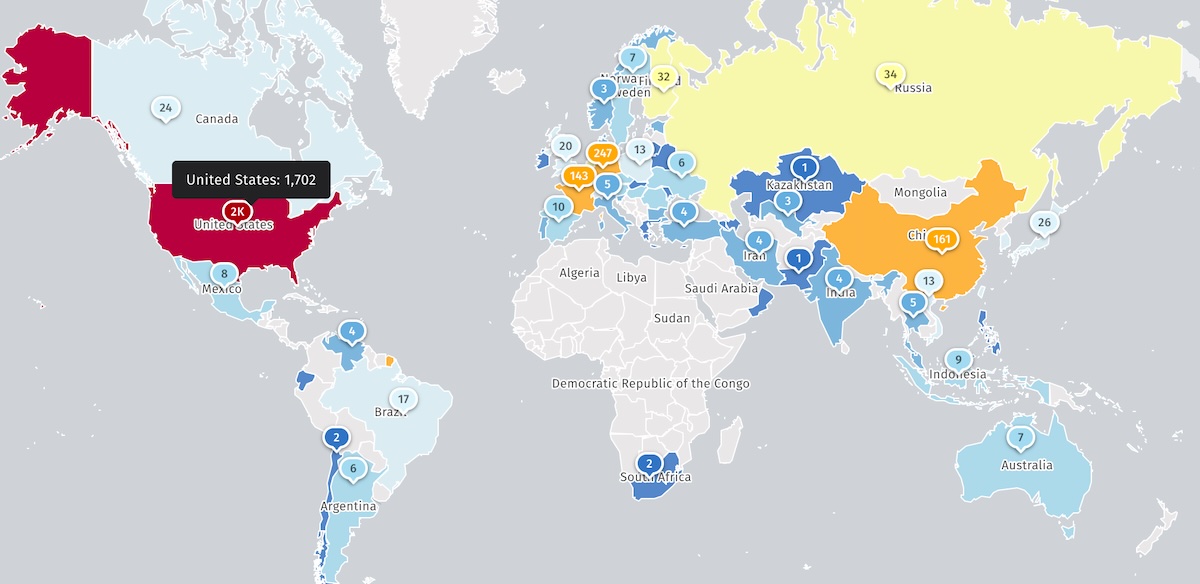
Data compiled by the internet threat watchdog Shadowserver indicates that more than 2,700 distinct GitLab Community Edition instances remain exposed directly to the public internet. While telemetry data from organizations like Shadowserver provides crucial visibility into the scale of potential surface areas, researchers note that these statistics do not differentiate between production environments, test servers, honey-pots, or instances that may have already been independently secured or backported by their respective administrators. Nevertheless, the vast footprint of publicly reachable developer infrastructure creates a lucrative target pool for automated exploitation scripts and opportunistic cybercriminal syndicates.
The urgency surrounding CVE-2026-110264 is further heightened by a pattern of similar vulnerabilities affecting the platform’s regex parsing infrastructure. Just ten days prior to the disclosure of this integer overflow flaw, GitLab issued warnings regarding another critical remote code execution vulnerability, tracked as CVE-2026-97229. That separate flaw also carried a maximum 10 out of 10 CVSS base score and affected the CI/CD Regular Expression Compiler engine. Notably, both vulnerabilities were identified and reported by the same security researcher, ‘joaxcar,’ underscoring a concentrated focus on the security boundaries of GitLab’s parsing and compilation subsystems.
Broader Enterprise Context and Regulatory Scrutiny
These recent regular expression compiler flaws arrive on the heels of other high-profile security incidents for the platform. Last month, GitLab rushed to patch another maximum-severity flaw in its Community and Enterprise editions, tracked as CVE-2026-85706. That particular vulnerability involved a severe path traversal defect that permitted unauthenticated attackers to read sensitive internal data, including hardcoded credentials, API keys, and other critical secrets, directly from vulnerable servers.
The fallout from CVE-2026-85706 quickly escalated beyond standard software patches. Just one day after its public disclosure, the U.S. Cybersecurity and Infrastructure Security Agency (CISA) added the flaw to its authoritative Known Exploited Vulnerabilities catalog. CISA issued a binding operational directive ordering federal civilian executive branch agencies to secure their vulnerable systems within an aggressive three-day window, reflecting the immediate danger posed by active exploitation in the wild.
Government and private sector watchdogs continue to monitor developer platforms closely due to their central role in the modern software supply chain. Since November 2021, CISA has formally flagged five distinct GitLab vulnerabilities that have been actively leveraged in real-world cyberattacks, including security gaps that were subsequently weaponized in targeted ransomware campaigns.
As an essential component of modern DevSecOps pipelines, GitLab’s ecosystem commands immense market penetration. The platform currently boasts more than 30 million registered users globally and is integrated into the core workflows of over 50 percent of Fortune 100 companies. Major global enterprises—including technology leaders, telecommunications providers, aerospace contractors, and financial institutions such as Nvidia, T-Mobile, Lockheed Martin, Airbus, and Goldman Sachs—rely daily on GitLab for code management, continuous integration, and deployment automation. Consequently, any security flaw impacting the foundational integrity of these environments demands immediate operational prioritization from IT and security leadership worldwide.

Related News