Foundation Introduces Legacy Mode Beta for Passport Prime, Allowing Ledger Users to Transition to Open Source Hardware
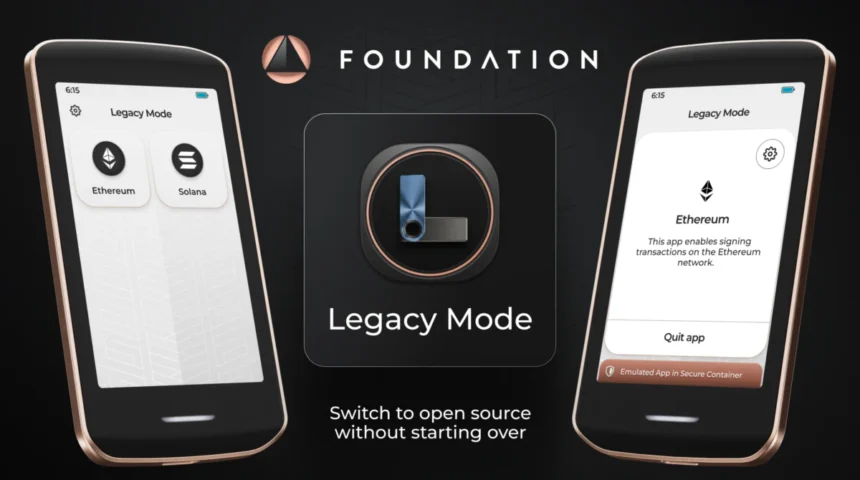
Hardware wallet manufacturer Foundation has announced the release of a public beta for Legacy Mode on its Passport Prime device, a development designed to let Ledger users migrate to open source hardware and software without abandoning their existing accounts. The launch coincides with the company’s new "Switch" campaign, which targets cryptocurrency holders looking for transparency while aiming to eliminate the friction typically associated with changing hardware wallet ecosystems.
For years, cryptocurrency security advocates have argued that a truly decentralized and trustworthy financial ecosystem must be built entirely on open source hardware and software, where anyone can independently verify the underlying code and circuit designs. However, forcing users to migrate their funds has historically presented a major obstacle. Cryptocurrency holders spend years establishing complex wallet configurations, accumulating transaction histories, and organizing addresses across multiple assets. Asking these users to empty their balances, pay network transaction fees, and completely relearn a new operating system creates a severe barrier to adoption, often discouraging people from upgrading their security setups.
Legacy Mode is designed to address this friction directly. By allowing Passport Prime to run open source cryptocurrency applications originally developed for Ledger, the new compatibility layer ensures that users can transition to fully open source hardware while keeping their existing accounts, balances, addresses, and transaction histories intact. This launch arrives at a notable time in the hardware wallet market, particularly as Ledger begins phasing out software and firmware support for its older Nano S devices. Users affected by these lifecycle changes can now move to Passport hardware without the cumbersome process of transferring supported assets to entirely new cryptocurrency accounts.
The technical framework behind Legacy Mode relies on bridging distinct operating environments. Ledger and its active developer community have historically built and maintained an extensive library of open source cryptocurrency applications. However, these applications are natively designed to run on Ledger’s proprietary operating system, known as BOLOS, which includes closed-source components that prevent complete auditing. Foundation solved this challenge by engineering a specialized compatibility layer that enables these supported applications to execute securely on KeyOS, the fully open source operating system that powers the Passport hardware line.
To make this execution possible, Foundation engineers reimplemented the specific application programming interfaces that Ledger’s open source apps use to communicate with the underlying operating system. This encompasses a wide range of low-level device operations, including cryptographic functions, screen rendering routines, and USB communication protocols. By replicating these interfaces, Foundation can take existing, community-tested application code, recompile it for the Passport architecture, and execute it smoothly within KeyOS. This approach achieves cross-platform compatibility without relying on any part of Ledger’s proprietary operating system software.
KeyOS itself is structured as a modern microkernel operating system written in the Rust programming language, which prioritizes memory safety and system resilience. The operating system utilizes isolated processes and strict application sandboxing to contain potential security vulnerabilities. Furthermore, Foundation publishes both its operating system source code and its physical hardware designs publicly, allowing independent security researchers, developers, and everyday users to thoroughly inspect how the Passport device operates under the hood.

At the launch of the beta release, Legacy Mode supports Ethereum and Solana, two major app families chosen specifically for their widespread adoption and active developer ecosystems. Early beta testers have already verified smooth operational compatibility over USB using popular software wallet interfaces, including Rabby for Ethereum and EVM-compatible networks, alongside Phantom for Solana. Foundation has indicated that it plans to expand this compatibility by incorporating additional open source Ledger applications over time, guided directly by user demand and developer feedback.
Legacy Mode is available immediately as an optional, manual installation for users of the Passport Prime hardware device. To begin using the feature, individuals can enter their existing Ledger recovery phrase directly onto the Passport device and establish a connection to their preferred compatible software wallet over a USB cable. Foundation is positioning this initial beta phase as an opportunity to gather critical feedback from early adopters, allowing the engineering team to refine performance, fix bugs, and enhance application compatibility ahead of the planned full public release scheduled for later this fall.
Importantly, Foundation views Legacy Mode not as a permanent destination, but as a transitional bridge toward a fully native open source ecosystem. As independent developers continue to build applications designed specifically for KeyOS, users will have the flexibility to install those native programs onto the exact same physical device. This gives cryptocurrency holders the freedom to choose when they wish to move beyond Legacy Mode and adopt natively compiled applications.
This software progression aligns with broader updates across Foundation’s ecosystem. The release of KeyOS version 1.4.0 introduced app sideloading capabilities, while the company’s software development kit remains publicly available for external developers. Looking ahead to the fall, another major KeyOS system update will introduce Foundation’s centralized app catalog. This upcoming feature will allow users to seamlessly browse a growing library of native KeyOS applications created by both Foundation and third-party developers, enabling one-tap installation directly onto their hardware devices.
Detailed information regarding the Switch campaign, a complete list of currently supported applications, and comprehensive installation documentation can be found directly on the official Foundation website.
(Ledger and BOLOS are registered trademarks of Ledger SAS. Foundation is entirely unaffiliated with Ledger, and Legacy Mode is neither sponsored nor endorsed by Ledger SAS. References to Ledger are utilized strictly for identification and compatibility purposes.)

Related News