Serbian Student Movement Holds Final Mass Rally in Belgrade Ahead of High-Stakes Parliamentary Election
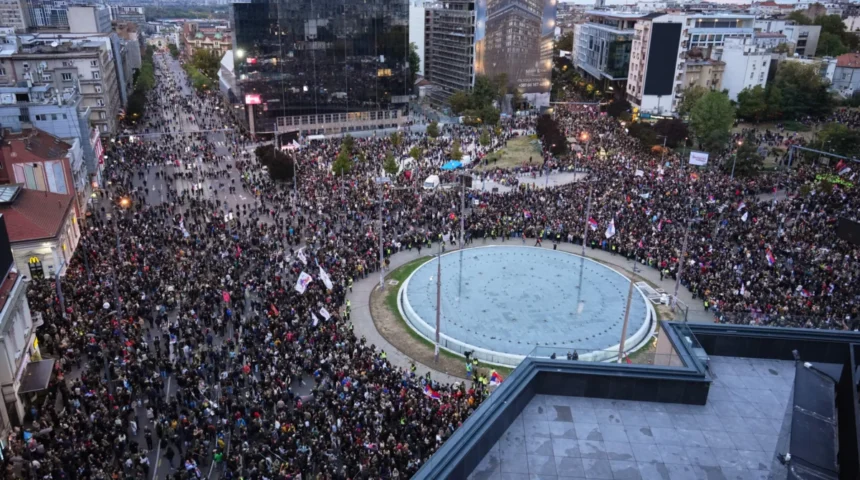
Tens of thousands of supporters of Serbia’s student-led opposition movement have gathered in central Belgrade for their final mass rally ahead of a high-stakes parliamentary election, mounting a formidable challenge in their bid to oust the party of veteran leader Aleksandar Vucic.
The sprawling crowds flooded the Serbian capital on Thursday, painting the streets with national flags and the distinct colors of the youth-driven uprising. The vibrant demonstration unfolded simultaneously as Vucic held a rival rally at a sports hall across town, highlighting the deeply polarized political landscape of the Balkan nation. Waving "students are winning" flags and blowing sharp whistles to signify their protest, the marchers converged on Slavija Square, a historic landmark that has served as the epicentre for some of the movement’s most potent demonstrations.
Sunday’s vote is widely regarded by analysts, citizens, and political observers as a watershed moment—a historic chance to bring an end to Vucic’s lengthy 14-year grip on power.
"Really, for the first time in my life, I believe that it is possible," said 47-year-old Marija Nedeljkovic Radic, expressing a sentiment shared by many in the crowd who credited the nation’s youth with instilling a renewed sense of hope for achieving what she described as a normal country.
The crucial parliamentary vote follows nearly two years of relentless, student-led protests that shook the political foundations of the country. The mass mobilization was initially triggered by a profound national tragedy in 2024: the sudden and catastrophic collapse of a concrete canopy at a newly renovated railway station in the northern city of Novi Sad. The disaster resulted in the deaths of 16 people, instantly igniting public outrage over systemic negligence, institutional decay, and entrenched corruption.
At the heart of the opposition challenge is the Student List, a leaderless movement comprised of student-backed candidates seeking to unseat Vucic’s right-wing populist Serbian Progressive Party (SNS). The SNS has maintained a dominant grip on Serbian politics for more than 14 years. For this electoral test, the Student List is running a full slate of 250 candidates for the 250-seat parliament. Notably, many of these candidates are academics, civic activists, and political outsiders whose campaign platform is squarely centered on eradicating corruption, increasing government transparency, and restoring public accountability.
Addressing the thunderous crowd in Belgrade, university professor Jugoslav Gasic, one of the prominent candidates running on the Student List, delivered a scathing critique of the current administration while outlining the movement’s core mission.
"We are putting an end to 14 years of humiliation, chaos and betrayal, and to decades of putting personal and party interests above yours," Gasic told the cheering masses, who rhythmically chanted "Victory, victory!" in response. "You deserve better, and we know how to deliver it. Students are winning!"
The tragic railway station collapse, which was widely blamed by the public and independent experts on rampant corruption within public works projects, catalyzed some of the largest demonstrations Serbia has witnessed since the historic fall of former leader Slobodan Milosevic in 2000. What began as localized demands for accountability and transparency quickly evolved into a nationwide movement calling for sweeping political change and an early election.
Demonstrating the extensive grassroots reach of their campaign, student activists spent the preceding week marching for days across various regions of the country. These cross-country marches included treks through rural areas that have traditionally served political strongholds for Vucic and the SNS.
Vucic, who strategically resigned from the presidency in September in a move positioning him to run for prime minister, called the snap election just last month in an effort to consolidate his political footing. Throughout the campaign, the veteran leader has pushed back aggressively against the opposition, accusing the student movement of orchestrating a foreign-funded coup attempt designed to destabilize the nation.
Addressing his own supporters at his rival Thursday gathering in Belgrade, Vucic adopted a defiant and mobilizing tone. "Let us go out and defeat them! Defeat them decisively!" he urged the crowd.
The political dynamics of the election remain difficult to quantify with precision, as Serbia currently lacks reliable independent polling infrastructure. However, political scientist Dusan Vucicevic told the AFP news agency that he expected the student-led opposition to capture more than 40 percent of the vote. Such a result would represent a significantly higher share of the electorate than any single opposition list has managed to secure since the SNS first came to power in 2012.
Meanwhile, reporting from the Associated Press indicated that available polls suggest an exceptionally close race between the ruling party and the opposition challengers. This tight projected margin has raised concerns among observers regarding potential unrest or contested outcomes if both sides ultimately claim victory on election night.
Compounding these tensions, a coalition of 24 Serbian civil society groups issued a joint warning during the week, stating that the fundamental conditions required for free and fair elections were notably lacking. Furthermore, domestic monitoring organizations documented more than 100 violent incidents over the course of the heated electoral campaign.
The volatile atmosphere was further underscored mid-week when Serbian prosecutors questioned six individuals who had been arrested on suspicion of plotting violence, coordinated riots, and targeted attacks slated to disrupt polling day.

Related News