Independent TÜV Lab Tests Confirm Braiins OS Custom Firmware Boosts Bitcoin Mining Efficiency
When the hashprice falls and network difficulty rises, Bitcoin miners face a familiar economic squeeze. Traditionally, operators have assumed that weathering market downturns means simply accepting compressed profit margins or turning off older generation hardware. However, a recent rigorous testing initiative suggests that hardware obsolescence is not always inevitable and that software optimization can fundamentally alter the economics of mining operations.
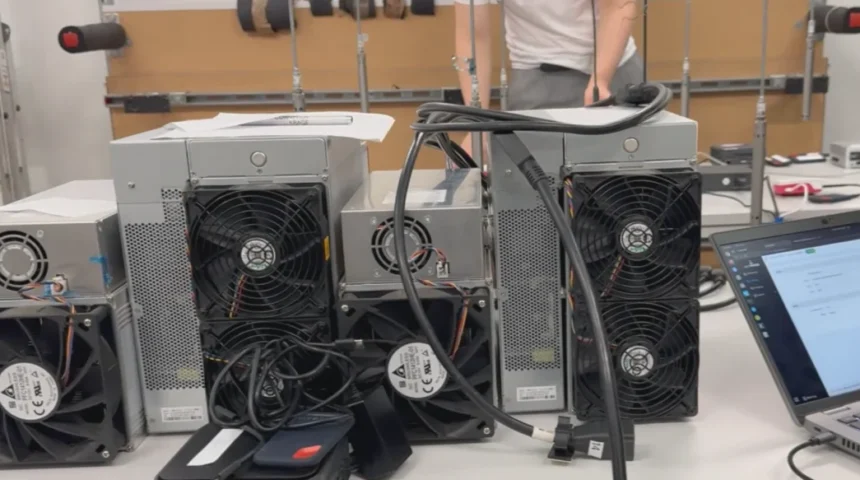
To move past marketing claims and provide verifiable proof of performance, Braiins subjected its custom firmware to independent scientific testing. In a controlled environment monitored by TÜV, real-world Application-Specific Integrated Circuit (ASIC) hardware was put through its paces to measure the precise impacts of custom firmware on energy consumption, hash rate output, and overall operational efficiency.
The Significance of Independent Testing by TÜV
In the rapidly evolving landscape of Bitcoin mining equipment and software, empirical claims about performance gains are common, but independent, third-party verification is rare. To establish definitive credibility, all evaluations were conducted at the TÜV SÜD energy laboratory in Germany. Utilizing a strictly controlled thermal chamber designed to eliminate external environmental variables, technicians were able to measure power consumption and computing performance with scientific precision.
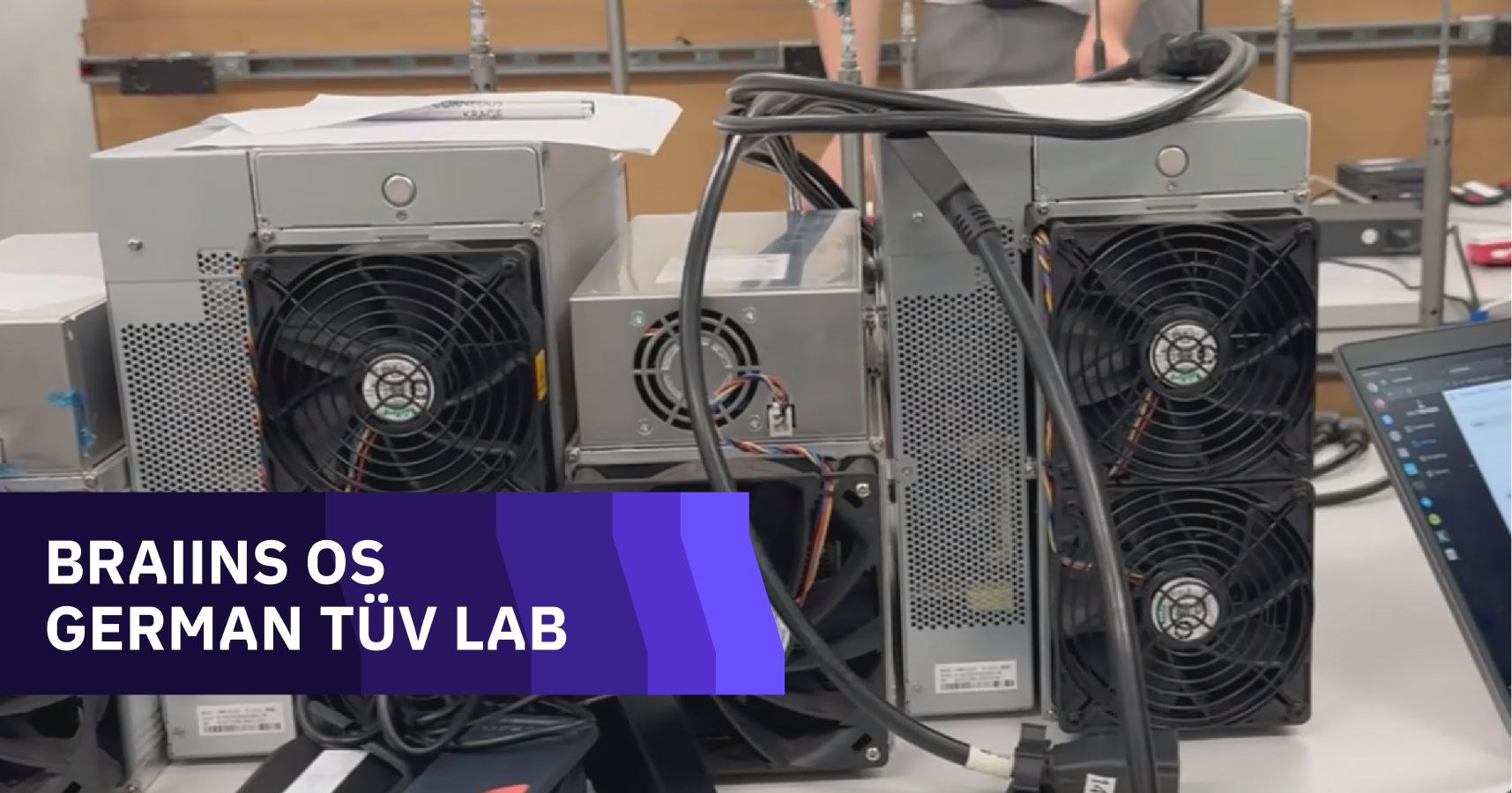
TÜV—formally known as Technischer Überwachungsverein, or the Technical Inspection Association—is a globally recognized authority renowned for rigorous product testing and certification across heavy industrial machinery and advanced electronics. By bringing custom mining firmware into this tightly regulated testing paradigm, the evaluation successfully stripped away external factors like ambient temperature fluctuations and power grid inconsistencies, yielding clear, unbiased data on how software optimization interacts with physical mining hardware.
Putting S19 Series Hardware to the Test
The testing protocol focused on two popular ASIC miner models: the Antminer S19k Pro 120T and the Antminer S19j Pro 104T. To establish a clear baseline for comparison, technicians first operated both machines using their default, factory-installed stock firmware under controlled ambient conditions. Following the baseline runs, the machines were outfitted with Braiins OS and subjected to a series of tests utilizing both strict power targets measured in watts and precise hash rate targets measured in terahashes per second.
The empirical results demonstrated that Braiins OS secured superior efficiency performance across every single test scenario.

When evaluating the S19k Pro 120T, baseline stock firmware operations produced an average of 122.4 terahashes per second while consuming 2,835.3 watts of power. When running Braiins OS with a designated power target of 2,766.9 watts, the machine maintained a comparable hash rate of 122.6 terahashes per second, delivering a 2.62 percent improvement in overall efficiency. Alternatively, when configured with a fixed hash rate target of 121.7 terahashes per second, the machine operating on Braiins OS consumed just 2,695.2 watts, representing a 4.46 percent boost in efficiency compared to stock configurations.
The performance divergence was even more pronounced in the S19j Pro 104T tests. The stock firmware configuration for this model averaged 102 terahashes per second while drawing 3,080.0 watts. When Braiins OS was applied with a reduced power target of 2,847.7 watts, the machine achieved an average output of 106 terahashes per second—a substantial 12.47 percent efficiency boost. When targeted for a specific hash rate of 101.1 terahashes per second, the custom firmware reduced power draw to 2,883.3 watts, yielding a 5.89 percent efficiency improvement.
The empirical data highlights a fundamental reality for modern Bitcoin mining operations: specialized firmware unlocks higher efficiency performance regardless of whether an operator prioritizes capping energy expenditures or maximizing output.

The Mechanics of Autotuning in ASIC Hardware
To understand why custom firmware outperforms stock configurations, it is necessary to examine the manufacturing realities of modern ASIC hardware. Mining rigs are constructed with hundreds of individual silicon chips, each possessing unique physical characteristics due to microscopic variations inherent in the semiconductor manufacturing process. Factory stock firmware applies a uniform, generalized voltage and frequency profile across all chips, treating them as identical components. Consequently, this broad approach ignores the reality that certain chips can comfortably handle higher frequencies, while others require lower voltages to maintain operational stability without throwing errors.
Autotuning solves this structural inefficiency by evaluating the individual capabilities of silicon chips across the entire hashboard. Rather than applying a blunt, one-size-fits-all approach, autotuning dynamically maps out performance tolerances. This allows mining operations to target specific power thresholds while maximizing the hash rate generated per watt consumed, granting operators a crucial competitive edge in both profitability and hardware longevity.
Miners generally deploy two primary power strategies beyond standard factory settings: overclocking and underclocking. Overclocking involves driving hardware to consume more power than normal in order to extract a higher hash rate, a strategy that typically compromises raw efficiency as chips are pushed closer to their physical limits. Conversely, underclocking involves reducing power consumption to achieve greater operational efficiency, lowering electrical overhead while maintaining a strong relative output compared to baseline factory efficiency.

Autotuning software enhances both operational strategies, ensuring that whether a mining facility seeks maximum throughput during periods of high hashprice or superior electrical efficiency during market contractions, the underlying hardware operates at its absolute peak capability.
Implications for Bitcoin Mining Operations
In an industry where profit margins are razor-thin and heavily dictated by external forces such as global hashrate fluctuations, electricity costs, and the price of Bitcoin, every single percentage point of efficiency carries significant financial weight. Over the operational lifecycle of a commercial mining fleet, the cumulative difference between standard factory firmware and optimized custom firmware translates directly into reduced operational expenditure, extended hardware lifespans through sophisticated thermal regulation, and more sats captured per terahash.
As the Bitcoin mining sector matures and competition intensifies, software optimization has transitioned from an optional enhancement to a fundamental requirement for commercial viability. Independent laboratory validations, such as the TÜV testing initiative, provide the empirical backing necessary for enterprise-scale miners to modernize their infrastructure with confidence. For operators navigating volatile market conditions, deploying advanced firmware solutions has become an essential strategy for protecting margins and securing long-term operational sustainability.

Related News