Institutional Market Perspectives: Q4 2026 Shift as Traditional Assets Move onto Crypto Rails
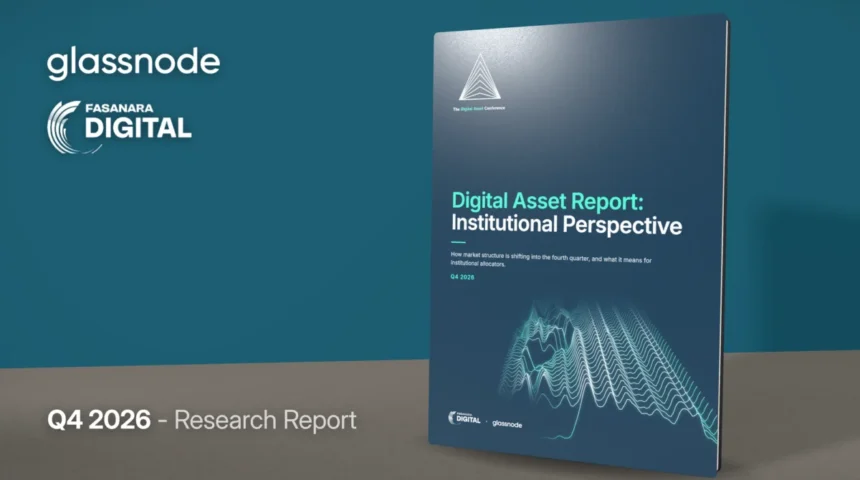
As the market enters the final stretch of the fourth quarter, a comprehensive joint report from Glassnode and Fasanara Digital sheds light on a significant structural evolution within the digital asset ecosystem. The analysis offers institutional allocators a detailed roadmap of how market dynamics have shifted following a prolonged period of consolidation, highlighting crucial trends ranging from on-chain capital flows and derivatives activity to the rapid expansion of traditional financial assets migrating onto blockchain infrastructure.
The preceding twelve months presented a unique environment characterized by a persistent price correction in Bitcoin alongside broader macroeconomic milestones. While Bitcoin retraced from the all-time highs recorded late last October, traditional equity markets pushed to successive record highs. During this divergence, capital experienced net outflows from major blockchain networks, while trading volumes and market volatility compressed to cycle lows.
Yet beneath the surface price action, foundational metrics continued to expand at a steady pace. Stablecoin settlement volumes climbed, the tally of tokenized-equity holders increased, and the adoption of perpetual futures tracking traditional assets maintained upward momentum throughout the downturn. This quiet accumulation phase was abruptly disrupted in August, initiating a market turn driven initially by a short squeeze. However, subsequent on-chain and order-book data indicate that the post-August recovery extends far beyond mere short-covering, signaling a broader resurgence in institutional participation and structural market maturation.
A Comprehensive Layer-by-Layer Market Assessment
The latest Digital Asset Report provides a granular examination of this market inflection point, dissecting the landscape layer by layer. The analysis spans the prevailing macroeconomic backdrop, on-chain capital dynamics, spot and order-book liquidity, derivatives markets, the integration of traditional assets onto decentralized rails, and the evolving behavior of institutional allocators.
Methodologically, the report combines Glassnode’s robust on-chain and market data analytics with Fasanara Digital’s specialized order-book capture and trading-volume datasets. This dual-lens approach offers a comprehensive view of both fundamental blockchain activity and high-frequency exchange liquidity. The report concludes by identifying the specific technical levels and on-chain signals required to confirm the durability of the current market recovery.
A central focus of the new edition is the section dedicated to traditional finance assets operating on cryptographic rails. This sector represents a striking dichotomy: while traditional crypto-native trading volumes experienced a contraction over the past year, activity surrounding tokenized traditional instruments expanded aggressively. Last autumn, perpetual futures tracking equities, major stock indices, gold, and oil accounted for a negligible share of trading on crypto-native exchanges. Today, these instruments command a substantial portion of perpetual contract trading volume across major liquidity venues, signaling a profound convergence between traditional finance and decentralized infrastructure.

Crypto Volume Is Still a Fraction of the US Equity Tape
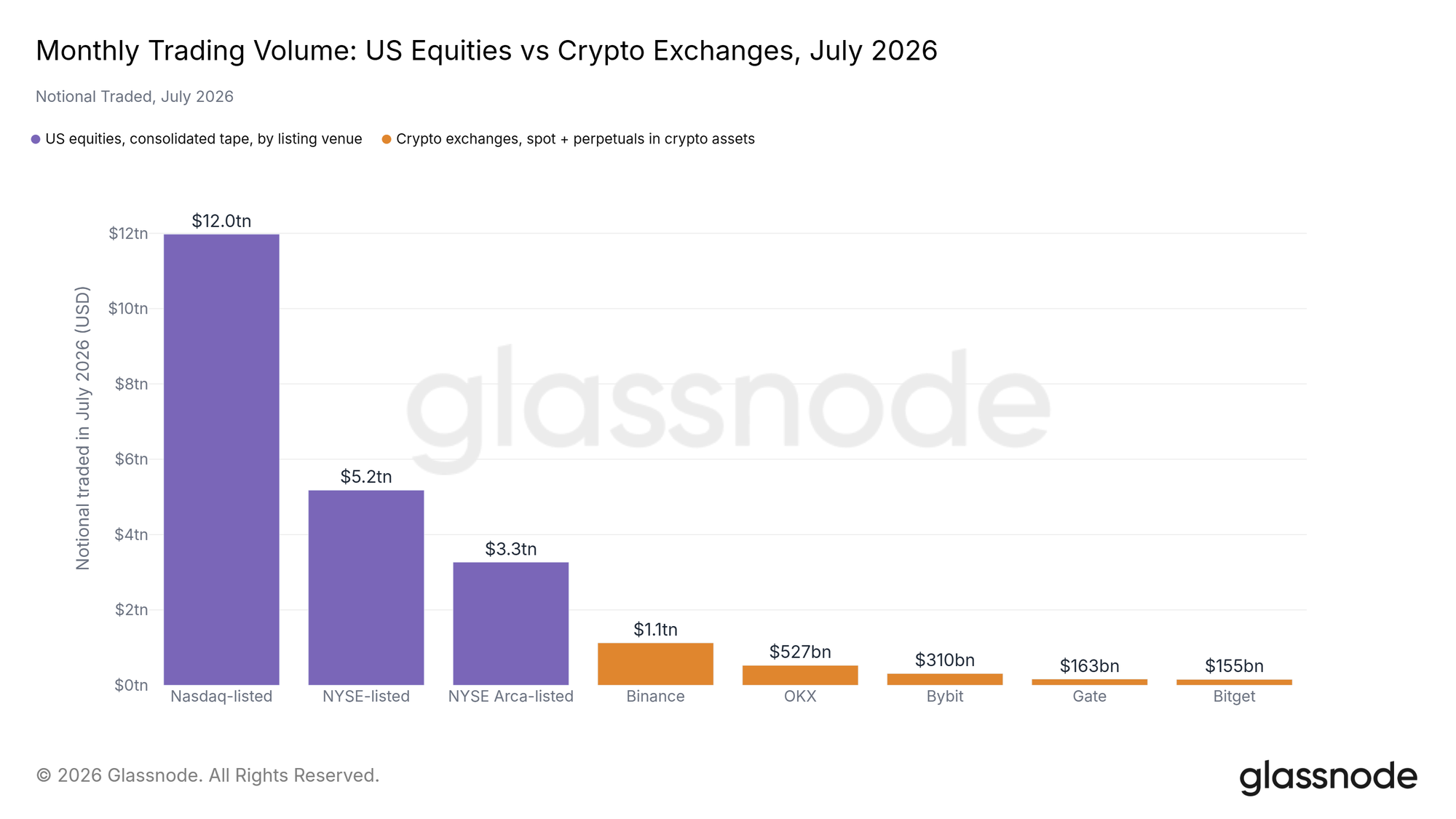
To contextualize the scale of the digital asset market relative to legacy financial systems, the report examines aggregate spot trading volumes across major cryptocurrency exchanges against traditional equity listing venues. Despite their global reach and 24/7 availability, the largest centralized crypto exchanges still record trading volumes that represent only a fraction of the traditional equity tape.
In July 2026, the five largest cryptocurrency exchanges combined recorded $2.28 trillion in trading volume. By comparison, that figure equates to approximately 11 percent of the $20.5 trillion that changed hands across US equities during the same monthly period. Analysts note that while the crypto figure serves as a conservative baseline—omitting several significant trading venues—the comparison underscores the vast runway remaining for institutional capital inflow and structural market expansion as digital asset rails continue to scale.
Perpetuals on Traditional Assets Now Rival Bitcoin on Hyperliquid
The blurring lines between traditional finance and decentralized derivatives are particularly evident on specialized venues such as Hyperliquid, where permissionless architecture allows participants to launch perpetual markets for virtually any asset backed by a reliable price feed.

These diversified markets crossed a notable threshold in April, recording trading volumes that surpassed the venue’s native Bitcoin perpetual book. According to the report’s data, perpetual futures tracking traditional equities, macroeconomic indices, and physical commodities now trade at more than four-fifths the volume of the platform’s primary Bitcoin market. This rapid adoption highlights a growing demand among market participants to trade macroeconomic hedges and legacy asset exposures directly within high-performance decentralized environments.
Bitcoin Is Back Above Its On-Chain Cost Bases
On-chain metrics analyzed by Glassnode reveal a similarly encouraging technical posture for the flagship cryptocurrency. The sharp market squeeze in August propelled Bitcoin’s spot price back above its critical on-chain cost bases, reclaiming valuation levels that dictate broader market health.
Specifically, Bitcoin has successfully re-established positions above the aggregate average cost basis of all circulating coins, the adjusted cost basis of active market participants, and the realized cost basis of the most recent cohort of buyers. Historically, maintaining spot valuations above all three major cost bases is indicative of a robust bull market regime. The collaborative report outlines the specific threshold levels that institutional allocators are monitoring to determine whether this bullish market structure will hold firm through the remainder of the fourth quarter.
Disclaimer: This report does not provide any investment advice. All data is provided for information and educational purposes only. No investment decision shall be based on the information provided here and you are solely responsible for your own investment decisions. Users are urged to exercise caution and discretion when utilizing these metrics. Glassnode shall not be held responsible for any discrepancies or potential inaccuracies.

Related News