How Decentralized Solar and Renewable Energy Are Keeping Mykolaiv and Ukraine Afloat Amid Russian Strikes
When wave after wave of Russian air strikes knocked out Ukrainian power plants across the country earlier this year, plunging major urban centers into darkness and freezing conditions, most of the Black Sea port city of Mykolaiv in southeastern Ukraine was entirely unable to pump fresh water to its sprawling housing blocks. Essential municipal infrastructure ground to a halt as central power grids failed under the weight of relentless bombardment.
Yet, in an easterly suburb of Mykolaiv, clean drinking water continued to flow steadily from kitchen taps, functioning just as it had since the previous year. This localized lifeline exists thanks to a small, off-grid solar field tucked inconspicuously into the neighborhood’s midst, offering a quiet testament to a radical transformation in how war-torn communities are keeping the lights—and the water—running.
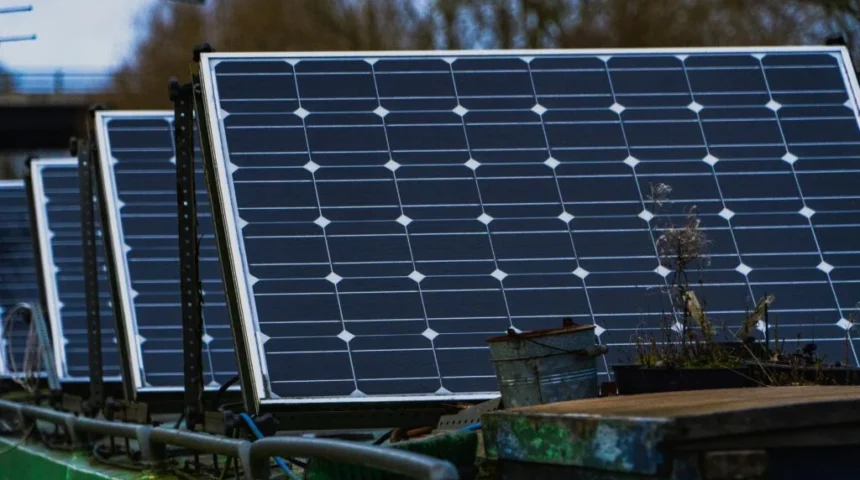
The installation, funded by the Danish government, features two sets of elevated solar arrays paired with advanced battery storage that power an underground municipal water pump directly on the premises. Olena Kondratiuk, project manager at Ecoclub, a non-profit organization that assists Ukrainian municipalities in acquiring renewable energy systems, notes the remarkable efficiency of the setup. Even during the bleakest winter days, she explains, there is just enough sunlight to keep the system operational and water flowing to local residents.
The city of Mykolaiv, located a mere 60 kilometers from Russian-occupied territory, has borne a heavy brunt of the war. In 2022, when the Russian army launched its full-scale invasion of Ukraine, the city was battered by wave after wave of missiles, rockets, and cluster bombs. The relentless shelling laid waste to homes, hospitals, schools, and local factories, while severely crippling the central water supply system. This left the roughly half-a-million residents of the frontline town without regularly flowing, safe water for daily life.
For older residents like Iryna, the return of running water through local renewable initiatives has been nothing short of transformative. Until the solar park commenced operation, the water emerging from her taps was often nothing more than salty liquid pulled from a nearby estuary—if it dripped at all. Before the decentralized solar solution took root, Iryna had to regularly purchase drinking water or fill plastic jugs from mobile public tanks stationed around the neighborhood, relying heavily on neighbors to help her carry the heavy containers up to her fifth-floor apartment. She captures the prevailing sentiment of many locals simply and directly: she is just happy to have running water again, without caring too much about the complex mechanics behind how it gets there.
Mykolaiv has quietly emerged as a country-wide pioneer in renewable energy integration. Other districts within the city also receive fresh water thanks to distributed solar technology, notably through five large-scale solar-powered desalination systems that convert saline or polluted water into safe drinking water when the sun shines. During cloudy days and at night, these systems seamlessly draw from the central electrical grid—provided it remains operational. Together, this system ranks as one of the largest of its kind in Europe, capable of supplying up to 250,000 residents with roughly 1.2 million liters of drinking water every single day. Furthermore, critical infrastructure facilities like the Mykolaiv children’s hospital and the maternity hospital are scheduled to steady their energy supplies with dedicated solar panels over the course of this year, joining a dozen other similar projects unfolding across the country.
Since the onset of the war, Russia has relentlessly targeted Ukraine’s energy infrastructure. The attacks have predominantly focused on bulky, old-school thermal power plants and the vast, interconnected country-wide grid in an overt effort to hobble the national war effort and break the morale of the civilian population. Last winter proved to be the gravest yet for the energy sector. Coordinated strikes against coal, gas, cogeneration, and hydropower plants, as well as high-voltage transmission grids and their associated substations, left giant swaths of the country grappling with irregular electricity and heat as outdoor temperatures plummeted to minus 20 degrees Celsius.
The human and economic toll has been staggering. Many schools and other public services that were unable to reopen safely after the Christmas holidays remain closed to this day. Economists and energy sector analysts estimate that the total cumulative damage inflicted on Ukraine’s energy infrastructure now exceeds $56 billion.
Prominent U.S. environmentalist Bill McKibben has argued that Ukraine’s increasingly autonomous, decentralized power sources are comparatively invulnerable to military attack. In an era defined by advanced drone warfare, McKibben points out that centralized and complex energy facilities have effectively become sitting ducks for aerial assaults. Conversely, smaller, scattered generation sources equipped with local battery storage and independent transmission grids—such as the solar fields deployed in Mykolaiv—present much harder targets for Russian forces to strafe. Furthermore, when damage does occur, these decentralized assets are far more quickly repaired.
This resilience stands in stark contrast to traditional petrochemical refineries, which McKibben describes as some of the most complicated machines ever constructed by humanity, often covering hundreds of acres. These facilities are filled with highly intricate equipment and vast amounts of flammable hydrocarbons; hitting just a single corner with a drone can trigger catastrophic fires and widespread damage that takes months or years to rectify.
Jeff Oatham, representing DTEK, Ukraine’s largest private energy investor, echoes this operational reality. A traditional coal power station represents a large, singular target that a single well-placed missile can completely knock out. By contrast, Oatham notes that an adversary would need roughly 40 missiles to inflict an equivalent amount of capacity damage across a distributed wind farm. Moreover, much like wind parks, a modular solar field continues to function even if individual components or sections are temporarily damaged or knocked out of operation.
Driven by existential necessity, Ukraine is revamping its entire national energy system at warp speed. This historic transformation is driven squarely by the imperative of national security rather than traditional climate protection goals. Levgeniia Kopytsia, a Ukrainian energy analyst at the Berlin-based think tank Institute for Climate Protection, Energy and Mobility, emphasizes that the country’s ongoing energy transition is far more than a political slogan. It is a security-driven transformation unfolding under extreme constraints, prioritizing decentralization, operational flexibility, and unprecedented speed of recovery. In wartime Ukraine, Kopytsia explains, renewables and local micro-grids function as coldly calculated security assets designed to systematically boost system resilience—which, in the context of the ongoing conflict, translates directly into saving civilian lives.
Ukraine’s strategic shift away from fossil fuels actually began well before the full-scale invasion, largely accelerated by ongoing negotiations to join the European Union, which require the country to adapt to the bloc’s stringent climate criteria. In 2021, Ukraine formally pledged to phase out coal-fired power generation entirely by 2035. Today, for strict operational and national security reasons, precise public figures regarding domestic energy production levels are kept under wraps.
According to assessments by the International Energy Agency, Ukraine made strong strides this past summer in rebuilding its energy network and bolstering systemic resilience. The rapid renewables rollout was—and continues to be—anchored by a massive surge in rooftop solar installations, small-scale utility photovoltaic generation, local battery storage systems, and biomass combustion initiatives.
Before Russian forces seized three of them in 2022, Ukraine boasted 34 wind parks featuring around 700 wind turbines, with numerous additional projects actively in the pipeline. Currently, Ukraine has roughly seven gigawatts of wind power ready to deploy as soon as favorable security conditions permit. If fully realized, this pipeline would more than triple the nation’s existing wind capacity, which accounted for over 20 percent of its total renewable energy mix in 2022.
The relentless waves of aerial attacks on national infrastructure have prompted a profound generational shift within Ukraine’s energy sector. A new, younger cohort of energy managers has stepped up to replace the aging, Soviet-style old guard, bringing an uncompromising commitment to distributed energy systems. Their mandate is clear: deploy decentralized renewables as fast as humanly possible, with the explicit goal of doubling the country’s renewable energy consumption in just four years.
While the ongoing war has naturally sidelined the rollout of large-scale infrastructure projects like massive wind turbine fields, households, private businesses, and public institutions have embraced solar installations at an unprecedented, grassroots rate. YASNO, a major utility company supplying electricity and gas to millions of Ukrainian households, reports that its customers are eagerly snapping up combined solar and battery storage packages as fast as they become available. On exceptionally sunny days, the decentralized influx of solar power has even allowed parts of Ukraine to boast temporary energy surpluses.
The German-Ukrainian Energy Partnership, an intergovernmental dialogue platform, estimates that Ukraine’s technical potential to add new solar capacity over the next five years is roughly equivalent to the output of about 80 medium-sized nuclear reactors. According to their published assessments, the sector is rapidly emerging as one of the fastest-developing renewable markets anywhere in Eastern Europe.
Andriy Martynyuk, a prominent Ukrainian energy expert, notes that individual consumers are intensely motivated to get off the central grid by any means possible. He describes the phenomenon as largely grassroots and somewhat chaotic at present, predicting that public demand for renewable solutions will only accelerate further once heavy state subsidies for conventional fossil fuels eventually fade away.
Naturally, this unprecedented solar boom creates an urgent demand for advanced energy storage solutions, an area where Ukraine is also racing forward at a remarkable pace. Last year alone, the country’s national grid operator invested heavily in half a gigawatt of new storage capacity—an impressive achievement that energy experts note amounts to just under a quarter of Germany’s total national storage supply. Citing reports from the Financial Times, analysts point out that battery projects which typically take up to two years to roll out in Western Europe are being successfully designed, permitted, and constructed in Ukraine in as little as six months.
Renewables, however, are not the only component of Ukraine’s evolving distributed supply strategy. The country also envisions large-scale diesel generators, biomass facilities, and relatively small gas turbines—including combined heat and power plants—as integral pillars of its decentralized energy grid. Roman Nitsovych, an expert at the Kyiv-based DiXi Group think tank, explains that distributed generation generally encompasses facilities with up to 20 megawatts of capacity. These gas-fired units offer distinct operational advantages, including guaranteed output availability, rapid start-up times, and exceptional operational flexibility.
Despite the intense focus on decentralization, experts emphasize that no matter how dedicated Ukraine is to diversifying its energy system, the country will ultimately still require a functioning centralized transmission grid. Larger supply options, such as industrial gas turbines and major wind parks, depend entirely on a robust transmission network, including the high-voltage substations that Russian forces continue to target with regular missile barrages.
To counter this vulnerability, the emerging Ukrainian playbook involves burying critical electrical infrastructure and substations deep underground—much like the country has increasingly done with its schools and hospitals—thereby rendering them physically impervious to direct hits from Russian weaponry.

Related News