Institutional Market Shifts in Q4 2026: Glassnode and Fasanara Digital Release Comprehensive Digital Asset Report
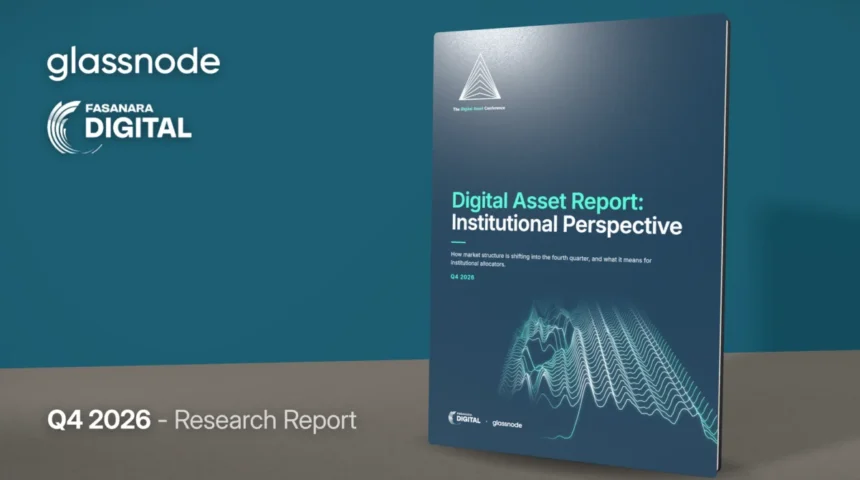
As the fourth quarter gets underway, institutional allocators are navigating a rapidly evolving market structure characterized by shifting liquidity pools, recovering on-chain metrics, and the surging integration of traditional financial assets onto decentralized crypto rails. A joint report published by blockchain analytics firm Glassnode and Fasanara Digital provides a comprehensive examination of these trends, tracing the market’s trajectory from last year’s protracted price consolidation to the decisive market turn initiated this past August.
The period following the previous year’s market edition presented a distinct dichotomy: while Bitcoin retreated from its all-time high set last October and broader equity markets continued to notch record highs, foundational network activity told a different story. Capital outflow from native networks accompanied multi-cycle lows in trading volumes and market volatility. Yet, beneath this surface-level cooling, structural adoption quietly expanded. Stablecoin settlement volumes continued to climb, the cohort of tokenized-equity holders expanded steadily, and perpetual futures tracking traditional financial assets recorded persistent growth month after month.

This environment shifted dramatically in August, triggering a powerful short squeeze that catalyzed broader market momentum. According to the collaborative report, subsequent market data indicates that the recent price recovery extends far beyond mere short covering, pointing toward a deeper, structurally driven reconfiguration of digital asset markets.
A Layer-by-Layer Deconstruction of Market Dynamics
Authored in partnership with Fasanara Digital, the latest Digital Asset Report offers a granular, layer-by-layer analysis of the macroeconomic backdrop, on-chain capital distribution, spot and order-book liquidity, derivatives markets, and the migration of traditional assets onto blockchain rails. The publication synthesizes Glassnode’s advanced on-chain and market intelligence with Fasanara Digital’s proprietary order-book capture and trading-volume datasets. By combining these complementary analytical frameworks, the report maps out the precise market conditions necessary to confirm a sustained recovery, highlighting the specific price levels and technical signals monitored by institutional participants.

A core focus of the Q4 report is the burgeoning sector designated as "TradFi on Crypto Rails." While native cryptocurrency trading volumes experienced a relative contraction over the past year, activity surrounding traditional financial assets integrated into decentralized architectures experienced a significant boom. Last autumn, perpetual futures contracts tracking major equities, stock indices, gold, and oil represented a negligible fraction of derivative volumes on major crypto exchanges. Today, these instruments have evolved to command a substantial share of perpetual trading activity across leading decentralized and centralized venues alike.
Crypto Volume Remains a Fraction of the US Equity Tape
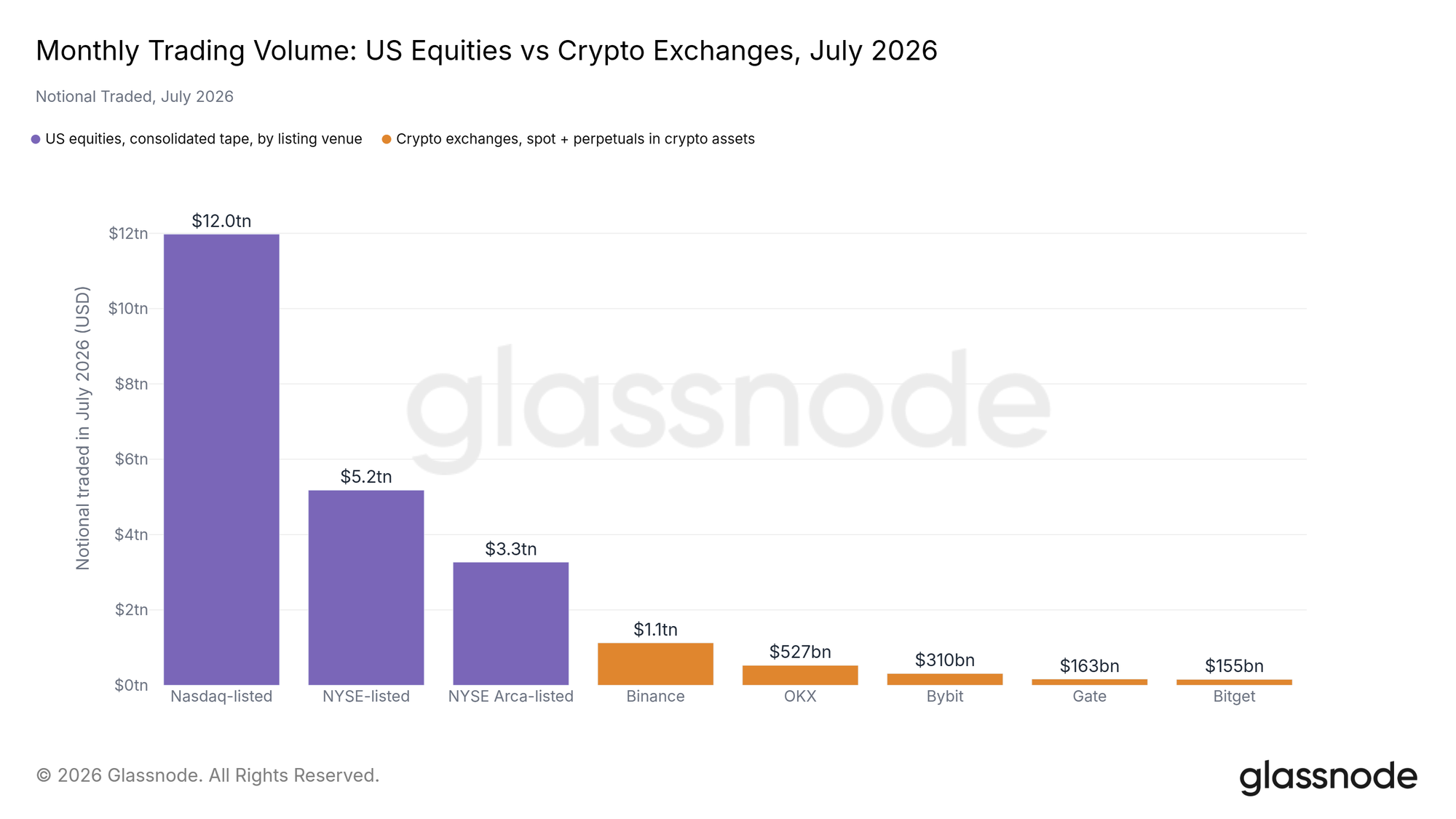
Despite significant maturation within the digital asset ecosystem, traditional financial markets continue to dwarf crypto trading figures by a wide margin. A comparative analysis featured in the report highlights the sheer scale of traditional capital markets relative to digital asset exchanges.

During July 2026, the five largest cryptocurrency exchanges combined facilitated approximately $2.28 trillion in trading volume. While substantial, this figure represents roughly 11% of the $20.5 trillion that changed hands across US equities during the exact same timeframe. Furthermore, industry analysts note that this crypto volume figure acts as a functional floor, given that several major liquidity venues operate outside the scope of the tracked data aggregation. This stark disparity underscores both the vast runway for future institutional capital inflows and the current reality of market depth between traditional and digital asset classes.
Traditional Asset Perpetuals Rival Bitcoin on Hyperliquid
The blurring lines between traditional finance and decentralized trading infrastructure are perhaps most evident on Hyperliquid, an advanced venue where market participants can permissionlessly launch perpetual markets for any asset backed by a reliable price feed.
The report highlights a significant milestone reached in April, when perpetual futures tracking traditional equities, major global stock indices, and commodities first surpassed the trading volume of the venue’s native Bitcoin perpetual book. Currently, perpetual contracts tied to these traditional financial assets trade at more than four-fifths the volume of the platform’s premier cryptocurrency market. This development illustrates a growing demand among crypto-native traders for synthetic exposure to mainstream macroeconomic assets without leaving decentralized rails.
Bitcoin Reclaims Major On-Chain Cost Bases
On-chain metrics analyzed by Glassnode indicate a fundamentally improved health profile for the leading cryptocurrency following the August market squeeze. The sharp upward price movement successfully lifted Bitcoin back above its most critical structural cost bases.

Specifically, Bitcoin has reclaimed price levels sitting comfortably above the aggregate average cost of every circulating coin, the cost basis of active investor cohorts whose coins continue to change hands, and the cost basis associated with the newest market participants. In historical on-chain analysis, trading above all three of these major cost thresholds serves as a primary indicator of a healthy, robust bull market regime. The joint report outlines the specific downside support levels and invalidation markers that institutional allocators are monitoring to determine whether this bullish market structure will hold firm through the remainder of the fourth quarter.
Disclaimer: This report does not provide any investment advice. All data is provided for information and educational purposes only. No investment decision shall be based on the information provided here and you are solely responsible for your own investment decisions. Users are urged to exercise caution and discretion when utilizing these metrics. Glassnode shall not be held responsible for any discrepancies or potential inaccuracies.

Related News