DOJ Seeks Ballot Segregation in Alaska Senate Race Amid Criminal Investigation Over Candidate Name Confusion
The United States Department of Justice is moving aggressively to preserve and segregate all ballots ranking a candidate named Dan Sullivan in Alaska’s high-stakes U.S. Senate election. The extraordinary legal maneuver comes amid an ongoing federal investigation into whether Democratic operatives improperly recruited a potential spoiler candidate to sow voter confusion just ahead of the midterm elections.
In a court filing submitted late Friday in Anchorage, a federal prosecutor outlined the department’s request to U.S. District Court Judge Sharon Gleason. The DOJ is asking the court to block state election officials from immediately certifying the Senate election results if incumbent Republican Senator Dan Sullivan loses by a margin that might reasonably be attributed to voter confusion. That confusion, federal authorities argue, stems directly from the presence of a second candidate on the ballot who shares the exact same name: retired school teacher Daniel J. Sullivan.
If the incumbent senator loses, the Justice Department wants the legal authority to conduct a comprehensive investigation to determine true voter intent. The unfolding legal drama takes place against the backdrop of an intensely competitive election cycle where control of the United States Senate hangs in the balance. Republicans currently hold a narrow 53-seat majority in the 100-member chamber, making the outcome of Alaska’s race critically important to the national political landscape.
"Election Day is on November 3, 2026, which poses a substantial risk that the candidacy before us will mislead voters and ultimately result in an electoral process that lacks integrity," U.S. Attorney for Alaska Michael Heyman said in the federal court filing, which was signed by one of his assistant prosecutors.
The legal filing further emphasized the urgency felt by federal law enforcement officials, noting that waiting until after the votes are cast would render precautionary measures impossible. "The United States of America contends that the proposed precautionary measures will be impossible after Election Day, showing good cause for expedited consideration," the document stated.
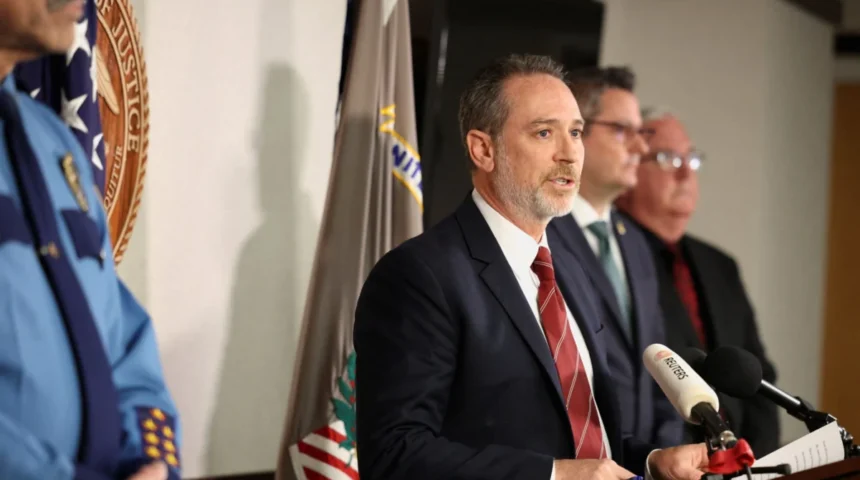
Earlier on Friday, U.S. Attorney Heyman addressed reporters during a press conference in Anchorage, confirming that an active criminal investigation is underway to uncover how and why the retired school teacher decided to enter the Senate race for the first time this year. According to the DOJ’s civil lawsuit—which President Donald Trump publicly stated he had requested—the "sole purpose" of the non-incumbent Sullivan’s candidacy was to siphon votes away from the Republican incumbent, thereby boosting the campaign of Democratic nominee Mary Peltola.
"We will not let anyone or any group undermine this election," Heyman told reporters, speaking just four days before the official close of voting.
Detailing the scope of the federal response, Heyman revealed that both civil and criminal investigations are moving forward in parallel. "There is both a civil investigation and a criminal investigation that is ongoing," Heyman said. "There is a surge of FBI resources and resources in this office."
Emphasizing the gravity of the situation to the local electorate, the prosecutor added, "Every Alaskan deserves a fair election, and they’re going to get one."
Heyman noted that the criminal probe has actually been underway for months. The U.S. Attorney had previously recused himself from overseeing the investigation because he was being actively considered for a federal judicial nomination. However, that recusal was officially rescinded on Thursday after he was removed from consideration for the judgeship.
The criminal investigation was notably accelerated following a investigative report published Wednesday by The New York Times. The report alleged that aides working for Peltola’s campaign, alongside senior officials at the Democratic Senatorial Campaign Committee, helped recruit the retired teacher to enter the Senate contest with the specific intent of splitting the conservative vote by drawing ballots away from Senator Dan Sullivan.
"When credible information comes out, we are committed to pursuing that information… and we will act on it," Heyman said when asked about the timing of the accelerated probe.
Representatives for Peltola’s campaign and the Democratic Senatorial Campaign Committee have firmly denied any involvement in recruiting the retiree to run for the Senate. When pressed by reporters during the press conference, Heyman declined to specify which exact criminal statutes might have been violated by the alleged recruitment scheme.
Meanwhile, the legal battle playing out inside the federal courthouse is moving at a breakneck pace. Earlier on Friday, a federal judge kept efforts to dismiss the DOJ’s lawsuit on an accelerated schedule. U.S. District Judge Sharon Gleason ordered the Department of Justice to respond by 1 p.m. Alaska Time to newly filed dismissal motions. Those motions had been filed just hours after the department amended its civil suit in U.S. District Court in Anchorage to introduce a brand-new legal claim.
The DOJ’s decision to update its civil complaint technically rendered all prior dismissal motions legally moot. In response, Judge Gleason gave state election officials, the Democratic nominee’s campaign, and other intervening groups until noon on Saturday to submit their replies to the DOJ’s response.
The tight scheduling leaves open the distinct possibility that Judge Gleason could issue a ruling on the dismissal motions before polls open on Tuesday, matching requests made by both the state and Peltola’s campaign.
The state, the Peltola campaign, and other parties intervening in the lawsuit have argued passionately that the Justice Department lacks any legal authority whatsoever to block the certification of an election simply because two candidates on a four-candidate ballot happen to share the same name.
Alaska utilizes a ranked-choice voting system for its federal elections. Under this system, if no single candidate manages to secure more than 50% of the vote in the initial count, the fourth-place finisher is automatically eliminated. The second-choice rankings on those eliminated ballots are then reallocated to the remaining candidates. Political analysts note that only Peltola and incumbent Senator Sullivan are expected to draw substantial shares of the electorate.
The DOJ’s amended complaint, which builds upon the original suit filed on October 23, introduces a new claim invoking the Supremacy Clause of the U.S. Constitution, supplementing its initial reliance on the National Voter Registration Act. It also incorporates additional details sourced from the recent investigative reporting.
In their formal motion to dismiss filed Thursday, Peltola’s campaign pulled no punches in criticizing the federal government’s legal strategy. "Rather than defend its indefensible legal claims as it was ordered to do, the Department of Justice… has filed an Amended Complaint that does nothing to address the fatal problems that preclude it from bringing this case or obtaining the relief that it seeks," the motion read.
"The U.S. Constitution leaves the regulation of federal elections exclusively to the States and to Congress, and DOJ has no statutory authority to bring this case," the campaign’s legal team argued.
State election officials echoed those sentiments in their own dismissal motion, asserting that the updated federal lawsuit "rests on the same meritless theory that the National Voter Registration Act (NVRA)—a voter registration law—governs this case, which has nothing to do with voter registration."
"Because this reading of the NVRA fails, the amended complaint fails," the state’s motion concluded.

Related News