How One Engineer Used Bitcoin Mining to Heat His Entire Home for a Year
For most homeowners, the arrival of winter brings a familiar dread: opening utility bills and bracing for the high cost of keeping living spaces warm. But for one quality assurance engineer at Braiins named Adam, the cold months bring a unique financial advantage. Rather than burning natural gas, oil, or traditional electricity to heat his modern 140-square-meter timber-frame home, Adam has spent the past year relying entirely on the thermal output of a hydro-cooled Bitcoin miner.
Dubbed by friends as the "Bitcoin Shower Project" or a "Hashpunk Citadel," the home setup successfully integrates high-performance computing hardware into residential life. Backed by a full year of real-world operational data, Adam’s experiment offers a compelling look at the practicalities, economics, and technical hurdles of repurposing the immense heat generated by ASIC mining rigs. Growing up learning the fundamentals of electrical work from his father, Adam knew long before breaking ground on his house that he wanted hashrate to be his primary source of warmth. Working alongside a project engineer, he designed the home specifically to accommodate mining heat reuse within a low-temperature floor radiant heating system, mirroring the design requirements of a standard heat pump setup.
While a certified plumber installed the tap water loop and floor radiant heating, Adam took charge of the miner loop itself, spending months researching thermodynamics, hydrodynamics, and various cooling methodologies across online forums, Reddit, Twitter, and YouTube. After weighing options like two-phase and immersion cooling, he ultimately settled on hydro cooling as the most reliable and efficient method for residential application. The entire technical setup is strategically located just behind the kitchen, making noise control and efficient spatial planning critical components of the initial build.
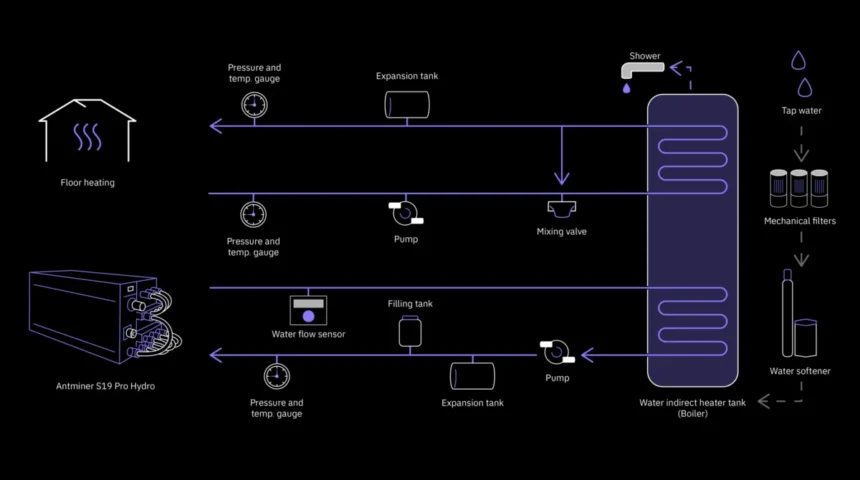
To make the system function seamlessly, Adam implemented a complex three-loop architecture designed to handle distinct temperature ranges and residential requirements. The primary loop, known as the miner loop, operates at the highest temperatures and is responsible for extracting heat directly from the Bitcoin miner to move it into a central boiler tank. Managing temperatures safely within this loop is critical, as Bitmain documentation typically lists the maximum allowable inlet temperature for ASIC miners at 45 degrees Celsius. However, by utilizing Dynamic Power Scaling through Braiins OS firmware, Adam can automatically adjust the miner’s power when temperatures fluctuate, protecting the hardware, maintaining high uptime, and safely allowing higher inlet temperatures.
The secondary loop acts as an intermediary, sitting between the miner and the home’s water heating system. This city or tap water loop is less common in traditional residential heating configurations but serves as a vital bridge in a hashrate-heated home, ensuring that domestic hot water for the bathroom is consistently warmed alongside the primary heating supply. The third and final loop governs the low-temperature floor radiant heating, which evenly warms the living spaces throughout the house. Because the system relies heavily on low-temperature water circulation, it achieves a high level of thermal efficiency that performs reliably regardless of fluctuating outdoor weather conditions.
The software stack running the operation is remarkably straightforward, anchored by Braiins OS, Home Assistant, and the open-source hass-miner integration. This combination provides full visibility and granular control over the entire system, turning what could be a volatile computing setup into a self-regulating domestic utility. Dynamic Power Scaling proves to be the indispensable linchpin of the entire project, automatically scaling mining power up or down to match real-time heating demands without requiring constant manual intervention or external automation scripts.
When evaluating the financial reality of the project after a full year of operation, Adam compared his hashrate heating setup against traditional alternatives, including a standard heat pump and a conventional electric boiler. Built with a calculated thermal loss of 3.5 kilowatts at an ambient temperature of negative 10 degrees Celsius across a 4.5-month heating season, the home’s energy demands provide a clear baseline for economic comparison. Upfront capital expenditures for a traditional heat pump typically range from 10,000 to 15,000 dollars, whereas an electric boiler or a Bitcoin mining setup requires a significantly lower initial investment, alongside standard boiler and plumbing costs that remain relatively uniform across all heating methodologies.
While a heat pump can offer savings on electricity compared to a direct electric boiler, the high initial equipment costs result in an extended payback period stretching well over two decades, yielding a modest return on investment of roughly four percent. Furthermore, traditional heat pumps suffer from efficiency drops when forced to heat water to higher temperatures for daily household use, such as preventing bacteria buildup in showers. In contrast, a hashrate heating system maintains consistent operational efficiency regardless of target water temperatures. More importantly, because the electricity spent on running the miner is already being utilized to heat the home, any Bitcoin rewards earned during the heating season represent direct additional income that offsets operational overhead.
Maintenance requirements for the system have proven surprisingly minimal over the course of the year. By utilizing propylene glycol in the miner loop and maintaining proper electrical grounding, regular upkeep has been practically nonexistent, while low operating temperatures have successfully kept calcium buildup inside the boiler to a minimum. Once properly configured, the self-regulating nature of the system means day-to-day operations require very little human intervention, balancing automated chip power scaling, smart pump pressure regulation, and room-by-room thermostats.
Looking ahead, Adam is already planning his next iterations in hashrate heating. As more efficient hardware enters the market and older ASIC models drop in price, he aims to upgrade his setup to modern S21-series miners. Because these newer devices feature individual chip temperature monitoring, they can safely run at higher air output temperatures, opening the door for ambitious projects such as a bitcoin-miner-preheated sauna. As shrinking margins and lower hashprices continue to challenge the mining industry, projects like Adam’s demonstrate how creative heat reuse can transform industrial computing hardware into a sustainable, decentralized, and financially viable solution for residential heating.

Related News