Foundation Releases Envoy 2.3.1 Mobile App Update Amid Active Phishing Warning for Passport Users
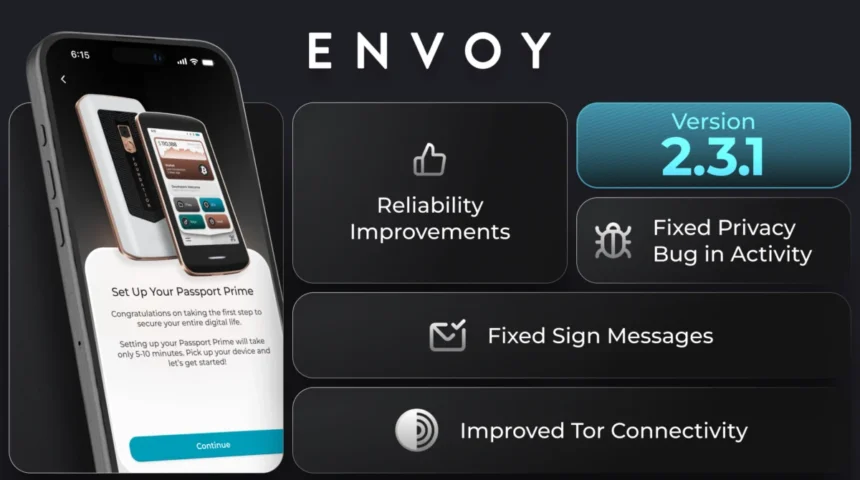
Foundation has officially announced the release and distribution of Envoy version 2.3.1 across major mobile platforms. The newly published application version follows closely on the heels of the 2.3.0 release, serving as a dedicated maintenance update designed to resolve critical bugs, enhance overall network reliability, and deploy necessary security patches for underlying wallet dependencies. Users seeking to acquire the latest iteration can now find it available through official download channels or by checking for pending updates directly within their preferred mobile application marketplace.
However, the rollout of the updated mobile application coincides with an urgent security alert issued by the platform regarding a widespread phishing campaign. Developers have confirmed that malicious actors are currently circulating deceptive emails carrying the subject line "Your Passport funds are at risk." These fraudulent communications are engineered to trick cryptocurrency holders into clicking unauthorized links or surrendering their private recovery phrases. Foundation officials have strongly urged all users to disregard these messages, avoid interacting with any embedded URLs, and under no circumstances disclose sensitive backup materials. Investigations into the origin and scale of the phishing attempts are currently underway.
Regarding the software deployment itself, the development team has noted that while Envoy 2.3.1 is officially published, users may experience a temporary delay before the update appears on their local devices. Due to the standard review procedures, security checks, and platform propagation policies enforced by both the Apple App Store and the Google Play Store, a noticeable lag often occurs between the initial publishing phase and general availability across all regions. Those eager to obtain the software immediately are encouraged to monitor their respective app stores or consult the official Foundation download portal for direct access.
Serving primarily as a follow-up release to version 2.3.0, Envoy 2.3.1 concentrates heavily on refining user privacy, improving hardware device integration, and optimizing network connectivity under challenging conditions. Among the key improvements included in this patch is the resolution of a privacy leak that previously allowed transactions originating from passphrase-protected accounts to inadvertently appear within the global Activity feed. By correcting this oversight, the update ensures that sensitive transaction metadata remains properly isolated and private to the individual user.
Additionally, the new version restores full message-signing capabilities for non-zero accounts when interacting with Passport Prime hardware devices. Users who encountered hindrances with message validation and signing in previous iterations will find these workflows re-enabled and functioning as intended. The update also addresses a minor cosmetic and reporting error on the Devices tile, where the application previously displayed incorrect information regarding the latest available firmware version for Passport Prime hardware.
Network connectivity and communication protocols have also received substantial enhancements in Envoy 2.3.1. The development team successfully tackled a connectivity challenge affecting Tor users in regions or network environments where Google actively blocks Tor exit nodes, improving resilience and connection stability for privacy-conscious individuals. Furthermore, the release resolves a persistent and frustrating Tor restart loop that previously caused the background networking service to repeatedly crash and restart. For Android users operating on older software environments, the update successfully restores QuantumLink Bluetooth pairing functionality for devices running Android 10 and Android 11. Beyond these functional repairs, the engineering team has integrated vital security updates for various third-party wallet dependencies, reinforcing the overall cryptographic posture of the mobile client.
For advanced users and privacy advocates who prefer to independently verify the authenticity of their software installations, Foundation continues to support cryptographic verification methods. Individuals wishing to take the optional additional step of verifying Envoy binaries on the Android platform can reference the organization’s dedicated documentation and step-by-step verification guides published on their official web portal. This transparency allows technical users to independently validate that the application binaries match the official source code releases hosted on public repositories before executing the software on their personal devices.

Related News