Synology Urges Immediate DSM Updates Amid Surge in C3RB3r Ransomware Attacks
Taiwanese network-attached storage appliance manufacturer Synology has issued an urgent security warning to its customer base, advising users to update their devices immediately following a sharp surge in targeted C3RB3r ransomware attacks. The hardware and software vendor strongly urged users to enable automatic update features and upgrade the DiskStation Manager operating system running on their network-attached storage devices to the latest available software versions to safeguard their stored data from ongoing compromise.
According to the advisory published by the company, Synology has identified malicious threat actors actively exploiting a security vulnerability that was originally patched back in December 2024. These ongoing attacks are specifically designed to target network-attached storage devices running outdated versions of the DiskStation Manager operating system. Once the attackers successfully breach an unpatched system, their primary objectives are to encrypt the victim’s valuable data and subsequently extort a heavy financial ransom in exchange for a decryption tool.
Synology emphasized that all users currently running vulnerable software versions must take immediate action to protect their systems from unauthorized access. The vendor also strongly recommended enabling automatic updates across all supported devices to ensure that the DiskStation Manager operating system remains fully patched and protected against emerging threats at all times. Representatives for Synology were not immediately available for additional comment when independent security journalists reached out for more detailed information regarding the scope and origin of the C3RB3r ransomware campaign.
While Synology has not explicitly named the exact vulnerability being leveraged in these active assaults within its latest bulletin, the company pointed directly to a security advisory released in November 2024. That preceding advisory detailed critical patches developed to resolve multiple security flaws that previously allowed remote attackers to execute arbitrary code, read sensitive files, and write arbitrary files directly onto unpatched network-attached storage appliances. Security researchers and system administrators have since been advised to immediately block any direct access to the device management web interface from the public internet, a crucial step designed to thwart attackers attempting to hack and encrypt enterprise and consumer storage systems.
In terms of specific software updates required to mitigate the risk, Synology has outlined the necessary versions across various iterations of its operating system. For devices running DiskStation Manager 7.2.2, which carries a critical severity rating, users must upgrade to version 7.2.2-72806-1 or a newer release. Similarly, users operating DiskStation Manager 7.2.1 are urged to update to version 7.2.1-69057-6 or above, while those on DiskStation Manager 7.2 must transition to version 7.2-64570-4 or higher. For older platforms, administrators running DiskStation Manager 7.1 need to upgrade to version 7.1.1-42962-7 or above, and users on the legacy DiskStation Manager 6.2 branch are advised to apply version 6.2.4-25556-8 or higher to address moderate-severity concerns.

It is relatively rare for Synology to issue direct security advisories warning of widespread attacks actively targeting its customers’ hardware. The last comparable public alert published by the manufacturer was issued in August 2019 following a wave of large-scale brute-force attacks that ultimately resulted in widespread eCh0raix ransomware infections across multiple hardware configurations.
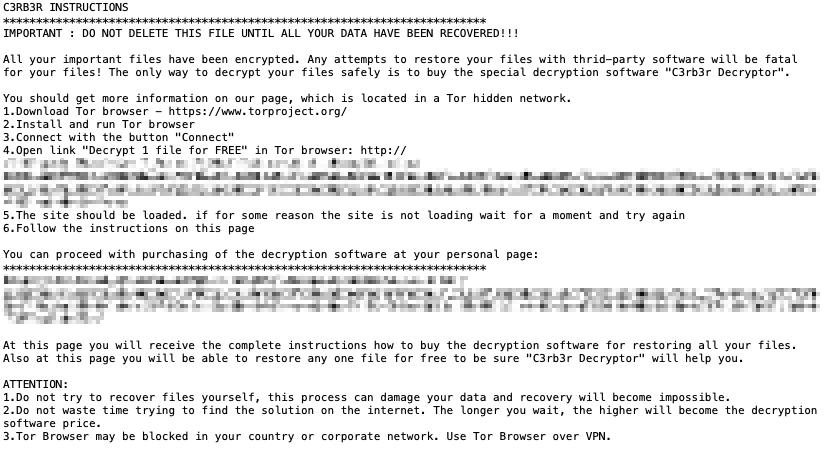
This latest advisory follows an overwhelming volume of reports from frustrated Synology customers who discovered that their stored files had been abruptly encrypted. Victims reported being prompted by the attackers to purchase a specialized decryption utility known as the C3rb3r Decryptor through a dark web portal, with pricing demands reaching thousands of dollars. The initial reports of these infections surfaced more than two weeks ago across prominent online technical support forums and community discussion boards, where affected users detailed how the ransomware left behind a ransom note named read-me3.txt and appended a distinctive .L0CK3D extension to all encrypted files on the compromised storage units.
The alarming ransom note left behind by the threat actors warns victims that all their important files have been encrypted and cautions that any attempts to restore data using third-party recovery software will prove fatal to the files. It asserts that the only safe method for data recovery is purchasing the specialized decryption utility, promising that the dark web portal will provide complete purchase instructions as well as a complimentary single-file decryption test to prove the software’s efficacy.
The variant of ransomware currently deployed against Synology network-attached storage devices borrows its name from the notorious Cerber ransomware-as-a-service operation, which first emerged on the threat landscape in 2016. Before eventually disappearing from the cybercrime ecosystem at the end of 2019, the original Cerber operation was responsible for a dominant share of all global ransomware attacks, accounting for more than eighty percent of infections in certain sectors and a substantial fraction of enterprise endpoint compromises.
A newer incarnation of the Cerber malware family first appeared in December 2021, when security analysts spotted it targeting Atlassian Confluence and GitLab servers during successive waves of cyberattacks. Those historical campaigns heavily exploited remote code execution flaws and authentication bypass vulnerabilities to infiltrate corporate networks and deploy malicious payloads.
In the wake of the current attacks, internet threat intelligence watchdogs have highlighted the massive scale of the potential attack surface. Statistics from organizations such as Shadowserver indicate that there are currently more than 380,000 internet-exposed Synology network-attached storage devices active worldwide, though these tracking metrics do not differentiate between secure systems, unpatched targets, and active security honeypots deployed to monitor threat actor activity.

Related News