Jim Cramer Says a New Guard of Tech Stocks May Be Emerging as Market Leaders, Urges Caution Before Buying
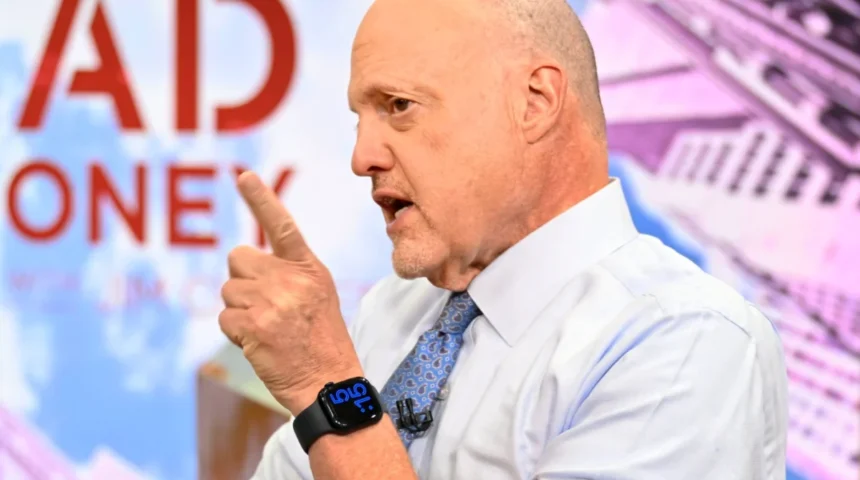
CNBC’s Jim Cramer warned investors on Tuesday that while major technology heavyweights have struggled to maintain momentum in recent weeks, a new group of technology equities may be quietly establishing themselves as the market’s next leaders.
Speaking during his regular broadcast, the "Mad Money" host pointed to Tuesday’s trading session as a prime example of changing tides within the sector. While traditional market titans such as Nvidia, Microsoft, Alphabet, and Meta have found it increasingly difficult to sustain meaningful rallies, other prominent technology companies have stepped up to support the major market averages. Notable gains from infrastructure and semiconductor firms like Broadcom and Micron provided a much-needed cushion, signaling to Wall Street that market participants might be in the process of rotating toward a different set of winners.
"Tech’s trying to make a stand here. It’s just not the tech that’s led us for the last few years," Cramer told viewers, highlighting a broader shift in investor sentiment away from the familiar mega-cap names that have dominated equity markets over the recent past.

This evolving landscape was further underscored by robust corporate updates from other key players in the tech ecosystem. Cramer highlighted chipmaker Advanced Micro Devices and networking infrastructure specialist Arista Networks—both of which were scheduled to report their latest quarterly financial results after the closing bell on Tuesday—as prime examples of enterprises capable of anchoring the sector’s broader recovery. He also drew attention to database and cloud giant Oracle, whose shares surged by nearly 6% during the Tuesday session alone, reflecting persistent institutional demand for alternative avenues of technological growth.
Despite these encouraging signs of life outside of the traditional leadership circle, Cramer urged a balanced and measured perspective, emphasizing that investors should avoid getting overly enthusiastic based on a single session of positive indicators.
"I want to believe that non-magnificent tech can lead us," Cramer said. "लेकिन I also know that there are concerns we must be aware of before we get too cocky about one session’s set of positives."
Among the primary headwinds facing the broader technology landscape, Cramer pointed to mounting regulatory and community opposition directed at the rapid development of data centers. Local communities across various regions are increasingly pushing back against the construction of these massive facilities, driven by growing anxieties over surging local electricity costs and the immense water consumption required to keep server farms cool.

The "Mad Money" host noted that smaller, highly specialized developers and infrastructure providers—such as Iren, Nebius, and CoreWeave—could find themselves particularly vulnerable if local pushback leads to project cancellations, lengthy delays, or costly forced relocations. In contrast, larger, well-capitalized technology behemoths like Amazon possess vastly superior financial resources and logistical flexibility, enabling them to secure alternative sites and absorb regulatory friction much more effectively.
Compounding these structural and environmental hurdles are lingering geopolitical tensions, particularly the ongoing conflict involving Iran. Earlier in the session, oil prices had turned lower following reports of potential progress or diplomatic openings in negotiations, offering a brief moment of relief to global markets. However, Cramer cautioned that Wall Street has repeatedly underestimated the latent risks of further military and economic escalation in the region. Because of this persistent unpredictability, he argued that it remains far too premature to dismiss geopolitical conflict as a non-factor for the equities market.
Reflecting on these intersecting challenges—ranging from localized infrastructure pushback to geopolitical volatility—Cramer stopped short of declaring that the broader technology sector had definitively reached a lasting bottom. Following months of false starts and failed market rebounds, the veteran host reiterated his preference for patience before deploying substantial new capital back into technology shares.
Cramer concluded that he would prefer to wait for a definitive market crescendo or capitulation event in the tech space before committing significant funds, ensuring that any new investments are made on a more stable and thoroughly tested foundation.

Related News