Wall Street Plunges as AI and Tech Stocks Erase Post-Midterm Gains, Putting Trump’s Record Claims to the Test

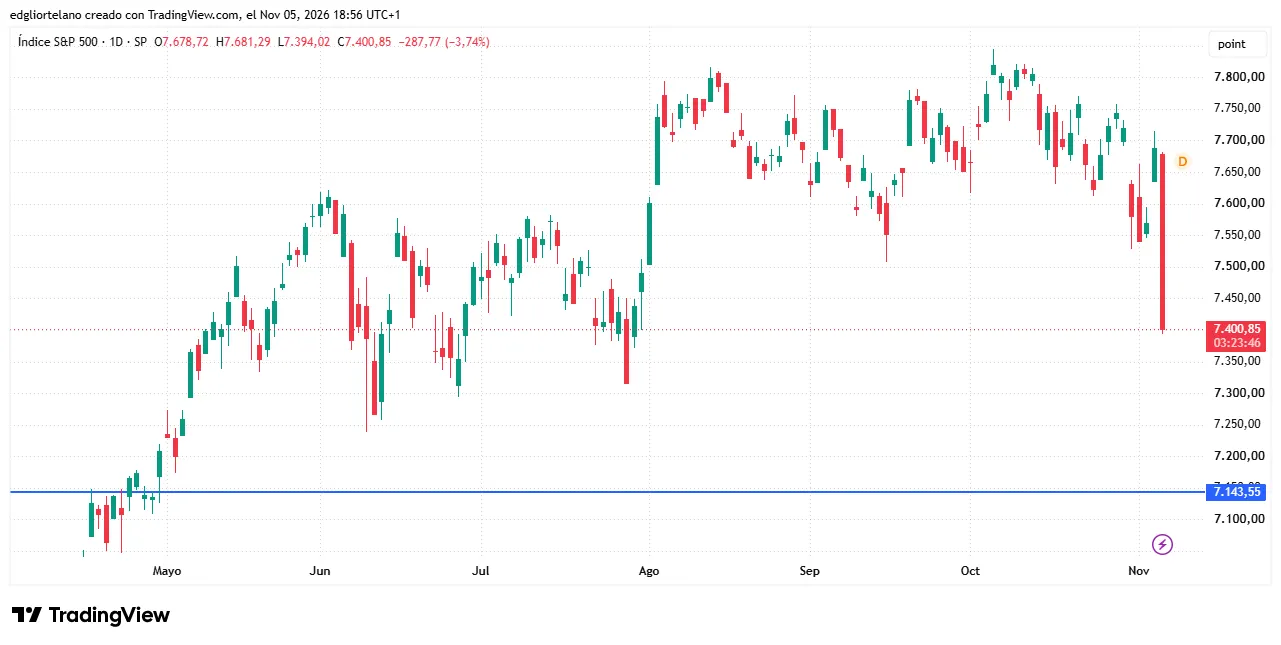
President Donald Trump’s celebratory remarks regarding the historic highs of Wall Street aged poorly in less than 24 hours. Just a day after boasting on social media about Americans’ retirement accounts going "through the roof," the broader U.S. stock market experienced a severe reversal. The S&P 500 plunged as much as 3.8% during Thursday’s trading session, rapidly shifting market conversation away from record-breaking milestones toward emergency trading halts and panic-selling thresholds.
The sharp selloff forced traders and financial analysts to closely monitor market circuit-breaker thresholds—emergency mechanisms designed to temporarily halt trading across all U.S. stock exchanges when losses reach predetermined severity levels. To trigger the first official market-wide emergency halt of the session, the S&P 500 would need to fall another 3.2 percentage points from its intra-day decline.
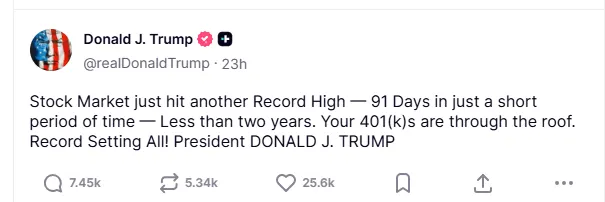
The abrupt downturn created an awkward political and economic timeline for President Trump, who has frequently anchored his administration’s claims of economic success to the upward trajectory of major stock indices. On Wednesday, Trump took to his Truth Social account to highlight a milestone achievement for the financial markets.

"Stock Market just hit another Record High—91 Days in just a short period of time—Less than two years. Your 401(k)s are through the roof," Trump wrote, concluding the post with the declaration, "Record Setting All! President DONALD J. TRUMP."
That mid-week enthusiasm was fueled by a strong Wall Street rally following the Democratic Party’s sweeping victories in the midterm elections. On Wednesday, the S&P 500 surged 1.6% to record its strongest single-day performance in three months. Concurrently, the Dow Jones Industrial Average jumped more than 1,500 points, closing at 53,361 points. However, Thursday’s aggressive selloff effectively wiped out those gains in a single trading session, with technology and artificial intelligence equities bearing the brunt of the downward pressure.
How Close Is Wall Street to a Circuit Breaker?
The modern U.S. stock market operates with three distinct emergency thresholds designed to interrupt panic selling and restore a measure of order during extreme volatility. Known formally as Market-Wide Circuit Breakers (MWCB), these rules automatically suspend trading across all U.S. equity exchanges if the S&P 500 drops by specified percentages relative to its previous closing price.

The first line of defense is a 7% decline. For Thursday’s session, that threshold corresponded to an S&P 500 level of 7,150.41 points. If the benchmark index were to drop to that level before 3:25 p.m. Eastern Time, it would automatically trigger a mandatory 15-minute trading halt across all U.S. equity markets, giving institutional investors, algorithmic traders, and retail participants time to reassess positions.
Should the selloff deepen drastically, a 13% decline—equivalent to 6,689.09 points—would trigger a second 15-minute suspension. The third and most severe threshold is set at a 20% drop, or 6,150.89 points. Reaching this extreme level would shut down trading for the remainder of the active session, a rare event historically reserved for monumental financial crises.
According to the regulatory rules established by the New York Stock Exchange, the first two circuit breaker thresholds cease to apply after 3:25 p.m. ET, meaning a late-day plunge of 7% or 13% would not halt trading during the final minutes of the session. However, the 20% threshold remains active throughout the entire trading day. Furthermore, these rules apply universally across the entire U.S. equity landscape rather than being restricted to S&P 500 components, ensuring that a market-wide halt immediately suspends activity for companies listed on the Nasdaq and other domestic exchanges.
AI Stocks Lead the Wall Street Selloff
The root of Thursday’s steep losses lay heavily within the technology sector as investors continued to digest the policy and regulatory implications of Tuesday’s midterm election results. By approximately 11:00 a.m. ET, the technology-heavy Nasdaq Composite had dropped nearly 5%, while the broader S&P 500 was sitting down 3.2%.
Individual market leaders suffered notable damage. Nvidia shares tumbled by more than 6%, while the broader semiconductor index plunged by nearly 11%. Companies heavily invested in the infrastructure required to build and scale artificial intelligence systems found themselves under intense pressure. Market participants grew increasingly anxious that Democratic legislative and regulatory victories could usher in stricter oversight, heightened antitrust scrutiny, and more stringent environmental or zoning restrictions on massive data-center construction projects.
"We suspect there is going to be some scrutiny on this aggressive AI buildout," Ipek Ozkardeskaya, a senior market analyst at Swissquote Bank, noted in commentary provided to Reuters.
The shockwaves from the equity market quickly bled over into other risk-on asset classes, most notably the digital asset ecosystem. Bitcoin dropped sharply below the $76,000 threshold, erasing the entirety of its post-election recovery. The rapid downward move triggered cascading liquidations, wiping out approximately $428 million in leveraged crypto long positions within the span of a single hour.
Beyond the immediate fallout from the midterm elections and the tech sector retrenchment, equities also faced sustained pressure from persistent inflation anxieties and ongoing uncertainty regarding the Federal Reserve’s future monetary policy path. Market participants remained cautious ahead of Friday’s highly anticipated October employment report, which is expected to offer crucial clues regarding the central bank’s upcoming interest-rate decisions and the overall health of the labor market.
Despite the intensity of Thursday’s market-wide retreat and the substantial losses recorded across major indices, the S&P 500 managed to avoid reaching its first market-wide circuit breaker threshold by the close of the reporting window.

Related News