The Evolution of Bitcoin ASIC Design: Why Operating Temperature May Become the Next Frontier for Heat Reuse
Since Bitcoin’s inception, the trajectory of its mining hardware has been defined by a relentless pursuit of performance and optimization. Over the past fifteen years, developers and manufacturers have navigated a technological arc divided into distinct eras. Initially, the focus centered entirely on maximizing the total hash rate of individual mining machines. As the network grew, the industry shifted its primary objective toward increasing overall hashing efficiency to maximize output per watt of consumed electricity.
This technological evolution began in earnest around 2010, marked by a significant leap in hashing performance as miners transitioned from initial CPU setups to more powerful GPU hardware. The dramatic increase in the hash rate brought by GPUs caused network difficulty to escalate rapidly. By 2011, this soaring difficulty necessitated the introduction of a new category of mining hardware: the Field Programmable Gate Array, commonly known as the FPGA.
FPGAs introduced the capability to optimize reprogrammable hardware specifically tailored for Bitcoin mining logic. This innovation drastically improved efficiency, marking a fundamental shift in design intention away from raw, maximum hash output toward refined efficiency. FPGAs allowed miners to extract more hash rate for a fixed amount of power consumption. However, the tenure of FPGA miners proved short-lived. They served primarily as an essential transitional bridge, moving the industry away from general-purpose computing hardware like CPUs and GPUs and toward highly specialized Application-Specific Integrated Circuits, which made their commercial debut in 2013.

ASIC chips represented a quantum leap in the industry, proving to be orders of magnitude more efficient than FPGAs due to their dedicated optimization at the silicon level. By combining high hash rates with unprecedented efficiency, ASICs revolutionized the economics of Bitcoin mining. The trade-off for this specialized performance was fixed, non-upgradable circuitry designed to execute only one specific function. Nevertheless, this dedicated logic hardware, engineered from the ground up strictly for hashing, quickly established itself as the undisputed preferred method for securing the Bitcoin network.
Since 2013, the market has witnessed numerous generational iterations of ASICs. Each new hardware release has continued to push the boundaries of the two foundational design intents: higher total hash rate and greater energy efficiency. However, the magnitude of these generational performance leaps has begun to change. In recent years, the industry has observed diminishing improvements specifically regarding ASIC efficiency gains. This trend reflects a natural maturation phase in semiconductor development. As manufacturers approach the fundamental physical limits at the silicon level, design optimization naturally reaches a point of diminishing returns.
Despite fifteen years of rapid technological iteration and generational improvements, one critical aspect of Bitcoin mining hardware has remained remarkably constant: ASIC chip operating temperature. Like any computer processor, ASICs generate heat as electrical currents flow through them to execute complex logic operations. If captured and managed properly, this thermal energy can be harnessed to perform useful work, particularly in residential and commercial heating applications. Across the globe, individuals and businesses are already utilizing ASICs to heat spaces such as homes and hot tubs.

While general-purpose computer chips are engineered to maintain high performance and longevity even when running at temperatures exceeding 100 degrees Celsius under full load, ASICs behave quite differently. They typically begin to experience thermal throttling above 80 degrees Celsius, which severely limits their hash rate and operational efficiency. This thermal discrepancy highlights a substantial opportunity for future improvement and optimization, particularly for ASICs engineered to operate effectively at higher temperatures.
This reality raises a fundamental question about hardware manufacturing: why would designers ever build ASICs to run at elevated temperatures when miners traditionally prioritize heat rejection to keep machines cool and reliable? The answer largely depends on the specific use case and scale of the mining operation.
Hashing and Heat at Different Scales
For large-scale mining operations housing thousands of machines and consuming megawatts of power, the primary objective is to reject heat as efficiently as possible. These enterprise-scale miners want to maximize hash rate efficiency to optimize profitability, largely indifferent to the exhausted thermal energy they produce. To achieve this, a specialized cooling industry has emerged, developing sophisticated immersion, air-cooled, and hydro direct-chip cooling systems designed to vent or dissipate heat rapidly.

On the opposite end of the spectrum are small-scale miners operating at a capacity ranging from hundreds of watts to hundreds of kilowatts. Many residential and commercial operators use Bitcoin miners not just for cryptographic rewards, but to actively provide environmental heating. These operators treat both the hash rate and the resulting heat as valuable products.
This creates a distinct divergence in industry applications. While large-scale operations seek maximum hash rate for a given power consumption, small-scale participants often view the mining hardware as a sophisticated resistive heater that simultaneously subsidizes its own energy costs through the Bitcoin it earns. For these localized miners, marginal improvements in hashing efficiency are secondary. Maintaining a desired thermal setpoint and reliable high-temperature output from the miner is often equally, if not more, important than industry-leading electrical efficiency. Consequently, increased operating temperature is emerging as a potential third design intent for ASIC chips tailored specifically for heat-reuse applications.
A Fork in ASIC Optimization
This dynamic points toward a broader bifurcation in the future design intent of ASIC chips. Large mining operations often secure lower electricity costs by operating in remote locations, though they frequently face criticism regarding their impact on network decentralization. A robust, globally distributed hash rate is vital for network security, but small-scale miners in densely populated urban environments typically face significantly higher energy costs.

Leveraging miners for practical heating applications introduces an economic motivation independent of raw electrical costs, thereby encouraging the physical decentralization of the hash rate. By integrating ASICs into heating systems, operators can offset sunk heating costs and reduce overall energy bills, meaning their economic viability does not rely solely on volatile Bitcoin mining rewards.
Higher chip operating temperatures yield a greater temperature differential between the miner and its surrounding environment, and larger temperature differentials are inherently more effective for transferring thermal energy. When heat is treated as a commercial product, higher operating temperatures open the door to a wider array of applications, such as integrating miners into water boilers or even evaporative refrigeration loops.
State-of-the-art ASICs are expensive, and maintaining a position at the forefront of hashing efficiency requires significant capital expenditure. For industrial operations, these expenses are typically financed, and the economics favor high-efficiency deployment given their low power rates. Small-scale miners, however, operate under entirely different constraints. Many individuals reusing heat already rely on retrofitted machines that are several generations old to keep their systems economical. By repurposing older industrial hardware, these operators demonstrate that they value thermal output over peak efficiency.

For home-based miners utilizing older hardware, the primary incentive is room heating combined with subsidized electricity costs, accompanied by the added benefit of earning mined Bitcoin. Because these operational incentives differ so drastically from enterprise mining, it is logical for ASIC chip design to eventually split into distinct developmental pathways. A significant, largely untapped market exists for mining hardware explicitly optimized for heat reuse, transforming thermal energy—an essential component of modern residential and commercial life—into a subsidized utility.
Ground-Up Design Integration
Optimizing ASIC silicon for higher operating temperatures requires a departure from current manufacturing standards. Presently, the vast majority of the ASIC market share is controlled by major manufacturers like Bitmain and MicroBT. Their hardware is engineered for industrial environments, featuring extruded aluminum enclosures, high-speed and high-noise fans, and closed-source hash board and chip architectures.
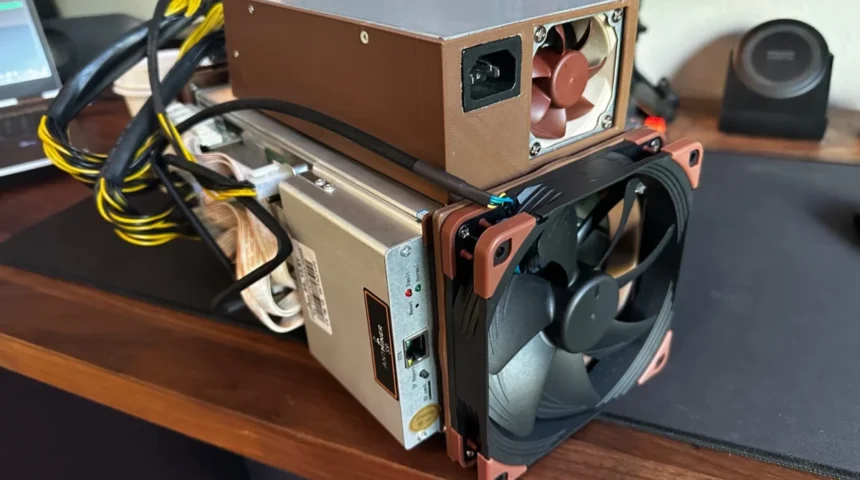
Consequently, current small-scale miners must modify and retrofit industrial machinery for non-industrial spaces. Air-cooled units frequently undergo fan replacements to reduce noise, alongside power adjustments to ensure acceptable decibel levels for residential use. While immersion cooling tanks successfully eliminate noise, they require specialized dielectric fluid and external heat exchangers. Similarly, newer hydro-cooled machines circulate water directly against the chip for quiet operation, but they remain expensive and demand external pumps and heat infrastructure. Crucially, none of these existing industrial offerings can heat working fluids much beyond 80 degrees Celsius without encountering performance limitations.

The closed-source nature of leading hardware further complicates the development of simplified, integrated heating systems for homes and businesses. While a handful of smaller firms are actively developing integrated chips and hash boards designed for higher thermal tolerances, most home heating projects still rely on dismantling used machines and transplanting their components into custom enclosures.
Developing ASIC chips and hash boards specifically engineered for elevated operating temperatures and seamless system integration will unlock new incentives for heat-reuse mining at an accessible cost. Collaborative open-source initiatives and targeted chip architecture development can pool expertise to create hardware optimized for both thermal reliability and high-temperature utility.
This evolution represents a crucial step toward increasing the adoption of small-scale mining, which in turn strengthens the decentralization of the global hash rate. While industrial ASICs prioritizing maximum hash rate and efficiency will continue to serve large-scale operations incapable of monetizing waste heat, chips designed for higher operating temperatures offer superior value to small-scale participants. As new ASIC manufacturers enter the market in the coming years, increased operating temperatures and dedicated heating integration are poised to become primary selling points in hardware design.

Related News