Why Most Cryptocurrencies Fail to Accrue Value While Bitcoin Stands Apart
December 2025
For years, market observers and macro analysts have maintained a uniquely bifurcated view of the digital asset ecosystem. While bullish convictions surrounding Bitcoin have only deepened over time, that same enthusiasm has famously failed to extend to the broader universe of alternative cryptocurrencies.
This analytical framework continues to hold up against the realities of the market. Since initial public recommendations were issued in April 2020 when Bitcoin traded near $6,900, the pioneering cryptocurrency has experienced historic volatility, climbing as high as $126,000 before settling around $85,000. Despite CoinMarketCap tracking millions of distinct digital tokens, Bitcoin alone commands roughly 60% of the entire asset class’s total market value. When excluding dollar-backed stablecoins from the calculation, Bitcoin’s dominance swells closer to 70%.
The skepticism directed toward alternative crypto assets is rooted in a consistent track record of economic analysis. In January 2021, an in-depth examination of Ethereum’s underlying tokenomics sparked widespread industry debate, prompting direct responses from creators and community organizers alike. Looking back nearly five years later, Ethereum has fundamentally failed to establish higher highs relative to Bitcoin compared to its landmark 2017 peak.
Subsequent market cycles brought further validation to these cautionary warnings. During the spring of 2022, research notes detailed the fatal stability flaws inherent in the Terra/Luna ecosystem while the asset was still riding near its all-time highs. When the protocol collapsed into a total loss roughly a month later, it served as a stark reminder of why the vast majority of non-Bitcoin cryptos carry systemic risks.
By December 2022, amidst a punishing industry-wide bear market, further analysis highlighted the structural problems plaguing the broader decentralized finance (DeFi) sector. These issues ranged from hidden layers of centralization to predatory venture capital practices, where early backers engineered exit liquidity by dumping tokens onto retail investors before any sustainable economic value had been established. While Bitcoin subsequently rebounded to reach new all-time highs, the broader altcoin landscape has delivered underwhelming returns, with most tokens failing to reclaim previous peaks as market narratives evaporate.
Here We Go Again
Nearly two years after those initial warnings, the underlying thesis remains unchanged: enthusiasm for the digital asset industry must be strictly partitioned away from anything outside of Bitcoin and payment-grade stablecoins.
This perspective does not imply that alternative assets cannot be traded by speculators seeking short-term gains, nor does it mean that competing blockchains are entirely devoid of practical utility. For instance, even while maintaining a deeply critical stance on Ethereum as a long-term investment vehicle, analysts have long acknowledged the vital role of stablecoin proliferation, noting that Ethereum serves as one of the primary foundational rails for dollar-pegged digital currencies.
At the time of that 2021 analysis, the total market capitalization of stablecoins hovered around $32 billion. Today, that figure has exploded to over $290 billion, driven by raging global demand and accelerating real-world adoption. However, aside from the small handful of private corporations responsible for issuing them, investors cannot effectively invest in stablecoins, as their economic value is permanently pegged to the United States dollar.
Instead, the core economic reality remains that alternative layer-one blockchains will likely continue to fail to accrue major, sustained value over the long term. While speculative bull markets fueled by excess liquidity can temporarily lift virtually every token in sight, a retrospective look across any four-to-five-year window reveals that the vast majority of these projects deliver weak fundamental results.

Commoditized Tech Rails Accrue Limited Value
Back in 2017, institutional researcher John Pfeffer published a seminal paper titled An Institutional Investor’s Take on Cryptoassets. The central thesis of the work argued that utility blockchains are fundamentally unlikely to capture long-term value, even when the underlying technology proves genuinely useful. Conversely, a winning monetary protocol like Bitcoin possesses the unique capability to accrue substantial, lasting value. To the extent that utility blockchains add practical value to the economy, the primary beneficiaries are always the end-users—such as those utilizing stablecoins for cross-border payments—rather than the long-term coinholders of the underlying network.
Years later, that institutional analysis has proven remarkably prescient. Utility protocols face relentless competition, which continuously drives their operational revenues down toward the marginal cost of execution. In stark contrast, the Bitcoin network has expanded exponentially as a pure monetary asset and portable store of value. Bitcoins are accumulated for their own sake, driven by the network’s peerless security model and absolute supply constraints, rather than being deployed as a temporary transactional fee to execute unrelated computational functions. Consequently, the price of Bitcoin benefits directly from the compounding network effects of its own monetary ledger.
To understand this dynamic, one can look at traditional financial infrastructure, such as Exchange-Traded Funds. While most observers do not classify ETFs as traditional "technology," they fundamentally function as technological innovations that revolutionized asset management. Over the past several decades, capital has persistently migrated away from high-fee, less-liquid investment vehicles toward low-cost ETFs.
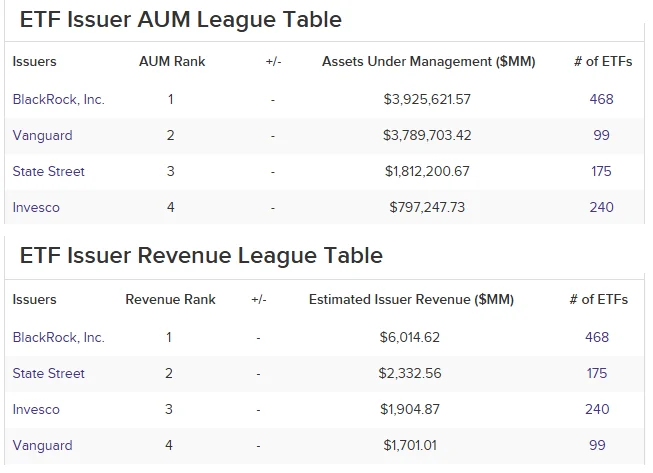
By mid-2025, United States ETFs collectively held approximately $11.5 trillion to $13 trillion in assets under management, according to data from the Federal Reserve and major financial institutions. The monumental shift of wealth away from traditional mutual funds into ETFs is historic in scale. Yet, the corporate issuers capturing these vast sums are not necessarily economic powerhouses.
Industry data indicates that the top four ETF providers—BlackRock, Vanguard, State Street, and Invesco—manage roughly $10 trillion of that total. Together, they generate an estimated $11.9 billion in annual ETF revenue, translating to an average fee rate of roughly 0.12% before operational expenses. Because competition is fierce, any provider attempting to charge elevated fees is immediately undercut by market rivals, pulling fee structures inexorably toward the marginal cost of operation.
While major financial institutions maintain massive corporate valuations, those market capitalizations are largely driven by non-ETF business lines such as active asset management and custodian banking services. Strip away those ancillary operations, and the valuation of the pure ETF issuing industry is modest relative to the trillions of dollars it manages. ETFs have undeniably delivered immense utility and operational flexibility to investors, yet they have accrued remarkably little direct value to the corporate entities operating them.
Meanwhile, Ethereum alone currently maintains a market capitalization exceeding $350 billion—dwarfing the combined valuation of the entire ETF management industry, despite hosting two orders of magnitude less economic value in locked assets such as stablecoins and decentralized finance. Furthermore, Ethereum faces relentless competition from alternative smart-contract platforms and scaling layers that offer identical computational functionality.
Arguments suggesting that Ethereum will capture immense long-term value because it serves as the foundational technological rail for the digital economy ignore a fundamental economic question: compared to what? Ethereum is already priced as if it will power a commercial footprint larger than the entire global ETF industry, despite handling a fraction of that economic throughput. Crucially, participants do not need to hold the native coin of a network to utilize its technology; they simply need to acquire minute amounts to cover transaction fees in the moment.
Unlike ETF issuers, whose revenues are tied strictly to assets under management rather than transactional volume, cryptocurrencies can theoretically route economic activity directly to tokenholders. Therefore, examining traditional stock exchanges provides another illuminating parallel.
The United States stock market boasts a capitalization exceeding $60 trillion, with the vast majority of that equity value trading across the New York Stock Exchange and the Nasdaq. Their daily trading volumes routinely measure in the hundreds of billions of dollars. Yet, their parent holding companies are valued at roughly $90 billion and $50 billion, respectively. Combined, their market capitalizations are less than half of Ethereum’s current valuation.

Individual alternative cryptocurrencies routinely surpass the corporate valuation of major global financial exchanges despite supporting a tiny fraction of their economic relevance. Valuing smart-contract cryptocurrencies based on their programmable utility—even factoring in speculative projections for the next decade—suggests that these digital assets are heavily overvalued relative to traditional financial giants.
Exhausted Narratives
Over successive market cycles, the altcoin sector has relied on a rotating cast of speculative narratives to sustain retail interest. Initial experiments sought to sacrifice auditability for enhanced privacy, compromise decentralization to achieve single-layer scalability, or introduce complex scripting languages that inadvertently expanded security attack surfaces. While these innovations carved out small, passionate niches, the broader market has largely failed to embrace them on a systemic scale.
Initial Coin Offerings, or ICOs, dominated the bull market cycles of previous years, functioning primarily as a mechanism to raise capital outside of traditional regulatory disclosure frameworks without delivering durable, revenue-generating products. Essentially operating as leveraged penny stocks, they left retail participants holding worthless assets once the initial hype subsided.
Decentralized exchanges and algorithmic lending protocols enjoyed a massive surge during subsequent cycles, but the fundamental demand for such platforms faces a natural ceiling. Decentralized trading directly competes with highly efficient centralized financial institutions, and while it eliminates certain custodial risks, it merely trades them for complex technical risks, such as cross-chain bridge exploits and smart-contract vulnerabilities.
Similarly, non-fungible tokens and digital collectibles experienced a speculative frenzy before succumbing to structural oversupply. Because the vast majority of NFTs fail to store media content directly on-chain—often relying instead on centralized web servers pointing to external assets—the market was eventually flooded with endless collections that exhausted consumer demand. While select historical artifacts maintain residual value as curiosities, the broader sector failed to transition into a permanent macroeconomic asset class.
As technological narratives lost their luster, the industry ultimately degraded into the proliferation of meme coins. Recognizing that many preceding utility projects were solutions searching for problems—often engineered by venture capitalists to offload tokens onto unsuspecting retail investors—the market openly embraced assets transparently devoid of fundamental value. Functioning purely as instruments for international speculation and digital gambling, meme coins followed the exact trajectory of prior fads: early participants captured profits while late entrants absorbed heavy losses as market demand dried up.
Ultimately, the inherent speculative fervor of the broader crypto industry has consistently disguised how little underlying economic demand exists for most decentralized applications once initial token hype fades. As competition intensifies, the operational revenues of utility blockchains continue to drift toward their marginal cost of production, leaving long-term coinholders with minimal sustained value capture.
Where Opportunity Is
Amidst a crowded and often speculative landscape, the Bitcoin network retains a structurally sound long-term outlook. While not devoid of regulatory, technical, and market volatility risks, Bitcoin occupies a unique position within a diversified portfolio because it is acquired primarily as a sovereign, portable store of capital rather than as a utility rail for external applications.
Beyond Bitcoin, the rapid structural expansion of dollar-pegged stablecoins represents a genuine technological advancement, acting as the modern-day digital equivalent of the eurodollar. Similarly, the tokenization of traditional assets, such as high-quality equities, provides vital financial access to individuals living in regions with restricted domestic capital markets.
With Bitcoin trading at a multi-trillion-dollar market capitalization, its long-term institutional adoption remains in its relative infancy. Much like the skepticism directed toward dominant mega-cap technology equities during the 2010s—only for those companies to scale to unprecedented heights in the subsequent decade—the Bitcoin network continues to command powerful network effects within a global financial system comprised of hundreds of trillions of dollars in liquid wealth.

Related News