US-Iran War: Trump Weighs Military Options Amid Surging Strait of Hormuz Attacks and Looming Midterms
United States President Donald Trump has stated on his social media platform, Truth Social, that he will not initiate any major military attacks against Iran before the November 3 midterm elections. However, the diplomatic and military landscape remains exceptionally volatile. Trump told a Republican convention in September that the ongoing conflict with Tehran "is going to end immediately after the elections," yet the US military has continued to deploy additional forces and assets to the Middle East in recent weeks, signaling that the administration is preparing for multiple eventualities.
Meanwhile, Iranian attacks on shipping in the critical Strait of Hormuz have surged to their highest level since the war began. An Iranian official told the Reuters news agency that Tehran has begun implementing different and more aggressive offensive tactics against vessels it considers to be violating its maritime restrictions. With control of the Strait of Hormuz remaining central to the overarching US-Iran conflict, questions are mounting over what military options President Trump has left at his disposal, and what the financial, strategic, and political costs of each path would be.
Where does the US-Iran war stand?
The conflict currently sits in a perilous and costly deadlock. The United States and Israel first launched coordinated military strikes against Iran on February 28, triggering a wave of counterattacks by Tehran against US military assets and other critical infrastructure across several Gulf countries and Jordan in the following months.
As part of its retaliatory strategy, Iran also moved to close the Strait of Hormuz. Before the outbreak of the war, the vital waterway carried at least 20 percent of global crude oil and liquefied natural gas (LNG) supplies, and its closure sent global energy markets spiraling into chaos. The price of Brent Crude, the global benchmark, climbed sharply from about $72 a barrel the day before the war began to a high of nearly $120 a barrel earlier this year. On Thursday, amid persistent disruptions, crude was trading at about $104 a barrel.
A fragile ceasefire agreement brokered in June ultimately collapsed over the contentious issue of control of the strait. In response, Washington has maintained a strict naval blockade on Iran’s southern ports, while Tehran has continued to target commercial vessels attempting to pass through the contested waters. Indirect diplomatic talks facilitated by intermediaries in Pakistan and Qatar are ongoing, accompanied by an exchange of various peace proposals from each side. However, Trump rejected Iran’s latest formal offer to reopen the strait last month.
While the US possesses "enormous military capability that Iran can’t match," that power has not delivered the definitive strategic outcomes Washington desires, according to Afzal Ashraf, a visiting fellow in international relations and security at Loughborough University in the United Kingdom and a former senior Royal Air Force officer who served in Iraq.
What forces does the US have in the Middle East right now?
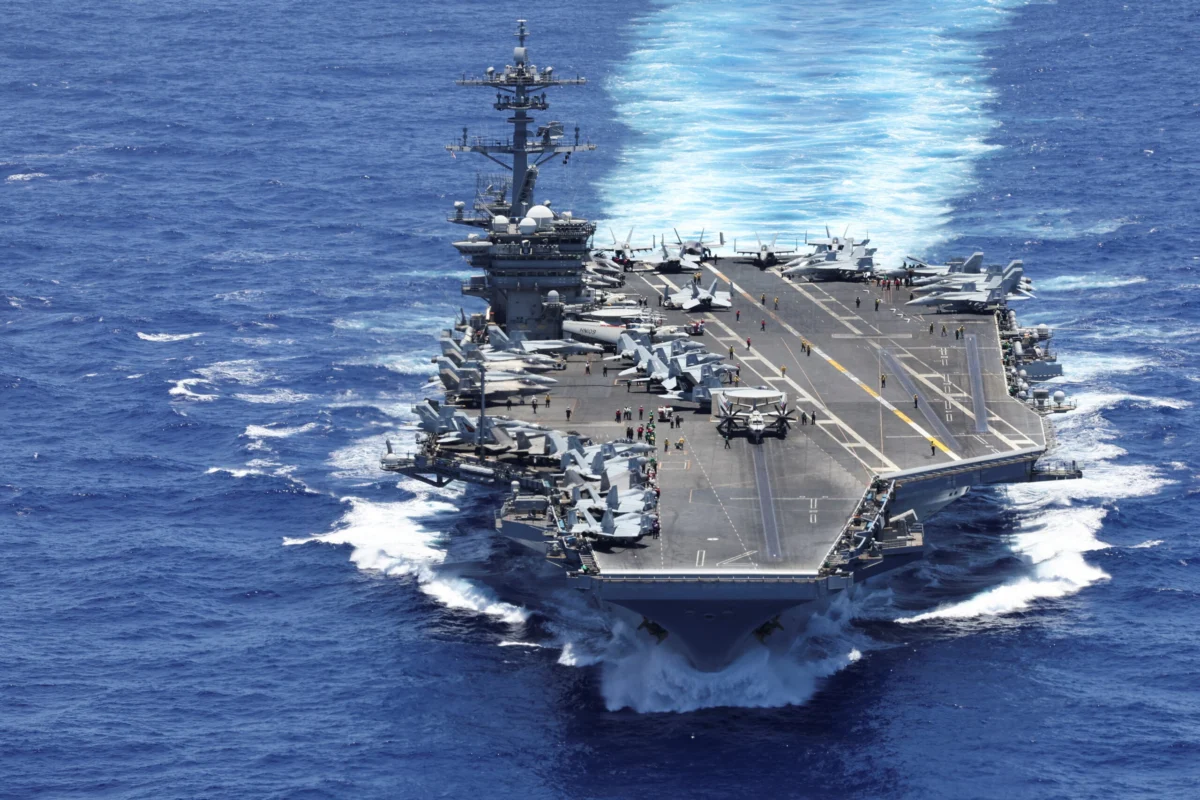
To maintain its posture in the theater, the US military maintains at least three aircraft carrier strike groups stationed in the Gulf region or actively heading toward it.
Among these is the USS Theodore Roosevelt carrier strike group, carrying approximately 7,000 sailors and 2,000 Marines, which has been sailing to the Middle East to reinforce the naval assets already operating in the area. In addition to its naval power, the United States maintains a broad host of military assets and roughly 50,000 active-duty soldiers positioned at various strategic bases across multiple Middle East nations.
What are Trump’s military options?
Keep squeezing Iran
The current operational status quo relies on the US naval blockade of Iranian ports and the provision of naval escorts for commercial shipping navigating the Strait of Hormuz. This is widely viewed as the most likely course of action for the immediate future, according to Patrick Bury, a senior associate professor at the University of Bath and a former NATO research analyst.
Before the conflict began, the Strait of Hormuz typically handled about 125 large commercial vessels daily, moving an average of 17.1 million barrels of oil. That vital flow collapsed when the strait was effectively closed in March. In recent weeks, aided by US Navy escorts, Gulf oil flows through Hormuz—excluding Iranian exports—had partially recovered, reaching more than 81 percent of pre-war levels in September, according to maritime tracking firm Kpler.

However, that recovery has experienced a sharp reversal due to Iran’s recent escalation of attacks on ships in the waterway. Data from Kpler shows that only 2.9 million barrels of oil were transported through the chokepoint on October 11, marking the lowest volume recorded that month.
Washington has attempted to sustain patrols and aerial surveillance over the southwestern sector of the strait, providing enough security protection for ships to safely clear the area, Bury noted. Increasingly, unmanned aerial drones are handling the labor-intensive work of gathering intelligence and carrying out defensive monitoring, which proves far cheaper than keeping manned aircraft on extended flight sorties. While he described these efforts as "somewhat effective," Bury emphasized that high global oil prices and substantial crew hazard bonuses mean commercial operators are still taking significant risks.
Now, however, Iran has adapted by shifting its tactical approach. The UK Maritime Trade Operations (UKMTO) centre recorded 15 distinct attacks on ships between October 6 and 14 alone. Tehran appears exceptionally well-prepared, Bury said, pointing to the inherent asymmetry of costs in the theater. By virtue of its geography, Iran continues to enjoy a much easier and more advantageous starting point.
Resume air and missile attacks
Another viable option for Washington is the resumption and expansion of direct air and missile strikes. While Trump has publicly suggested that it may be "possible" to ramp up a bombing campaign after the midterms, he has not outlined specific operational details.
If a major escalation does materialize, Bury said he expects further strikes to be delivered in fairly limited tactical packages directed at military targets along Iran’s coastline and deeper inland.
Yet, a renewed air campaign could achieve significantly less than the initial wave of strikes earlier this year, Ashraf cautioned, because Iran has actively adapted its tactics and defenses. Regarding Iran’s remaining missile inventory, Ashraf noted that they have fewer launchers left, but they are now capable of concealing them much more effectively.
The financial and material costs for the United States would also be exceptionally high. The US military has already severely depleted its stockpiles of advanced, highly expensive defensive missile systems. Every relatively cheap Iranian drone or missile launched forces the US to fire an interceptor costing a million dollars or more, according to Ashraf, who warned that the United States is running dangerously low on missiles for its own baseline defense.
Furthermore, the US has fired more than 1,000 Tomahawk cruise missiles at Iranian targets throughout the course of the war. Fully restoring pre-war inventory levels for these key munitions could take until the end of 2030, according to projections from the Center for Strategic and International Studies (CSIS).
Bury estimated that returning to pre-war operational readiness across key munition categories would take three to four years. The fundamental problem is that resolving supply chain and production deficits takes a long time, even when substantial funding is immediately approved.
Meanwhile, Tehran has vowed to retaliate with greater force. Iranian Parliament Speaker Mohammad Bagher Ghalibaf declared last month that the era of measured, proportionate responses has officially come to an end. Renewed US attacks could also jeopardize Washington’s access to vital regional bases in the Gulf, Ashraf warned. Iran’s recent retaliatory strikes have selectively targeted Jordan, Kuwait, and Bahrain, while sparing other Gulf states that Ashraf suggests may have reached an unpublicized understanding with Tehran to remain outside the active fighting.

Could a US ground operation against Iran be an option?
Military analysts agree that a US ground operation is highly unlikely. One potential target that has been discussed in strategic circles is Kharg Island, located 26 kilometers off Iran’s coast, which handles roughly 90 percent of the nation’s oil exports.
While Joseph Votel, a former US Central Command (CENTCOM) commander, has previously indicated that a force of 800 to 1,000 soldiers could theoretically seize the island, those troops would remain acutely and dangerously exposed to heavy artillery and missile fire from the Iranian mainland, according to Reuters reports.
Ashraf noted that US forces could theoretically launch a limited amphibious invasion, likely preceded by extensive electronic warfare operations designed to blind Iranian radar and coastal defenses. However, Iran would immediately counter by heavily bombarding the island itself. Once Tehran knows the island is occupied by American forces, they do not require complex targeting information to strike it, Ashraf said. Given that the broader war is already deeply unpopular at home, the public and political appetite for high troop casualties remains exceptionally low.
Furthermore, Iran could easily retaliate by targeting critical oil infrastructure across the wider Gulf region, he warned, concluding that any attempt to seize Kharg Island would represent the most irrational of strategic decisions.
Is a full-scale US invasion of Iran possible?
A full-scale US invasion of Iran is widely considered a near-impossibility. President Trump has largely ruled out a major ground offensive, and Secretary of State Marco Rubio stated back in March that ground troops would not be required to achieve the administration’s core strategic goals.
Echoing that assessment, Bury stated that an invasion is simply not going to happen. "I don’t think they can do it, to be honest with you," he added.
Why does the timing matter?
The timing of every military and political calculation is heavily influenced by domestic constraints. The war remains profoundly unpopular with the American public, with approximately 65 percent of Americans disapproving of Trump’s handling of the conflict, according to data from the Pew Research Center. With the midterm elections only weeks away, the political cost of escalation weighs heavily on the White House.
Looking beyond the immediate political horizon, Bury argued that the broader strategic dilemma is whether the US military can successfully rebuild its depleted combat power in a compressed timeframe. Posing the question of whether America can regenerate its strength as a dominant global military power over the next few years, he noted that the task will undoubtedly outlast Trump’s current term, requiring the next president to grapple with the exact same structural challenge.
The longer the war drags on, Ashraf warned, the greater the compounding risk of widespread political unrest and instability across the wider region. He cautioned that military options cannot be divorced from their enormous capacity to generate regional political fallout.
On Sunday, Iranian security chief Mohsen Rezaei underscored Tehran’s defiant stance, asserting that Iranian forces had been striking commercial vessels participating in the US-backed shipping shuttle through the Strait of Hormuz on a nightly basis for weeks. Accusing the coalition of illicit activity, Rezaei declared that despite foreign escorts, the strait remains firmly under Iran’s control.

Related News