France and Italy Crack Down on Violent Student Protests as Governments Target Parents with Fines and New Penalties
As high school student protests erupted across France last month, videos quickly circulated on social media capturing frustrated parents physically dragging their children away from the front lines of the demonstrations. Those parents may have had profound foresight. Following a severe wave of civil unrest, governments in both France and Italy are moving aggressively to hold families financially accountable for property damage, vandalism, and rioting carried out by minors.
The unrest initially began in late September as student-led demonstrations over deteriorating school infrastructure and teacher shortages. However, the movement rapidly evolved into a much broader socio-political crisis. Joined by public sector workers, citizens furious over the rising cost of living, fuel shortages, and proposed public spending cuts have taken to the streets in numbers not seen in years. What started as localized demonstrations outside school gates has frequently devolved into widespread rioting, looting, arson, and violent clashes with law enforcement.
The contagion of youth-led and cost-of-living protests has since crossed borders. Similar demonstrations have broken out in major Italian cities, as well as in Spain, Belgium, and Portugal. As authorities grapple with the spiraling social unrest, policymakers are deploying a mix of heavy-duty policing and strict financial penalties aimed directly at the instigators—and, crucially, their parents.
What are the protests in France and Italy about?
The current wave of demonstrations has deep roots in economic anxiety and public sector dissatisfaction. In late September, high school students in Seine-Saint-Denis, a northern suburb of Paris, walked out of classes to protest the deplorable state of their school buildings and chronic teacher shortages. Their anger was further inflamed by a proposed government budget that included millions of euros in cuts to public spending.
During the first week of October, students in Paris and other French urban centers erected fiery barricades around educational institutions, forcing hundreds of school closures. The movement quickly gathered momentum. Public sector workers joined the demonstrations to voice vehement opposition to planned public-sector pay freezes.
Within days, the protests widened into a multi-faceted crisis. Citizens frustrated by soaring inflation, the rising cost of living, petrol shortages, and surging fuel prices flooded the streets. Frequently, these demonstrations descended into chaotic scenes marked by rioting, looting, and arson.
French President Emmanuel Macron addressed the mounting crisis by declaring that "nothing justifies" violence. He granted local officials the authority to ban street gatherings deemed too dangerous and announced sweeping curfews in affected areas.
Despite government warnings, the unrest culminated on a single Saturday when hundreds of thousands of protesters across France, Italy, Spain, Belgium, and Portugal took part in largely uncoordinated demonstrations against the crushing cost of living.
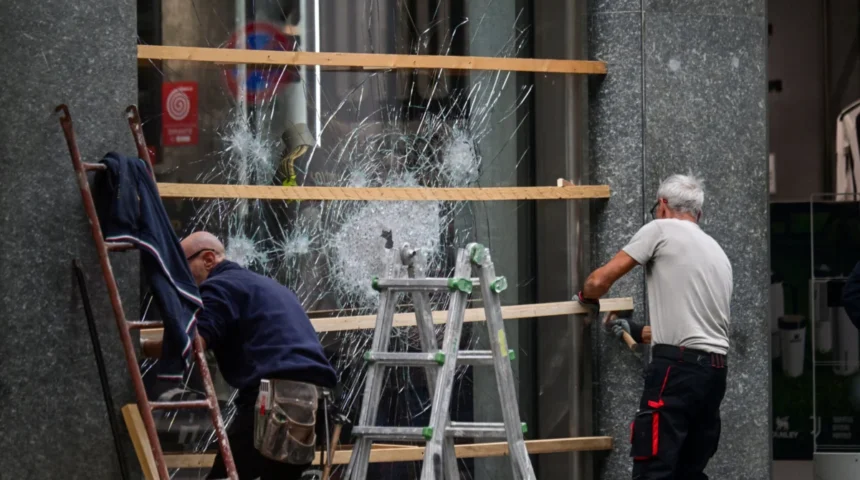
In Italy, what began as initially peaceful weekend protests in Milan quickly deteriorated into violent riots. Groups of predominantly young people looted shops, smashed windows, and engaged in pitched battles with police. Masked demonstrators hurled heavy stones, paving blocks, and various projectiles at riot police, while setting fire to barricades constructed from bar tables and other street furniture. Similar outbreaks of rioting and vandalism were subsequently reported in the Italian cities of Bologna and Turin.
As municipal authorities and business owners assess the wreckage, official figures detailing the total expected costs of the property damage in both France and Italy have yet to be fully calculated.
What has Italy announced?
In direct response to the escalating violence, the government of Italian Prime Minister Giorgia Meloni approved a stringent series of emergency measures on Tuesday. Among the most prominent deployments is the dispatch of 500 soldiers to Milan to maintain public order until the end of the year, alongside a sharp escalation of financial liabilities for parents whose children participate in vandalism, looting, and rioting.
Under the newly enacted rules, individuals participating in a group of at least five people who endanger public safety during protests face severe criminal penalties, including up to five years in prison and a maximum fine of 20,000 euros, equivalent to roughly $22,460.
Furthermore, the legal framework for minors has been tightened significantly. Protesters aged 14 to 18 can now be subjected to administrative detention, even if they have not yet committed a specific crime, provided law enforcement possesses evidence that they pose an active danger. This extends emergency powers that previously applied strictly to adults.
Emphasizing the philosophy of "You break it, you buy it," the Italian decree drastically reinforces existing laws holding parents legally and financially responsible for criminal damage committed by their offspring.
While Article 2048 of the Italian civil code already dictates that parents and guardians are liable for damages caused by the unlawful acts of unemancipated minor children living with them, the enforcement mechanisms have been sharply upgraded. Italian authorities now possess the legal backing to enforce these financial penalties swiftly through asset and wage attachments. The new measure empowers the state to directly fine parents or claim damages for resulting losses by seizing family property or deducting funds directly from public subsidies received by the household.
What is the situation in France?
France is experiencing a parallel legal and political reckoning. Under Article 1242 of the French Civil Code, parents who reside with their children and exercise parental authority already bear civil liability for damages caused by those minors. The law explicitly states that parents are jointly and severally liable for damages caused by their minor children, excepting instances where the minor has been placed under the care of a third party by an administrative or judicial decision.
This framework was reinforced last year through a legislative amendment to Article 1242 that strengthened the role of parents during youth justice proceedings by removing the strict cohabitation requirement for civil liability to apply. In France, financial compensation extracted from parents for damages caused by their children can be enforced through civil proceedings. This can result in the seizure of family assets if the damages are not covered by standard civil liability insurance policies, which are frequently bundled into household insurance subject to specific policy terms.
Building upon these existing statutes, the French government announced a draft bill known colloquially as "rioters pay," which was scheduled for formal debate in parliament. Prime Minister Sebastien Lecornu described the proposed legislation as "absolutely essential" to ensure that ordinary taxpayers are not left footing the bill for the extensive property damage inflicted during protests.
If passed, the bill mandates that individuals found responsible for vandalism could be forced to pay up to 10,000 euros, or about $11,200, in compensation. In cases where the criminal damage is perpetrated by minors, liability would automatically fall upon the parents.
Crucially, the draft legislation also introduces a controversial provision regarding collective civil liability. According to reports from French radio station RFI, the measure could potentially require an individual belonging to a group responsible for damage to pay for the destruction, even if they did not personally cause the damage, applying the exact same financial terms as those levied against the primary culprits.
Where else does this happen?
The legislative push in France and Italy is part of a broader international trend in which governments are increasingly looking to families to curb youth delinquency and public unrest. Several other nations maintain laws that hold parents financially liable for damages caused by their children under specific circumstances.
In Sweden, parents or legal guardians can be held legally and financially accountable, subject to strict statutory conditions and limits, for certain injuries or property damage resulting from crimes committed by a child.
Similarly, in the United States, parental responsibility laws vary by state but generally stipulate that if a minor intentionally destroys public property, local businesses, or private vehicles, victims or municipal governments have the legal right to sue the parents directly in civil court, subject to jurisdiction-specific conditions and financial caps. As the political and social landscapes across Europe continue to shift in the wake of these historic demonstrations, the question of parental accountability is taking center stage in the global debate over public order and civil disobedience.

Related News