Braiins Unveils Automated Balancing Rules and Sharable Custom Filters in Latest Manager Pro Update
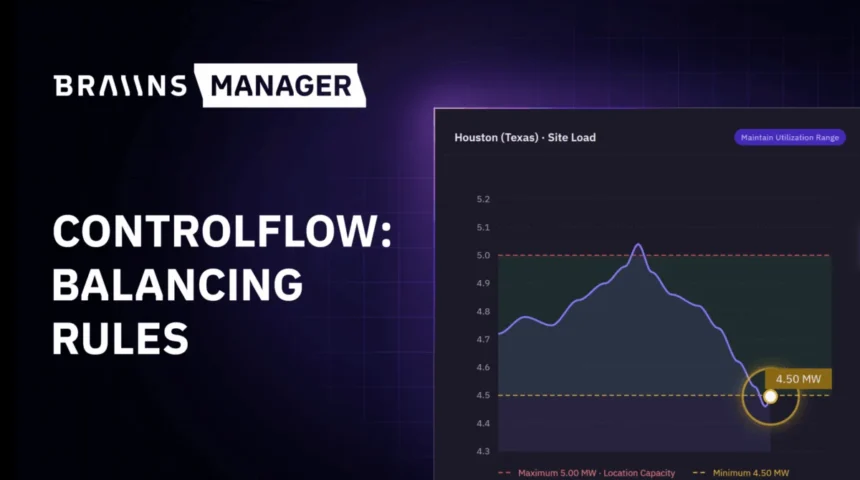
Braiins has announced a major update to its Braiins Manager Pro platform, introducing automated Balancing Rules within Controlflow alongside a suite of new fleet management enhancements, including sharable custom filters. The new features are designed to eliminate the labor-intensive processes traditionally required to manage electrical loads and site capacities in large-scale cryptocurrency mining operations.
Historically, maintaining a strict power threshold at a mining facility has demanded constant manual oversight. Operators typically monitor total load figures continuously, manually pausing or resuming miners to prevent overages when supply fluctuates or equipment drops offline. As grid conditions shift and power availability varies throughout the day, this manual intervention has to be repeated indefinitely, creating a persistent operational burden for site managers and infrastructure engineers.
The newly introduced Balancing Rules in Controlflow automate this entire cycle. By establishing a maximum, a minimum, or a dual threshold within the platform, operators can allow Controlflow to dynamically pause or resume only the exact number of miners required to keep the site operating smoothly within its designated electrical range. These rules are now live and fully available to users of Braiins Manager Pro.
A Balancing Rule operates by periodically evaluating the total power consumption of a designated target set of miners. This target can encompass an entire physical location or be narrowed down to specific groups, containers, and racks housed within the facility. During each automated check, the system compares the aggregate power usage against the configured limits and executes fleet adjustments if a discrepancy is detected.
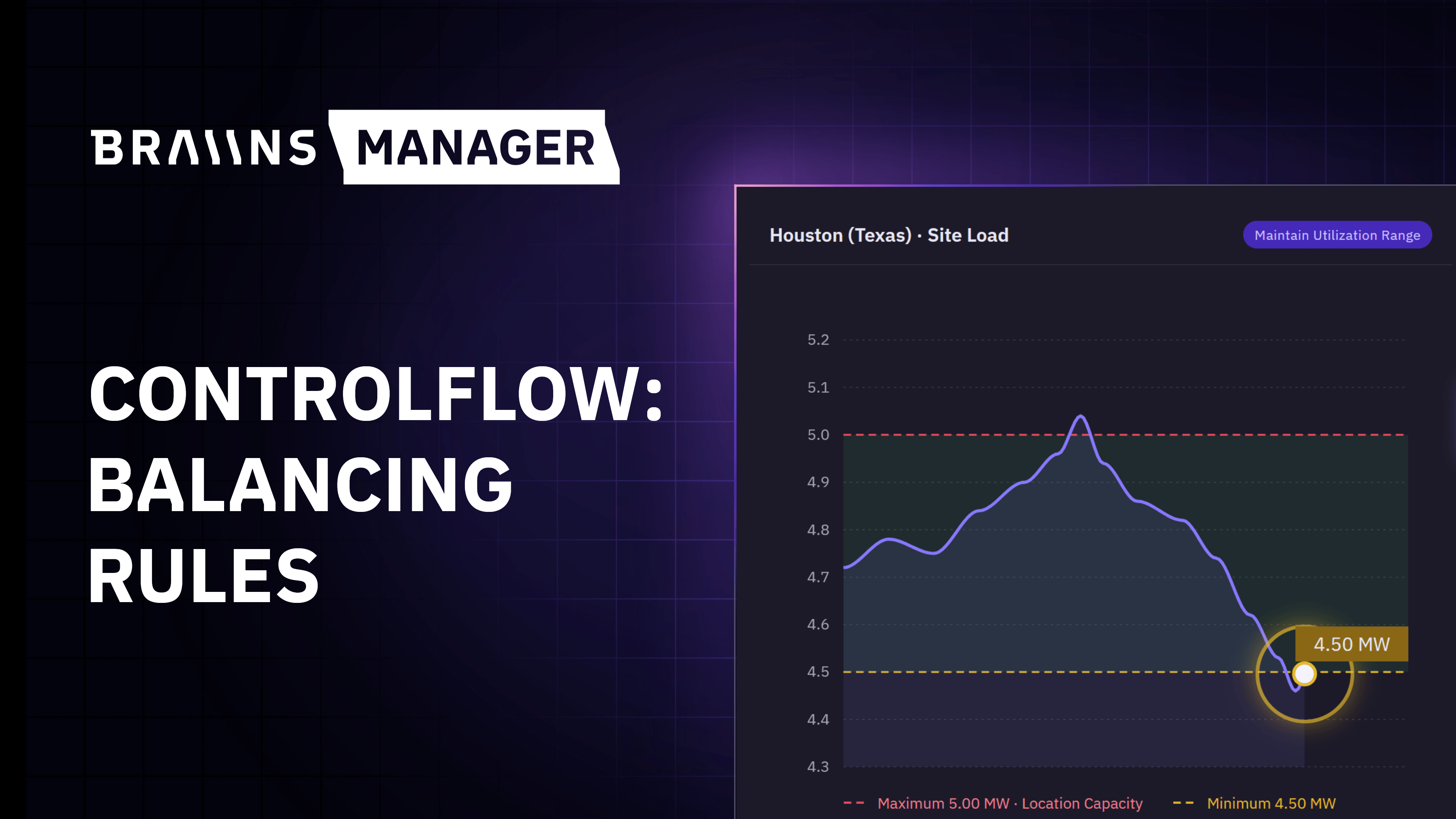
The scaling parameters governing these rules offer significant flexibility for site administrators. The maximum threshold can be configured as a fixed megawatt value or dynamically tied to the location’s total available capacity. When configured to follow the location’s capacity, the rule reads the current live value during every evaluation cycle, ensuring that any adjustments to site capacity are factored into the automation from the very next run. Because these balancing actions are achieved by pausing and resuming machines, the system operates seamlessly across both stock firmware and specialized environments running Braiins OS.
One of the primary operational considerations in automated load shedding is the preservation of electrical balance and hardware efficiency. Controlflow provides administrators with distinct options regarding how the system selects which miners to adjust. By default, the platform utilizes a random selection method, which spreads pauses evenly across the target site. While effective in uniform environments, facility layout must be considered. In operations where older hardware models, such as S19s, and newer units, like S21 XPs, are housed in separate containers connected to independent transformers, a purely random pause strategy could inadvertently draw all curtailment cuts from a single container. This scenario would leave one transformer running near idle while another operates at maximum capacity.
To address mixed-fleet realities, Braiins Manager Pro includes an efficiency-based selection option. When configured to adjust by efficiency, the platform ranks every miner across the facility based on its measured Joules per Terahash. When the site is forced to curtail load, the least efficient machines are paused first. Conversely, when power capacity returns and normal operations resume, the most efficient miners are brought back online first. In a heterogeneous fleet, this ensures that older generation machines are taken offline before modern hardware, allowing the facility to maintain the highest possible active hashrate while strictly adhering to its power boundaries.
The automation system is also designed to integrate smoothly with existing power curtailment protocols. Balancing Rules respect active curtailments by default. If any miner within a rule’s target group is currently subjected to an active curtailment event, the system skips that specific check and refrains from making overlapping adjustments. This prevents competing control loops from working against each other. Without this safeguard, a standard power rule might evaluate historical readings captured before a curtailment took effect and erroneously pause machines that were already offline. By accounting for active curtailments, the system ensures that subsequent evaluations rely on accurate, real-time data and execute precise, single-pass adjustments.
Transparency and auditing capabilities are built directly into the Controlflow interface. Every evaluation run is logged in the Controlflow History tab, providing a comprehensive record even for checks where power levels remained stable and no adjustments were required. Operators can inspect past runs to review the exact machines that were paused or resumed during a specific cycle, along with the precise rule settings active at that moment. Upcoming evaluation cycles are displayed in an upcoming events calendar alongside existing trigger-based and scheduled rules. Furthermore, Balancing Rules adhere to the hierarchical priority order established across the platform’s rule engine. If a higher-priority rule has already modified the state of a specific miner during a given evaluation cycle, lower-priority rules are instructed to leave that machine untouched for the duration of that cycle.
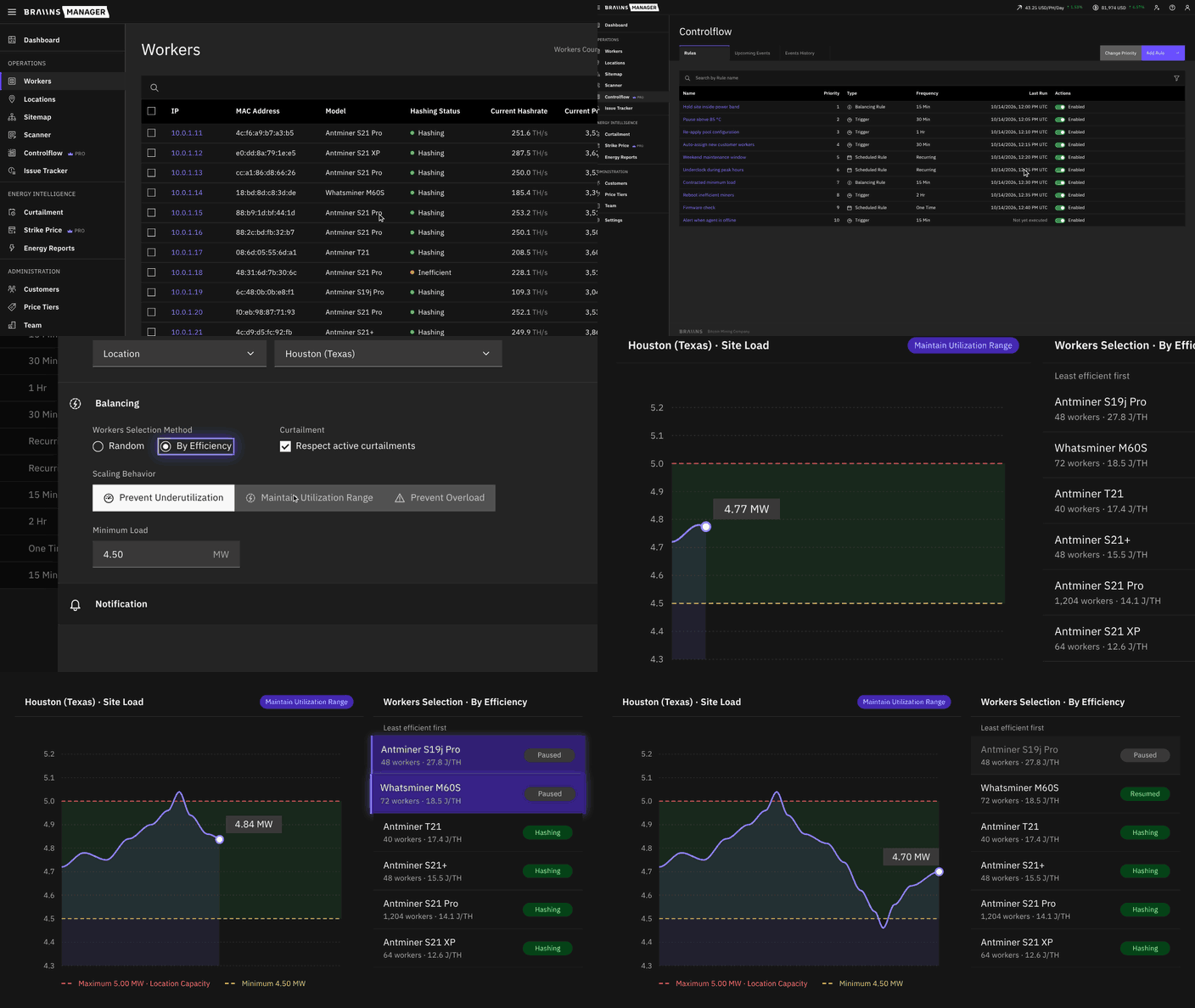
In addition to automated load balancing, the latest update introduces sharable custom filters within the Workers list. Expanding beyond traditional categorical filtering, the new Filter Builder allows administrators to construct filters based on specific, measured operational values rather than static categories. Users can define custom criteria, assign a name, and save the filter directly to their account, making it accessible across any browser or connected device.
These custom definitions can be shared selectively with specific site locations or across an entire company, ensuring that engineering and operations teams maintain a unified standard for metrics such as thermal thresholds or underperforming hardware. To maintain data security and operational boundaries, shared filters automatically restrict visibility, ensuring that individual users can only view miners and metrics they already possess authorization to access. While these advanced custom parameters live in a new saved tab, the familiar one-click categorization options remain readily available in the quick tab for rapid navigation.
Braiins Manager Pro users can access the new Balancing Rules immediately. Organizations interested in evaluating the updated Controlflow capabilities can initiate a trial of the Pro tier or consult the implementation guides provided through Braiins Academy. The development team has also encouraged users to share feedback and participate in ongoing discussions regarding future platform updates through the official Braiins Manager community channels.

Related News