Small Caps Trade Like Bond Proxies as Markets Navigate Crowded Positioning and Surprising Bond Rallies
By RIA Team | October 22, 2026 | 7 min read
The Russell 2000 Index of small-cap stocks has fallen 8.2% since late June, struggling to find momentum during a stretch where the broader S&P 500 has repeatedly set record highs. Over the past four months, small caps have notably lagged behind their large-cap counterparts, though they have shown a tendency to trade better whenever bond yields decline. This correlation is far from accidental. Recognizing why small-cap stocks remain tightly linked to bond yields helps illuminate the fundamental structural differences dividing smaller domestic firms from mega-cap corporate giants. Unlike large-cap powerhouses, smaller companies face three distinct, structural interest-rate sensitivities that amplify their vulnerability to macroeconomic shifts.

Given the persistent environment of high borrowing costs over recent quarters, small caps have clearly underperformed the broader equity market. While they are positioned to potentially outperform large caps should yields continue their descent, market analysts caution that the context of falling yields matters immensely. If yields drop rapidly due to acute credit concerns or an overarching economic growth scare, the theoretical yield benefit for small-cap companies could be diminished or even prove detrimental to their underlying business health.
This dynamic is clearly reflected in historical and current correlation metrics. The rolling 30-day correlation between the Russell 2000 and the 7- to 10-year U.S. Treasury has averaged 0.41 throughout 2026, marking a sharp departure from the 0.11 average recorded over the prior four-year period. This relationship even spiked to a peak of 0.87 in May. By contrast, historical readings before this year frequently oscillated around zero and spent prolonged stretches in negative territory, plunging as low as -0.83 during the regional banking stress of March 2023.
Market Trading Update and Retail Sentiment
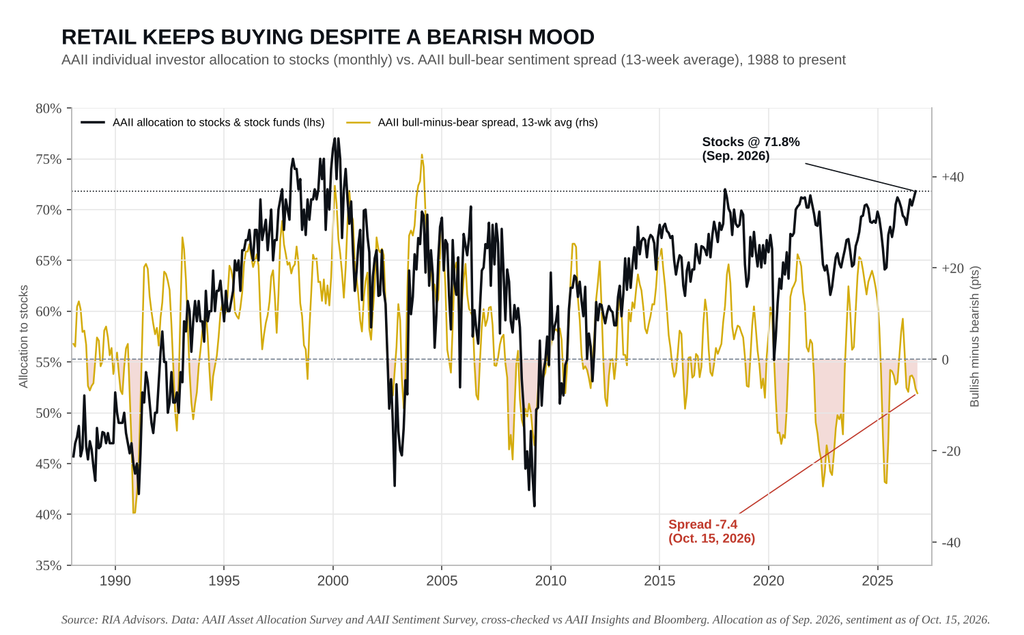
As the market navigates this ongoing correction, a critical question emerges regarding market positioning: who actually holds the equities if the leadership of megacap stocks finally rolls over? Michael Wilson and other market strategists have argued that the current correction may not fully run its course until megacap leaders experience a downward rotation. Recent retail stock allocation data provides a definitive answer as to who is exposed, revealing that individual retail investors—often referred to as "Main Street"—currently hold a higher percentage of their portfolios in equities than at almost any point in the last 25 years.
According to asset allocation surveys monitored across the financial industry, individual investors are maintaining roughly 71.8% of their portfolios in stocks. Aside from a brief reading of 72% at the close of 2017 just prior to the market volatility event known as "Volmageddon," observers must look all the way back to the peak of the 2000 tech bubble to find a comparable level of equity exposure among retail participants. A notable divergence has developed where retail stock allocation steadily climbs higher, even as the bull-minus-bear sentiment spread rolls over into negative territory.
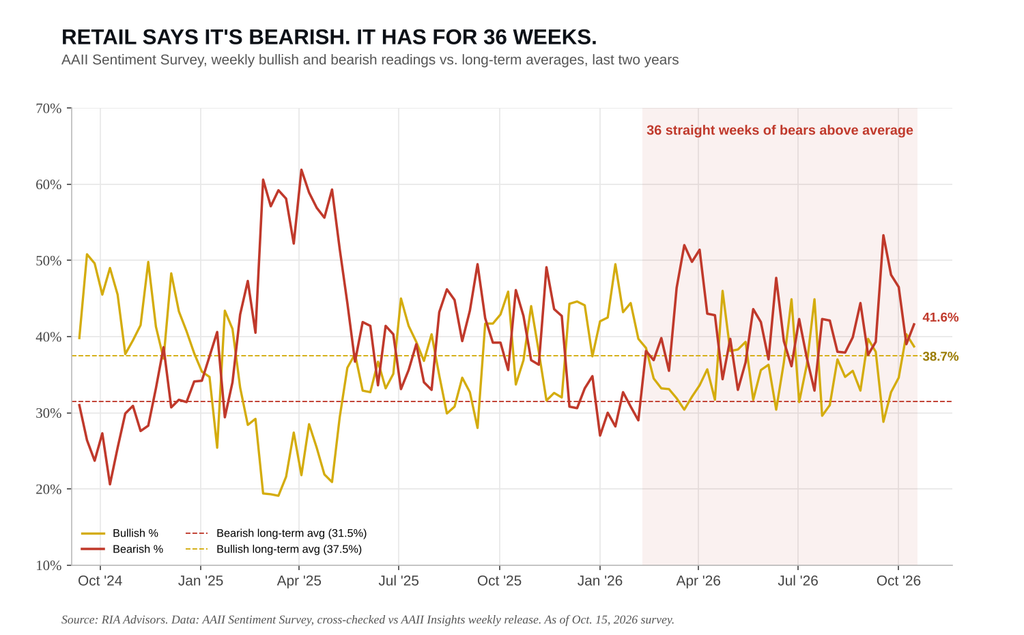
Market sentiment surveys indicate that bearish attitudes remain elevated. Weekly sentiment readings show that the percentage of bears has consistently run well above the long-term historical average of 31.5% for dozens of consecutive weeks. Traditional contrarian theory often treats heavy bearishness as a reliable buy signal. However, sentiment typically only alters market dynamics when it drives a corresponding change in investor behavior. So far, that behavior has not materialized; retail investors report feeling anxious in surveys while simultaneously keeping their brokerage accounts fully deployed in the market. When investors state that they feel afraid while remaining fully invested, that fear acts less like a protective cushion and more like a tripwire waiting for a catalyst.
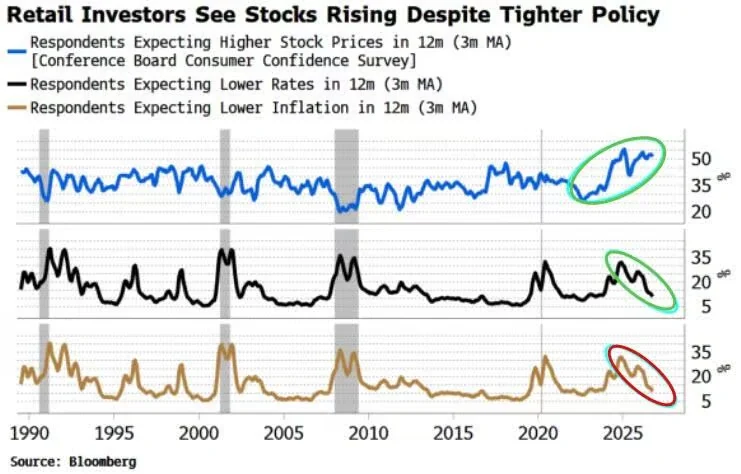
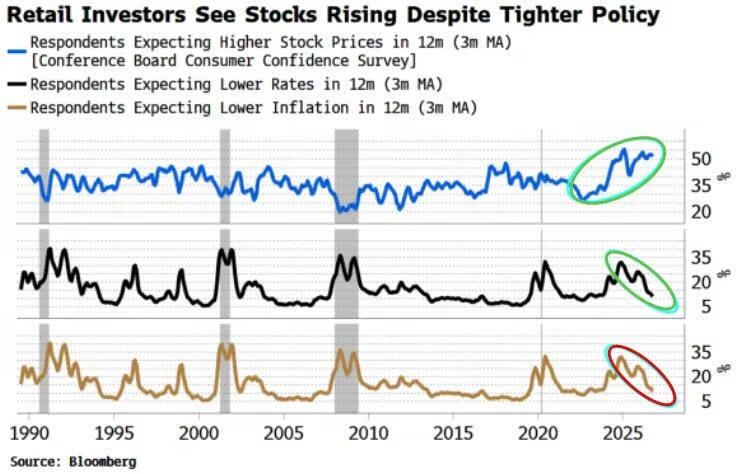
Broader consumer confidence data mirrors this internal split. More than half of surveyed respondents expect stock prices to push even higher over a 12-month horizon, reaching near 35-year highs for that specific sentiment series. Concurrently, the share of respondents anticipating lower interest rates and reduced inflation has declined sharply in recent months. Retail participants are largely expecting equity markets to advance even as the broader policy backdrop becomes less accommodating.
These positioning trends unfold against a backdrop where prominent financial figures, including notable market critics and institutional leaders, have increasingly described elements of the current technology and AI landscape as a bubble. The true consensus among professional observers is not necessarily found in unified economic forecasts, but rather in the crowded nature of market positioning. When nearly all market participants are already heavily long, the pool of marginal buyers becomes remarkably shallow the moment an unexpected macroeconomic or geopolitical shock arrives.
This environment warrants tactical adjustments rather than a wholesale exit from equities. Portfolio models continue to hold technology exposure at target weights without adding new capital, while systematically rebalancing from megacap strength toward sectors that have already undergone significant corrections. Major market indexes retain specific technical thresholds that serve as definitive risk-management lines to raise cash and implement portfolio hedges. Maintaining disciplined allocations remains essential, particularly for investors whose equity exposure has drifted upward over years of rising markets.
SpaceX Reports Strong Initial Public Earnings
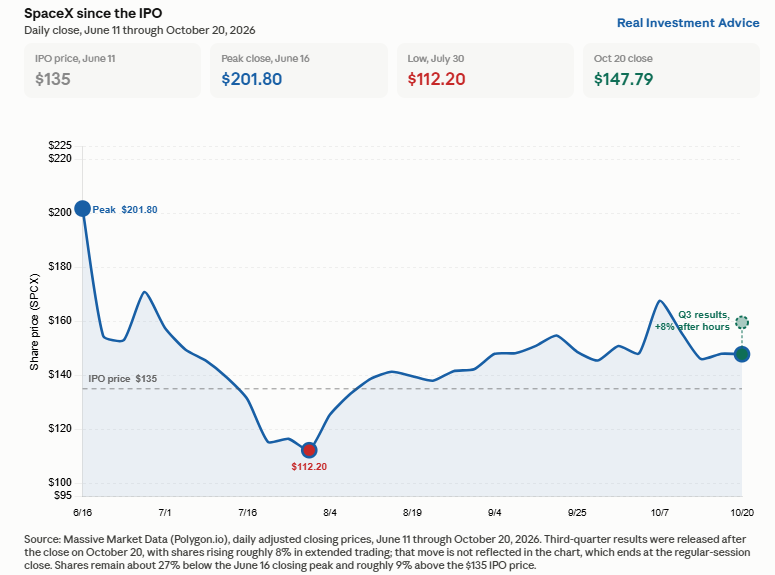
SpaceX shares experienced an upward surge following the release of the company’s first quarterly financial report as a publicly traded corporation. The aerospace and satellite enterprise posted robust revenue figures that substantially outperformed Wall Street consensus expectations, driven by rapid scaling across its primary operational segments. Net income also rebounded significantly compared to the losses recorded during the same period in the previous fiscal year.
Even as revenues exceeded expectations, corporate expenditures scaled up aggressively to fund ongoing strategic initiatives. Capital expenditures for the quarter substantially outpaced incoming revenue, with the vast majority of those funds directed toward expanding the company’s advanced infrastructure and intelligence business segments. Year-to-date capital expenditure totals reflect a heavy reinvestment cycle aimed at securing long-term operational dominance.
This dynamic illustrates an unusual financial combination: a high-growth enterprise posting substantial profit metrics while simultaneously committing capital expenditures that significantly exceed its immediate revenue streams. Under standard accounting practices, heavy capital expenditures are treated as a conversion of cash into durable property and equipment rather than an immediate operating expense. The financial impact of these investments flows onto the income statement gradually through depreciation over the useful life of the assets, smoothing the cost profile over time.
Consequently, the company’s free cash flow experienced a temporary contraction during the quarter. However, substantial cash reserves secured through its initial public offering provide a strong liquidity cushion, ensuring the firm will not need to rely heavily on traditional capital markets for borrowing in the near-term future. Additionally, corporate leadership has indicated that exploratory discussions have been initiated regarding potential structural evaluations between related corporate entities.

Are Bonds Pricing In A Fed Policy Mistake?
The behavior of the U.S. Treasury market has continued to perplex professional traders and economists alike. Consider a scenario where consumer price inflation reports print above expectations, producer price indexes surge well past consensus forecasts, and crude oil prices climb steadily higher over a multi-week period. Standard market intuition suggests that such acute inflationary pressures should drive bond yields higher as traders price in a more aggressive monetary policy stance from the Federal Reserve.
Yet, recent market episodes have defied these traditional expectations. Following hotter-than-expected inflation releases, benchmark 10-year and 30-year Treasury yields experienced sharp initial spikes before subsequently reversing course and moving markedly lower. Rather than selling off in the face of persistently elevated inflation data, the bond market staged a notable rally.
Prominent financial analysts and bond market experts have raised pressing questions regarding this disconnect. While several rationalizations have been offered—ranging from shifts in structural liquidity to technology-driven economic efficiencies—market observers increasingly emphasize a more concerning possibility: the fixed-income market may be beginning to price in the distinct risk that the Federal Reserve is being pushed into making a significant policy error. As central bankers navigate competing pressures between sticky inflation readings and underlying economic fragilities, the bond market’s unexpected response highlights growing anxiety over the future path of monetary policy.

Related News