Are Bonds Pricing In A Fed Policy Mistake?

By Michael Lebowitz | October 21, 2026
Imagine looking into a crystal ball at the beginning of October and learning that the upcoming September Consumer Price Index (CPI) data would run higher than expected, while producer prices (PPI) would surge 1.3% for the month—well above the 0.5% market forecast. Compounding that unfavorable inflation news, forecasters also noted that additional inflationary pressures were actively brewing, driven by a $10 jump in crude oil prices through just the first two weeks of the month. Based on that foresight, where would you reasonably expect the 10-year U.S. Treasury yield to land? To put that in perspective, the 10-year U.S. Treasury yield was already flirting with 5.25% on October 1. Most professional bond traders likely would have guessed 5.50% or even higher.
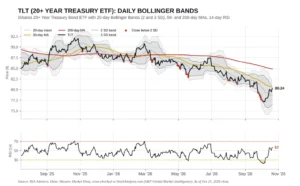
Yet, reality defied conventional expectations. On October 14, the 10-year Treasury yield did initially surge following the hotter-than-expected CPI report, hitting 5.33% minutes after the release. However, just a few days later, it dropped markedly to 5.03%. The 30-year yield fell by a similarly striking magnitude. In short, the bond market rallied directly into the teeth of bad inflation data.
The counterintuitive market movement prompted Mohamed El-Erian, the former CEO of PIMCO and a renowned bond market expert, to raise the obvious question on social media: Why are U.S. government bond yields falling despite hotter-than-expected CPI and PPI inflation prints?
El-Erian offered two valid rationalizations for the phenomenon. Expanding upon his insights, market analysts have since added two additional explanations. Crucially, observers emphasize one primary driver that may matter most: the bond market could be starting to price in the growing risk that the Federal Reserve is being pushed into a severe policy mistake.

Explanation One: A Flight To Quality Out Of Tech
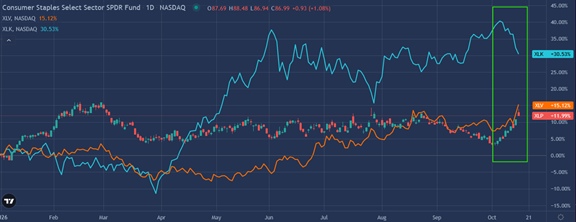
El-Erian’s first identified driver centers on a flight to quality, specifically out of formerly high-flying technology stocks that are increasingly coming under intense pressure.
In addition to equity market jitters, El-Erian noted emerging pockets of credit stress forming within the most vulnerable segments of the corporate debt market. Highlighting this trend, CoreWeave, a prominent data center provider, watched yields on its debt spike dramatically from 9% to 15%. Because investors are demanding such exorbitant yields for CoreWeave’s debt and the debt of several of its competitors, a growing anxiety has taken hold that CoreWeave might represent the AI trade’s canary in the coal mine.
Credit-related stress of this nature frequently triggers a flight to quality, prompting capital to rotate away from corporate credit and into the relative safety of U.S. Treasuries, thereby pushing yields down even when broader inflation prints run hot.
Explanation Two: Is Tech Still A Growth Engine?
El-Erian’s second driver carries much broader macroeconomic implications for the global economy. Artificial intelligence-related capital spending has served as a primary engine of recent economic growth. However, if investors grow increasingly hesitant to fund the massive ongoing AI infrastructure build-out, and if corporations find themselves unable to comfortably afford that financing, the broader economic growth outlook inevitably dims.
Charu Chanana of Saxo noted that investors are clearly becoming less willing to finance AI infrastructure growth at any cost. With 10-year yields sitting comfortably above 5% and select AI-related credit spreads widening to junk bond levels, the overall cost of financing critical data centers has risen sharply. Less AI capital expenditure directly translates to lower gross domestic product (GDP) growth. In turn, lower expected economic growth naturally argues for diminished future inflation, which ultimately justifies lower long-term bond yields.
Explanation Three: Short Covering And Signs Of Significant Demand
Beyond El-Erian’s framework, market mechanics played a critical role in the October bond rally, starting with aggressive short covering. The bond market entered October heavily positioned for higher yields.
According to Commodity Futures Trading Commission (CFTC) data highlighted by Bloomberg, asset managers added more than 100,000 contracts to their short 10-year Treasury futures exposure during the week ending September 22, marking one of the largest weekly position increases since 2023. Furthermore, open interest in 10-year futures rose in 13 of 14 trading sessions through late September, while 5-year futures open interest increased in 11 of 12 sessions. These metrics consistently pointed to the aggressive addition of new short positions as yields climbed.
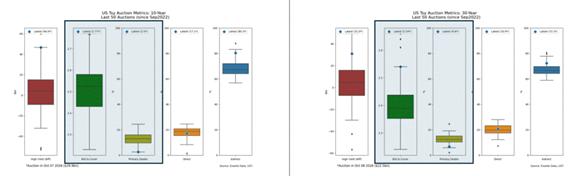
However, the 10-year and 30-year Treasury auctions held on October 7 and October 8 effectively foreshadowed the impending market reversal. Many market participants had anticipated exceptionally weak demand for the newly issued government debt supply. Instead, they encountered the exact opposite outcome.
The 10-year note auction sold $39 billion at a high yield of 5.300%, stopping 1.7 basis points through the when-issued level, meaning it cleared at a much stronger rate than the market anticipated. The subsequent 30-year bond auction of $22.5 billion followed a very similar trajectory. Statistical box plots courtesy of Exante Data illustrated how far outside normal parameters both readings landed. The bid-to-cover ratio, which measures the amount of dollars bid for every dollar sold, came in at 2.77 for the 10-year note compared to a twelve-month average of 2.51, representing a higher reading than any of the previous 50 auctions. The 30-year auction registered a bid-to-cover ratio of 2.54 against a 2.40 median, placing it at the upper edge of the last 50 auctions.
Primary dealer participation offered perhaps the most telling auction statistic. The U.S. Treasury’s primary dealers are required to bid and absorb whatever debt remains unsold by the broader market. When an auction features a high percentage of dealer take, it signals that the auction struggled and Wall Street was left holding unwanted inventory. By contrast, primary dealers took a mere 2.5% of the 10-year supply—marking their lowest share on record for that tenor—and only 6.8% of the 30-year supply. Meanwhile, indirect bidders, primarily foreign central banks and domestic institutional investors, snapped up 80.3% and 72.3% of the respective issues, both far exceeding historical averages.

When dealers are left purchasing such a minimal fraction of Treasury auctions, it demonstrates that real-money buyers are aggressively absorbing supply at yields above 5%. While the broader bond market did not experience an immediate rally during the auctions themselves, the results put short sellers on notice that robust demand existed at these elevated levels. This burgeoning demand likely triggered substantial Treasury bond buying designed to cover underwater short positions. Given how heavily offside the market had become, the resulting short covering created a powerful circular effect, forcing even more short sellers to buy back their positions.
Explanation Four: The Bond Market Smells A Policy Mistake
Underpinning these technical factors is a growing suspicion within the bond market that this month’s hot inflation data will ultimately force the Federal Reserve’s hand toward more rate hikes rather than fewer, culminating in a classic policy error.
The shifting shape of the yield curve over the course of two weeks strongly supports this perspective. The spread between the 2-year and 10-year Treasury yields stood at 57 basis points on October 7. Following the subsequent CPI and PPI reports, the curve flattened dramatically to 32 basis points. This represents a substantial 25-basis-point curve compression in just two weeks, with the vast majority of the flattening occurring precisely on the days the inflation data was released.
When all yields decline, but long-term yields fall faster and further than short-term yields, financial markets define the dynamic as a bull flattener. A market that anticipates the Fed will continue tightening monetary policy into a slowing or weakening economy will aggressively buy long-term bonds, thereby flattening the yield curve. Conversely, a market genuinely fearing runaway inflation would typically trigger a bear steepener reaction. As market observers note, the front end of the yield curve prices the immediate odds of Federal Reserve rate hikes, whereas the long end prices the ultimate consequences.
Reasons To Fret A Policy Mistake
Several distinct economic factors validate the bond market’s growing anxiety regarding potential Federal Reserve miscalculation.
First, the recent acceleration in inflation is predominantly a supply-driven shock. Gasoline and diesel prices have climbed largely due to geopolitical conflict involving Iran rather than an overheating domestic consumer base. The central bank possesses no mechanism to produce oil, yet its primary policy tool remains capable of crushing demand for everything else in the economy.
Second, underlying labor market indicators show clear signs of softness. September nonfarm payrolls rose by a meager 29,000, and payroll figures for prior months underwent downward revisions totaling 60,000 jobs. Additionally, the unemployment rate ticked upward to 4.2%, while real earnings remained flat to slightly negative, leaving virtually no empirical evidence of an inflationary wage-price spiral.
Third, everyday consumers are facing an undeniable squeeze. While the most recent retail sales figures beat consensus estimates with a 0.8% increase, surging gasoline purchases accounted for the vast majority of the gain. The Control Group metric, which the Bureau of Economic Analysis utilizes directly in its GDP calculations, rose by a modest 0.1%. In essence, higher energy prices are crowding out discretionary consumer spending elsewhere in the economy.
Fourth, monetary policy is already restrictive by the central bank’s own mathematical models. The September rate hike pushed the federal funds rate target to a range of 3.75% to 4.00%, placing it above the Fed’s own long-run neutral rate estimate of 3.20%. Furthermore, the median dot plots contained within the latest Summary of Economic Projections (SEP), alongside commentary from various Fed officials, indicate that another rate hike or two remains entirely possible.
Finally, broader financial conditions are already tightening significantly on their own. With the 10-year Treasury yield hovering above 5%, 30-year mortgage rates approaching 7.50%, the U.S. dollar reaching an 18-month high, and corporate credit spreads widening, the financial system is already doing the heavy lifting for the Fed. Implementing additional federal funds rate hikes risks rendering financial conditions overly restrictive.

The Hawk’s Case
To be fair, Federal Reserve hawks maintain a logically consistent rationale for advocating further interest rate increases. The recent CPI report demonstrated broader price increases spanning a wide array of goods and services, core Personal Consumption Expenditures (PCE) inflation continues running near 3%, and, most importantly, inflation has stubbornly remained above the central bank’s stated 2% target for more than five years. The Fed faces legitimate justification for worrying that long-term inflation expectations could become unanchored.
However, the bond market is not casting a vote on whether current inflation is too high or what past inflation prints have measured. Instead, the market is voting on where future inflation is headed and whether the central bank’s aggressive medicine will not only cure the patient of its inflation ailment but simultaneously induce severe recessionary side effects.
Summary
The emergence of falling bond yields in the face of hot inflation data represents no true paradox. Rather, it reflects a multifaceted financial environment characterized by a flight to quality out of technology equities, rising skepticism regarding artificial intelligence as an enduring economic growth engine, the orderly unwinding of crowded short positions, and strong institutional demand at higher yield levels.
Most critically, these market movements signal a deep-seated concern that the Federal Reserve risks responding improperly to an energy-driven supply shock by tightening monetary policy directly into a slowing economy. The changing shape of the yield curve and the decisive downward trajectory of long-term yields offer a revealing roadmap for the economic challenges that may lie ahead.

Related News