Neocloud Debt Strain and Market Divergence Signal Shifting Risks for Datacenter Stocks and the Broader Economy
By RIA Team | October 21, 2026 | 6 min read
The turbulence surrounding specialized artificial intelligence infrastructure providers intensified sharply this week, casting a harsh light on the structural vulnerabilities within the booming datacenter ecosystem. Elice Group made a tumultuous debut on South Korea’s Kosdaq exchange, suffering a punishing decline of roughly 30% in its initial trading session. The steep drop followed closely on the heels of another major setback in the sector: just a week prior, the Nvidia-backed firm Firmus shelved its highly anticipated $5 billion initial public offering.
These developments mirror mounting pressures felt closer to home, as evidenced by the dramatic stress in CoreWeave’s debt instruments. CoreWeave’s 2032 debt has seen its yield skyrocket to near 15%, a massive jump from below 10% just a week earlier. To fully grasp the underlying mechanics driving this sudden reassessment of datacenter stocks, investors must examine the fundamental divergence between the business models of independent "neocloud" providers and the massive, cash-rich tech titans known as hyperscalers.
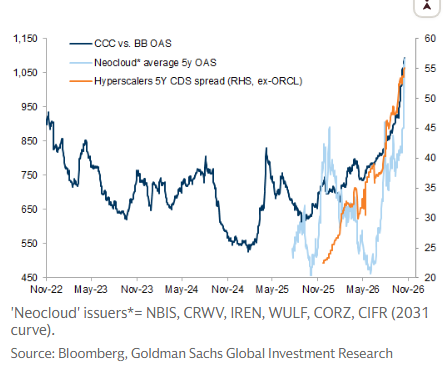
Neocloud companies operate primarily on a spread business model. They typically leverage debt financing to acquire expensive graphics processing units (GPUs), rent out that high-performance compute capacity to clients, and capture the difference—the spread—after accounting for debt service costs and equipment depreciation. This model can generate impressive profitability when product demand is sky-high and debt financing is readily available at low costs.
However, the macroeconomic environment has shifted dramatically. Financing has become increasingly expensive for independent neocloud firms. Credit default swaps (CDS) for neocloud companies are currently hovering at over 1,000 basis points, compared to a remarkably stable 55 basis points for large hyperscalers.
In stark contrast, hyperscalers operate within an entirely different financial framework. Industry giants such as Microsoft, Amazon, Alphabet, and Meta are projected to pour roughly $800 billion this year alone into building out advanced compute capacity. Unlike their neocloud counterparts, these technology behemoths fund the vast majority of their massive capital expenditures through robust operating cash flows, shielding them from heavy reliance on volatile debt and equity markets.
Furthermore, hyperscalers largely serve as their own primary customers, meaning that any short-term fluctuations or declines in external datacenter rental rates have minimal impact on their core operations. Their overarching customer bases span thousands of diverse enterprises rather than being concentrated among a small handful of counterparties.
Should neoclouds find themselves forced to cut back capacity or liquidate their GPU inventories prematurely simply to service their burdensome debt obligations, the balance of power could shift. Hyperscalers stand to gain immense pricing power regarding future GPU purchases and rentals, while also gaining opportunistic openings to acquire distressed datacenter capacity at bargain prices.
At the same time, a sudden wave of used GPUs flooding the secondary market could depress the resale value of existing hardware and signal to the broader market that compute scarcity is finally easing. Such a shift would inevitably carry heavy implications for major semiconductor manufacturers, whose current chip pricing trends are already sending cautious signals across the technology landscape.
Market Trading Update and the Tech Sell-Off
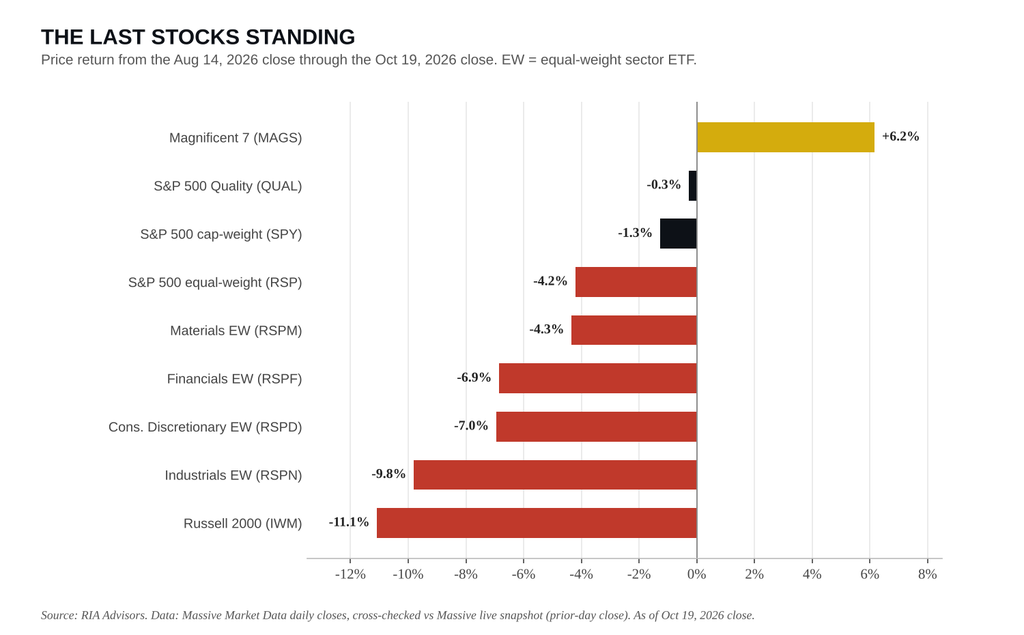
The recent breadth reversal beneath the broader megacap sell-off has sparked intense debate regarding whether the market is merely correcting or setting up for a more durable run into year-end. Market strategist Michael Wilson of Morgan Stanley has argued that the current equity correction is unlikely to reach a definitive conclusion until the last stocks standing—specifically the dominant "Magnificent 7" megacaps—finally catch down to the valuations of everything else.
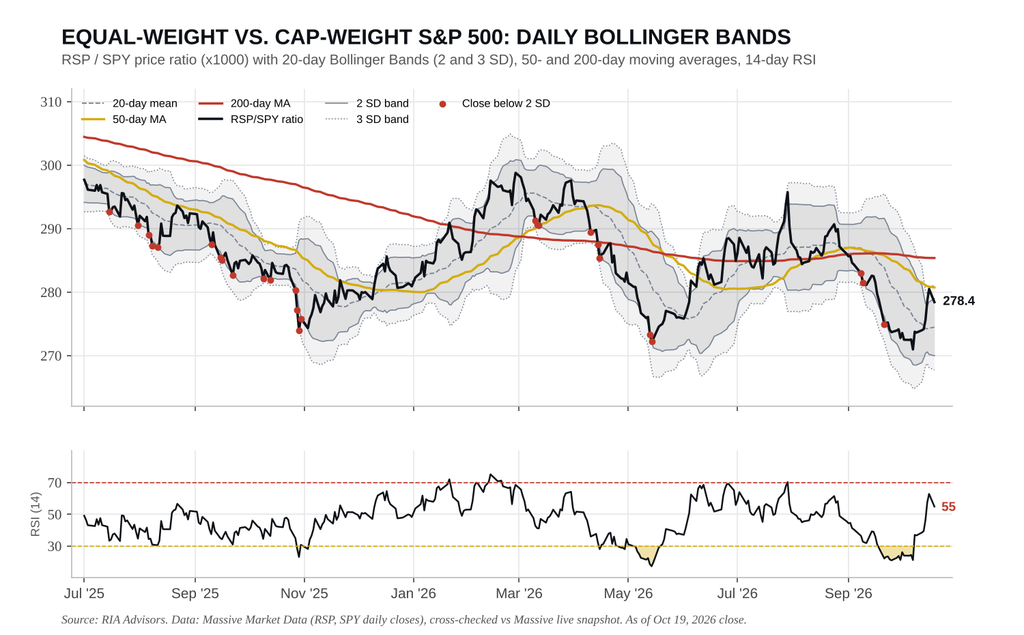
For the average stock, however, the underlying damage is already well underway. From the market close on August 14 through Monday’s session, the equal-weight S&P 500 index retreated 4.2%, while the traditional cap-weighted S&P 500 slipped a modest 1.3%. Damage was even more pronounced in specific corners of the market: equal-weight industrials lost 9.8%, and the small-cap Russell 2000 tumbled 11.1%. Over that exact same stretch, the Magnificent 7 index managed a 6.2% gain. For many analysts, this divergence encapsulates the primary structural imbalance in current equity trends.
Morgan Stanley’s internal research highlights a similar pattern across corporate quality factors. Their dedicated quality factor index has advanced roughly 6% since mid-August, recently breaking out to a fresh 52-week high. Meanwhile, the earnings revisions gap separating high-quality companies from low-quality companies stands near 10 percentage points, representing the second-widest spread recorded since 2010.

Furthermore, Morgan Stanley’s proprietary financial conditions composite—which factors in prevailing yields, the U.S. dollar, and energy prices—has tightened to levels not seen since 2022. In practical terms, the private market and monetary tightening have already completed a significant portion of the Federal Reserve’s work, with the average stock bearing the financial cost.
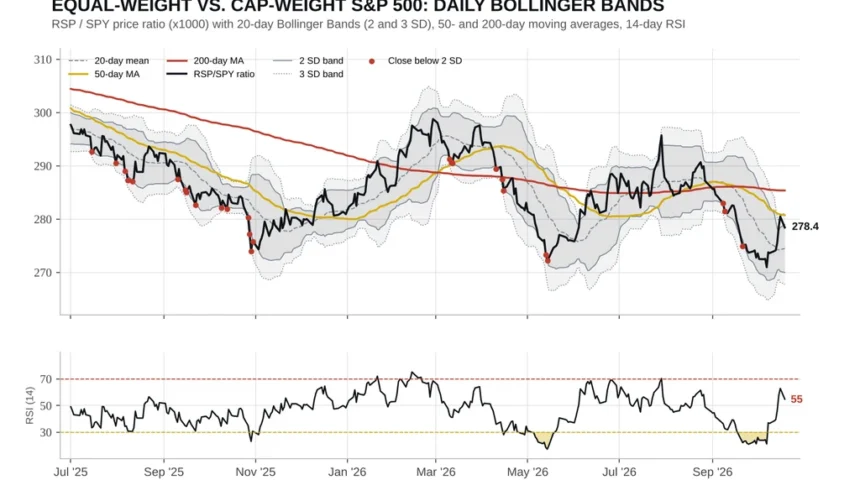
Technical indicators underscore this divergence. The ratio of the equal-weight S&P 500 to the cap-weighted S&P 500 touched 270.97, marking its weakest reading since mid-2024, with the Relative Strength Index (RSI) buried below 30. While a subsequent weekly bounce offered temporary relief, the ratio remains suppressed below both its 50-day and 200-day moving averages. While a single strong week does not constitute a regime change, it signals a technical setup that demands close attention.
Wilson’s core thesis is that mid-cycle corrections frequently conclude only when market-leading blue chips experience a sympathetic pullback. As an enduring Wall Street axiom suggests, a true market washout is never finished until heavy selling finally reaches the favored holdings that nobody wanted to part with.
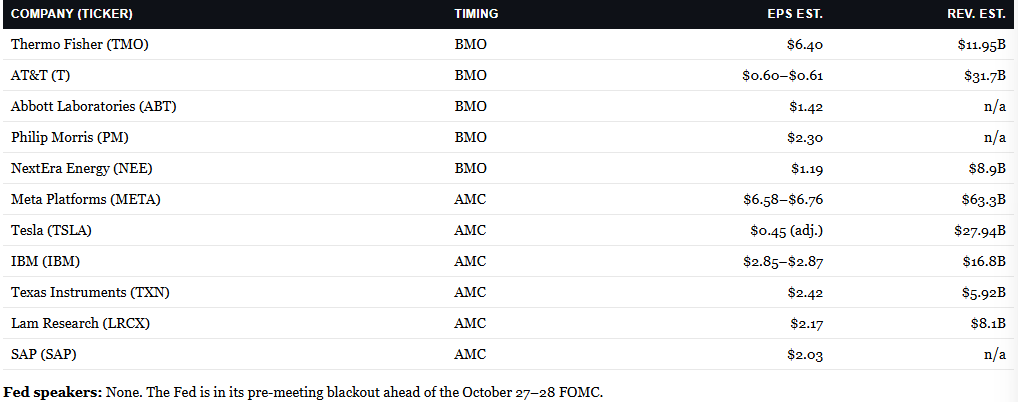
This theory faces an immediate test with a heavy slate of high-profile corporate earnings reports scheduled after the closing bell, featuring giants such as Meta, Tesla, IBM, Texas Instruments, and Lam Research. With the S&P 500 hovering near 7,682—roughly 1.8% below its record high set earlier in the month—the current market posture remains defensive. Portfolio management strategies continue to hold technology allocations at target weight ahead of earnings while avoiding new additions, utilizing strength in megacaps to rebalance toward out-of-favor sectors that have already absorbed their cyclical correction.
CoreWeave, Corporate Credit, and the Federal Reserve
A recent analysis published by Bloomberg Opinion sheds light on a broader economic dynamic, describing corporate credit as monetary policy’s "sleeping giant." For roughly four years, the corporate credit market largely failed to transmit the Federal Reserve’s aggressive interest rate hiking cycle directly to the real economy. However, the emerging bond rout at CoreWeave and other neocloud firms suggests that this disconnect may finally be closing.
The mechanics of this delay are straightforward. Many major corporations locked in ultra-low borrowing costs during the pandemic era. When the Federal Reserve embarked on its monetary tightening campaign in 2022, the immediate financial impact on established enterprises was surprisingly muted. Returns on corporate cash balances repriced rapidly to higher prevailing yields, while their existing debt liabilities repriced at a glacial pace as individual bonds slowly matured.
Data compiled by the Bureau of Economic Analysis indicates that corporate net interest payments rose by approximately $86 billion over a five-year span, while nonfinancial corporate profits expanded by roughly $1.2 trillion during the same period.
Now, as that wave of low-cost, pandemic-era debt approaches maturity, the lagged effects of higher interest rates are finally taking hold, reconnecting monetary policy directly to baseline financial conditions. High-yield corporate bond yields have drifted to their highest levels since 2025, while investment-grade yields sit at peaks last witnessed in 2023. Approximately one-quarter of the Bloomberg U.S. High Yield index consists of debt instruments scheduled to mature within the next one to three years.
This shift carries critical implications for monetary policy. Analysts distinguish between a healthy tightening cycle that merely cools speculative AI capital spending while component supply chains catch up—ultimately assisting the central bank in returning inflation to its target—and a disorderly widening of credit spreads that threatens to transform an orderly refinancing cycle into a broader corporate funding crisis. As these systemic pressures mount, interest rate futures indicate that the market is pricing in high probabilities that the Federal Reserve will hold benchmark interest rates steady in its upcoming policy decision.

Related News