How Wartime Ukraine is Forging a Decentralized Renewable Energy Future Under Fire
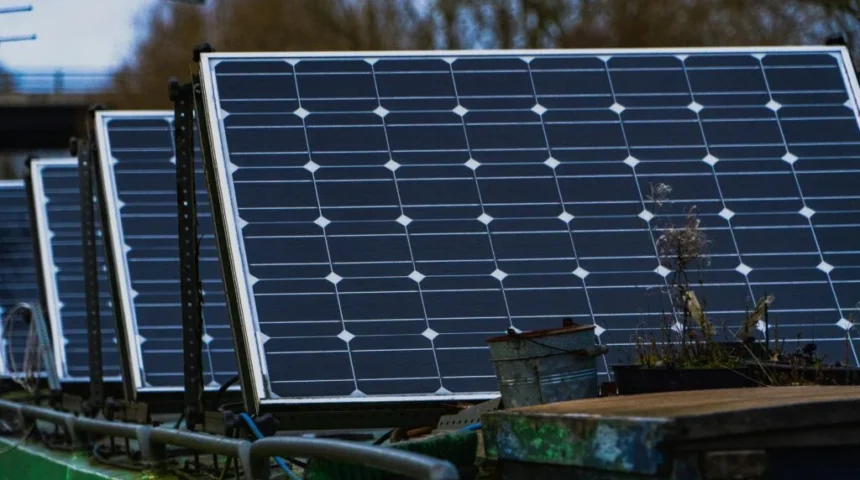
When waves of Russian airstrikes crippled Ukrainian power plants across the country earlier this year, most of the Black Sea port city of Mykolaiv in southeastern Ukraine was suddenly unable to pump fresh water to its residential housing blocks. Yet, in an easterly suburb of the city, clean drinking water continued to flow steadily from kitchen taps—just as it had throughout the previous year. The lifeline was not connected to the battered central grid, but was instead powered by a small, off-grid solar field tucked inconspicuously into the neighborhood.
Funded by the Danish government, the installation features two sets of elevated solar arrays paired with battery storage that directly run the underground water pump on the premises. Olena Kondratiuk, a project manager at Ecoclub, a non-profit organization that assists Ukrainian municipalities in acquiring renewable energy systems, notes that even during the dim days of January and the depths of winter, there is just enough sunlight to keep the system operational.
The city of Mykolaiv, located only 60 kilometers from Russian-occupied territory, bore the brunt of intense fighting when the Russian military launched its full-scale invasion of Ukraine in 2022. The city was relentlessly pummeled with missiles, rockets, and cluster bombs that laid waste to homes, hospitals, schools, and local factories. The heavy bombardment also severely damaged the central water supply system, leaving a population of roughly half a million people near the frontline without regular access to running water.
For residents like Iryna, an older local woman, the return of water meant a drastic change in daily survival. Until the solar-powered facility began operating, the water coming out of her taps—when it dripped at all—was salty, having been drawn from a nearby estuary. To get potable water, she had to purchase it or fill plastic jugs at mobile public tanks, often relying on neighbors to help carry them up to her fifth-floor apartment. "Of course I’m happy to have running water again, I don’t care how," Iryna said.
Mykolaiv has emerged as a national pioneer in renewable energy solutions, with other districts in the city also relying on distributed solar technology to secure fresh water. Five large solar-powered desalination systems work to turn saline or polluted water into safe drinking water whenever the sun shines. During the night and on heavily overcast days, these systems draw power from the central grid, provided that the main infrastructure remains functional. Together, this setup—one of the largest of its kind in Europe—can supply 250,000 residents with 1.2 million liters of drinking water every day. Furthermore, the Mykolaiv children’s hospital and maternity hospital are scheduled to stabilize their energy supplies with solar panels over the course of this year, joining a dozen other medical and public facilities across the country undergoing similar transformations.
Since the onset of the war, Russia has relentlessly targeted Ukraine’s energy infrastructure. The attacks have predominantly focused on bulky, old-school thermal power plants and the sprawling, centralized national grid in an attempt to undermine the country’s war effort and break the morale of its civilian population. Last winter proved to be the most severe test yet. Coordinated assaults against coal, gas, cogeneration, and hydropower plants, alongside transmission networks and electrical substations, plunged massive swaths of the nation into irregular electricity and heating conditions as temperatures plummeted to minus 20 degrees Celsius. Many schools and public services that were forced to close after the Christmas holidays remain shut. Economists currently estimate that the total financial damage to Ukraine’s energy sector exceeds $56 billion.
US environmentalist Bill McKibben argues that Ukraine’s autonomous power sources are comparatively invulnerable to targeted attacks. In the modern era of drone warfare, McKibben writes, centralized and complex energy facilities have become sitting ducks for aerial strikes. In contrast, smaller, scattered generation sources equipped with batteries and independent local transmission grids—such as the solar installations in Mykolaiv—are much harder for Russian forces to strafe and significantly quicker to repair when damaged. This resilience stands in stark contrast to massive petrochemical refineries, which McKibben describes as some of the most complicated machines ever constructed by humanity, often spanning hundreds of acres. Filled with intricate equipment and highly flammable hydrocarbons, hitting a single corner with a drone can quickly trigger widespread flames and catastrophic structural damage.
This vulnerability of massive centralized facilities is echoed by industry insiders within Ukraine. Jeff Oatham of DTEK, Ukraine’s largest energy investor, points out that a traditional coal-fired power station represents a large, single target that a solitary missile can easily knock out of commission. By contrast, he notes that an equivalent amount of capacity damage at a wind farm would require roughly 40 missiles. Much like wind parks, a decentralized solar field can continue functioning even if portions of its infrastructure are temporarily damaged or knocked out of operation.
Driven by extreme necessity, Ukraine is revamping its national energy system at a rapid pace, prioritizing energy security and survival over climate protection goals. Levgeniia Kopytsia, a Ukrainian energy analyst at the Institute for Climate Protection, Energy and Mobility think tank, emphasizes that the country’s energy transition is far more than a political slogan. It is a security-driven transformation unfolding under extreme constraints, prioritizing decentralization, operational flexibility, and the speed of recovery. In wartime Ukraine, Kopytsia explains, renewables and local micro-grids are calculated security assets designed to boost systemic resilience and, ultimately, save lives.
Ukraine’s strategic shift away from fossil fuels actually began well before the full-scale invasion. Ongoing negotiations to join the European Union require the country to adapt to the bloc’s stringent climate criteria, and back in 2021, Ukraine formally pledged to phase out coal entirely by 2035. However, for critical national security reasons, current public figures regarding domestic energy production are restricted.
According to the International Energy Agency, Ukraine made strong strides over the past summer in rebuilding its energy network and bolstering the resilience of the system. The nationwide renewables rollout has been spearheaded by rooftop solar installations, small-scale utility photovoltaic generation, local battery storage, and biomass combustion facilities.
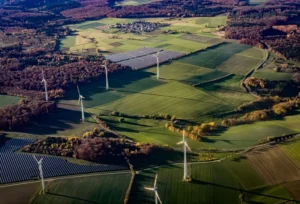
Before Russian forces seized three of them in 2022, Ukraine boasted 34 wind parks featuring around 700 turbines, with numerous other projects in various stages of development. The country currently has seven gigawatts of wind power in the pipeline, ready to be deployed as soon as conditions allow. This expansion would more than triple the nation’s existing wind capacity, which accounted for over 20 percent of its renewable energy mix in 2022.
The relentless waves of aerial bombardments targeting public infrastructure prompted a profound shift in mindset within Ukraine’s energy sector. A new, younger generation of energy managers has largely replaced the Soviet-style old guard, and they are fully committed to distributed energy models, advocating for implementation as fast as possible. Their stated goal is to double the country’s renewable energy consumption in just four years.
While the ongoing conflict has sidelined large-scale engineering projects like massive wind turbines, households, private businesses, and public institutions have been installing solar panels at an unprecedented pace. YASNO, a major utility supplying electricity and gas to millions of Ukrainian consumers, reports that its customers are eagerly purchasing packaged solar and storage solutions. On particularly sunny days, the decentralized influx is so effective that Ukraine occasionally records energy surpluses.
The German-Ukrainian Energy Partnership, an intergovernmental dialogue platform, estimates that Ukraine’s potential to add new solar capacity over the next five years is roughly equivalent to the output of 80 medium-sized nuclear reactors. According to their assessments, the sector is rapidly emerging as one of the fastest-developing renewable markets in all of Eastern Europe.
Individual consumers are motivated to disconnect from the main infrastructure by any means necessary, explains Ukrainian energy expert Andriy Martynyuk. He describes the movement as largely a grassroots phenomenon that is currently developing rapidly and organically. Martynyuk anticipates that public demand for renewable alternatives will surge even further once the heavy state subsidies for conventional energy are eventually phased out.
This massive solar boom naturally generates an urgent need for reliable energy storage options, a challenge Ukraine is addressing with notable speed. Over the past year, the country’s national grid operator invested heavily in half a gigawatt of storage capacity—an impressive achievement that energy experts note is just under a quarter of Germany’s total storage supply. Furthermore, battery installation projects that typically take up to two years to complete in Western Europe are being executed in Ukraine within a span of six months, according to reports from the Financial Times.
Renewables are not the only form of distributed supply being integrated into the country’s defense strategy. Ukraine is also incorporating large-scale diesel generators, biomass facilities, and smaller gas turbines, including combined heat and power plants, as essential components of its decentralized network. Roman Nitsovych of the DiXi Group, a Ukrainian think tank, explains that distributed generation facilities are classified as those with a capacity of up to 20 megawatts. Gas-fired units offer distinct advantages, including a guaranteed output of available power, rapid startup times, and high operational flexibility.
Despite the heavy push toward diversification, experts emphasize that Ukraine will still require a functioning centralized grid to tie the system together. Larger supply options, such as industrial gas turbines and major wind parks, depend on a stable transmission network, including the electrical substations that are frequently targeted by Russian forces. To counter this vulnerability, the current Ukrainian strategy involves placing critical grid infrastructure and substations underground—much like the country’s underground schools—effectively rendering them shielded from incoming weaponry.

Related News