Lawsuit Accuses President Trump and Family Crypto Firm of Violating Emoluments Clause With $2 Billion in Deals
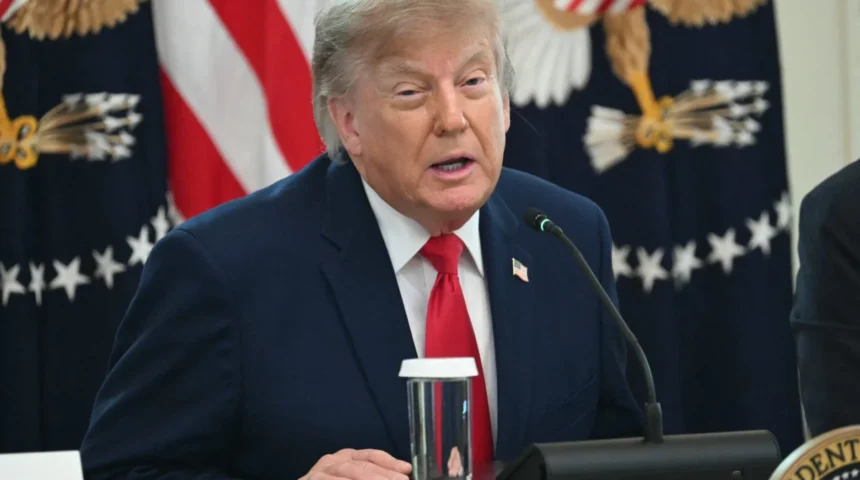
WASHINGTON — A federal civil lawsuit filed Thursday accuses President Donald Trump and his family’s cryptocurrency enterprise of "corruptly profiting" from more than $2 billion in digital currency-related transactions, alleging a direct violation of constitutional restrictions against accepting foreign money.
The federal civil complaint, brought by a shareholder of the publicly traded U.S. crypto company and Trump competitor Circle Internet Group, marks a sharp escalation in legal and political scrutiny surrounding the intersection of the presidency and the rapidly expanding digital asset market.
"No president in American history has profited from his office so brazenly," alleges the complaint, which was filed in the U.S. District Court in Washington by J. Benjamin Greenberg, a shareholder and former employee of Circle Internet Group.
The lawsuit centers heavily on two transactions involving World Liberty Financial—the crypto venture launched by members of the Trump and Witkoff families—and Sheikh Tahnoon bin Zayed Al Nahyan, the powerful national security advisor to the United Arab Emirates.
According to the legal filing, the first contested transaction occurred days before Trump’s inauguration in January 2025. An entity backed by Sheikh Tahnoon—frequently referred to in diplomatic and intelligence circles as the "Spy Sheikh" due to his oversight of the UAE’s vast security apparatus—agreed to acquire a 49% stake in World Liberty Financial for $500 million.
While representatives for World Liberty Financial previously told The Wall Street Journal, which first revealed the transaction in January 2026, that President Trump had no direct involvement in negotiating the deal, official financial disclosures later confirmed that Trump would receive millions of dollars from the purchase after assuming the presidency.
The lawsuit also targets what it describes as a deliberate scheme by an Abu Dhabi-based investment fund chaired by Sheikh Tahnoon to artificially inflate the value of President Trump’s personal cryptocurrency holdings. This allegedly occurred through the purchase of $2 billion worth of World Liberty’s native stablecoin, USD1, over the course of the previous year.
Legal experts point out that the conduct outlined in the complaint directly challenges the U.S. Constitution’s Foreign Emoluments Clause. The constitutional provision explicitly forbids federal officeholders from accepting any presents, emoluments, offices, or titles of any kind from any king, prince, or foreign state without the explicit consent of Congress, a mechanism designed to prevent foreign corruption and undue influence on American leadership.
The White House swiftly dismissed the legal action, characterizing it as politically motivated and legally meritless.
"This is yet another frivolous lawsuit that echoes the same, tired narrative that Democrats have pushed against President Trump, his family, and his administration for a decade," White House spokesperson Anna Kelly told CNBC in a formal statement. "There are no conflicts of interest."
Attorneys representing the plaintiff, however, argued that the transactions represent an unprecedented breach of public trust and executive ethics.
"What President Trump did is brazenly corrupt. He’s made millions from these deals by selling out the American people," said Matt Pelikan, an attorney at Evergreen Legal who is representing Greenberg, in a statement to CNBC. "We’re suing to stop the corruption and to force President Trump to return the profits to American taxpayers."
The lawsuit notes that Greenberg is filing the complaint derivatively on behalf of Circle Internet Group. Company representatives clarified that while the plaintiff is a shareholder, Circle itself is not orchestrating or bankrolling the litigation.
"Circle did not initiate, direct, authorize, or participate in the filing," a Circle spokesperson said in a statement, adding that the company maintains a policy of not commenting on pending private litigation.
The legal complaint casts a wide net, naming President Trump, World Liberty Financial, and U.S. Middle East Special Envoy Steve Witkoff as defendants, alongside four related limited liability companies tied to the business ventures.
Representatives for World Liberty Financial pushed back against the allegations, maintaining that the enterprise operates within full compliance of federal frameworks.
"World Liberty Financial is compliant with all U.S. laws and regulations," David Wachsman, a spokesperson for World Liberty Financial, told CNBC. "No one at World Liberty Financial works for the U.S. Government. These claims are without merit and we look forward to resolving them in court."
The White House and a spokesperson for Steve Witkoff did not immediately respond to subsequent requests for comment regarding the specifics of the lawsuit.
In addition to seeking a formal judicial declaration that President Trump’s crypto-related profits violate the U.S. Constitution, the lawsuit demands that the president disclose all other foreign crypto emoluments he has received since taking office and return any profits determined to be illegal.
The legal filing underscores the rapid and lucrative expansion of the Trump family’s footprint in the digital asset sector since his return to the White House. World Liberty Financial, which was established in 2024 by members of the Trump and Witkoff families, operates the USD1 stablecoin. Entities affiliated with President Trump and his family retain an ownership stake of approximately 38% in the company.
Financial disclosures released in mid-2025 highlighted the immense financial windfall the enterprise generated for the president, even as ordinary retail investors in World Liberty Financial experienced severe market downturns. Trump reported earning more than $1.4 billion in crypto-related income on his 2025 annual financial disclosure, with nearly $800 million of that total directly tied to World Liberty Financial.
In contrast, the platform’s valuation experienced significant volatility. Tokens that traded around 45 cents in August 2025 plummeted to approximately 5 cents by the end of June 2026, leaving many investors with steep financial losses while the Trump family reaped substantial gains.
The business venture has continuously attracted heightened scrutiny from watchmakers, ethics experts, and lawmakers due to its intersecting financial ties with foreign governments, particularly the UAE. Just months after Sheikh Tahnoon’s multi-million-dollar investment in 2025, the administration greenlit an expansion of the UAE’s access to advanced American artificial intelligence chips. The hardware allocations included provisions for G42, a prominent UAE state-backed artificial intelligence firm under the direct control of Sheikh Tahnoon.
Federal lawmakers have repeatedly sought documentation and transparency regarding those diplomatic and commercial dealings. Congressional Democrats have signaled that the business transactions involving the Trump family and foreign sovereign wealth funds could face aggressive legislative investigations and potential subpoena actions if Congress shifts power in the upcoming midterm elections.

Related News