Braiins Expands Controlflow Automation Platform With Fleet-Wide Aggregation and Telegram Alerts

Braiins has announced a major update to Controlflow, its advanced automation engine designed for industrial cryptocurrency mining operations. Building upon the introduction of Trigger Rules earlier this year, the latest iteration brings sophisticated new actions, richer evaluation conditions, fleet-wide aggregation logic, and direct Telegram notifications to the platform. The enhancements are engineered to give mining operators deeper control and real-time visibility over their infrastructure, moving automation far beyond static schedules and isolated device monitoring into holistic, farm-wide intelligence.
When Controlflow was first launched, it gave mining operators the unprecedented ability to automate responses to real-time fleet conditions, marking a significant leap forward from rigid, time-based scripts. However, the development team at Braiins recognized that automation is only as powerful as the underlying actions a system can take and the complexity of the conditions it can evaluate. With this latest release, the platform has been significantly bolstered to cover more of the nuanced scenarios that actually occur on the floor of a mining facility on a day-to-day basis.
The update introduces a comprehensive suite of new capabilities aimed at bridging the gap between individual hardware health and macro-level farm management. By expanding the toolkit available to operators, Braiins is seeking to address the growing complexity of large-scale mining operations, where managing tens of thousands of devices manually is no longer viable.
Aggregation: Rules That Think Across Your Fleet
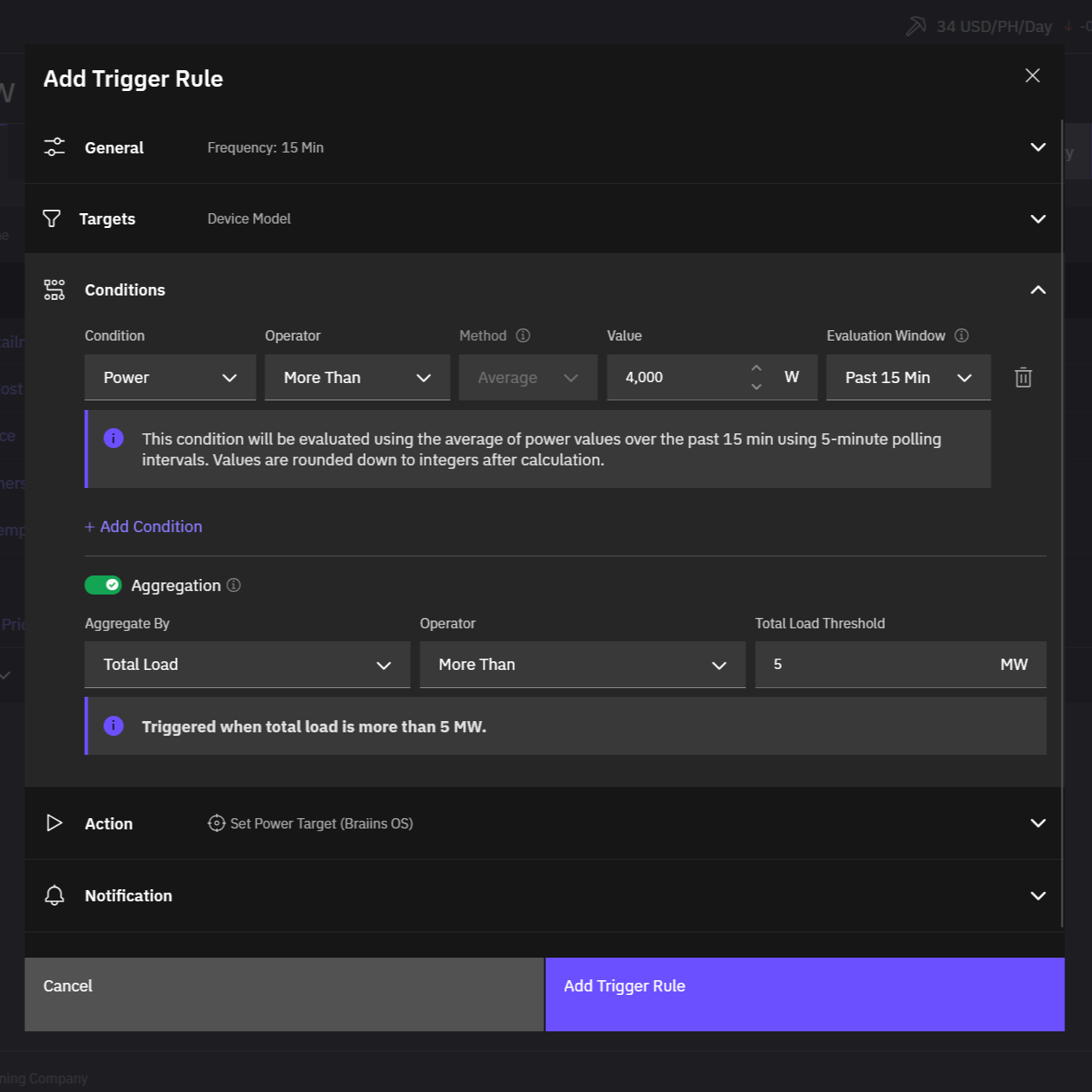
Perhaps the most significant architectural advancement in this release is the introduction of aggregation support. Previously, Controlflow conditions evaluated devices strictly on an individual basis, looking at metrics one machine at a time. With the new aggregation logic, rules can now evaluate conditions across entire groups of devices simultaneously, effectively unlocking true fleet-level automations.

This capability allows operators to build rules that trigger based on macro patterns rather than isolated incidents. For example, an operator can configure a rule to activate when the number of devices transitioning from a "hashing" state to a "non-hashing" state exceeds a predefined numerical or percentage threshold. This kind of threshold detection is crucial for identifying systemic problems early, such as a localized cooling failure affecting an entire row of containers or a sudden network switch failure taking down a major section of a mining farm.
Furthermore, operators can construct rules to monitor total aggregate fleet load, triggering automated responses when power consumption approaches or exceeds critical infrastructure capacity limits. By shifting the perspective from the micro to the macro, aggregation transforms Controlflow from a simple device-level automation tool into an intelligent system that understands broad fleet-wide trends, helping engineering and operations teams catch infrastructure issues before they escalate into catastrophic failures.
Real-Time Monitoring With Telegram Notifications
In industrial mining, response time is critical to maintaining profitability and hardware longevity. To ensure that operators remain informed even when they are away from the primary management dashboard, Braiins has integrated Controlflow directly with Telegram.
The integration allows teams to receive instant, real-time alerts on their mobile devices or desktop clients regardless of their physical location. To utilize the feature, operators simply need to connect their preferred Telegram bot within the Braiins Manager Settings and then enable notifications on any desired Controlflow rule.
The notification system is designed to be versatile, supporting both active interventions and passive monitoring. When a rule is activated, the system dispatches a Telegram message detailing the event. This functionality applies whether the rule executed a specific corrective action or utilized the newly introduced "Do nothing" option, which is ideal for monitoring-only alerts where the operator wants to be notified of a specific threshold breach without the system altering device states automatically.
Community-Driven Development and Availability
The release of these new features is deeply rooted in the ongoing dialogue between Braiins and its user base. According to the development team, many of the core improvements included in this rollout were shaped directly by feedback from mining operators around the world. Features such as fleet aggregation and specific hashing status transition conditions were among the most heavily requested additions to the platform. In response to this high demand, Braiins expedited the implementation and engineering process to deliver the tools to the community ahead of schedule.
All of the newly announced features are live and fully operational today inside Braiins Manager. Whether an organization is managing a modest fleet of hundreds of devices or a massive industrial deployment spanning tens of thousands of units, Controlflow is built to adapt to the specific operational workflows of the facility, ensuring that automated logic aligns seamlessly with human oversight.
As the mining sector continues to mature, automation and real-time telemetry are increasingly viewed as foundational requirements for maintaining competitive efficiency. Braiins has indicated that it intends to continue refining Controlflow based on real-world usage. Operators and industry professionals interested in contributing to the platform’s roadmap are encouraged to share their feedback directly with the engineering team or participate in ongoing discussions within the official Braiins Manager Telegram community.

Related News