Heating a Modern Home with Bitcoin: One Year of Real Data from a Hashrate Heating Pioneer
The intersection of home thermodynamics and cryptocurrency mining has moved past theoretical discussions and experimental blog posts. After operating a fully integrated, hashrate-powered home heating system for an entire year, a quality assurance engineer at Braiins known as Adam has published comprehensive data detailing the real-world operational costs, hardware configurations, and software automation required to heat a 140-square-meter residential property exclusively using an ASIC miner.
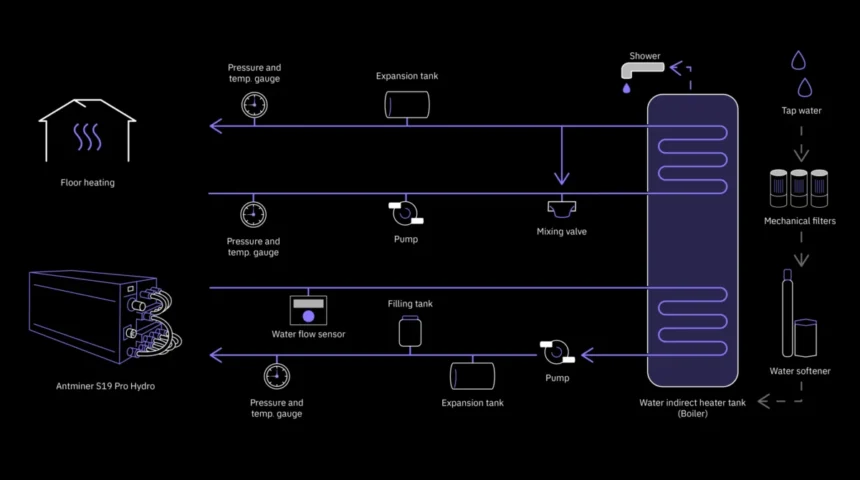
Growing up learning electrical work from his father, Adam always intended to incorporate mining heat reuse into his eventual home construction. When the time came to build his modern timber-frame house, he coordinated with a project engineer to design a heating architecture specifically tailored for low-temperature radiant floor heating—a setup functionally analogous to a standard heat pump configuration. While a certified plumber installed the tap water loop and floor distribution infrastructure, Adam engineered the custom miner loop himself. The result is a self-regulating, three-loop system capable of warming a 1500-square-foot home and supplying domestic hot water using a single 6 kW hydro Antminer.
Planning and Architecture of a Hashrate-Powered Citadel
Designing a system that safely captures thermal energy from specialized computing hardware required extensive self-directed research. Navigating through online forums, Reddit communities, Twitter discussions, and technical video platforms, Adam evaluated various thermal management techniques, including two-phase cooling and immersion cooling, before ultimately selecting hydro cooling. By merging foundational principles of thermodynamics and hydrodynamics with an iterative approach of continuous improvement, he developed a detailed blueprint for a three-loop thermal transfer system.
The planning phase presented unique engineering challenges, particularly regarding fluid dynamics and hardware selection. Sourcing the appropriate circulation pump proved especially tricky, as high-head industrial pumps generate excessive noise, while standard home circulation pumps lack the necessary pressure to drive the fluid effectively through the ASIC cooling blocks. Ultimately, sizing the central boiler accumulation tank and its internal heat exchangers correctly proved to be the project’s most critical success. Because the technical room is situated directly behind the kitchen, minimizing mechanical noise was an operational priority. To assist other builders exploring similar architectural concepts, Adam has publicly released detailed schematic diagrams created using SmartDraw and Google Drawings.
The Three-Loop Thermal Integration
The operational backbone of the installation relies on three distinct fluid loops, each designed to manage specific temperature ranges and serve separate domestic functions.
The primary loop, known as the miner loop, operates at the highest temperatures and is responsible for extracting thermal energy directly from the operating bitcoin miner and transferring it into the central boiler tank. Because Bitmain documentation typically specifies a maximum water inlet temperature of 45 degrees Celsius, maintaining safe operating parameters is essential. This is achieved through Dynamic Power Scaling firmware, which automatically throttles miner performance when thermal spikes occur, protecting the hardware while preserving consistent heat output. This loop incorporates the hydro miner, an expansion vessel, a specialized pump, and safety valves.
The secondary loop acts as a medium-temperature bridge connecting the primary boiler system to the domestic water supply. While uncommon in conventional residential plumbing, this filtration and circulation pathway is vital for hygienic hot water production and system stability.
The third loop drives the low-temperature floor radiant heating infrastructure that warms the living spaces. Because radiant floor systems operate efficiently at lower water temperatures, they align perfectly with the thermal output profiles of hydro-cooled mining hardware, providing steady and comfortable indoor climate control throughout a standard four-and-a-half-month heating season.
System automation relies heavily on software rather than manual oversight. By integrating Braiins OS with Home Assistant via specialized open-source tools, the installation functions largely as a self-regulating ecosystem. Dynamic Power Scaling dynamically modulates mining output based on real-time thermal demand, while smart circulation pumps and thermostatic actuators maintain consistent ambient room temperatures without requiring active user intervention.
Evaluating the Financial Realities and Operating Costs
With a full year of empirical data now available, the economics of hashrate heating offer a compelling comparison against traditional residential heating alternatives. Adam’s modern timber-frame home features an insulated wall assembly consisting of gypsum fiberboard, a vapor barrier, structural timber studs filled with mineral wool, and an external layer of expanded polystyrene. The house has a calculated thermal loss of 3.5 kilowatts at an ambient temperature of -10 degrees Celsius.
When evaluating upfront capital expenditures, a conventional air-source or geothermal heat pump system typically costs between $10,000 and $15,000 more than a basic electric boiler setup. In contrast, integrating a bitcoin miner into the heating loop incurs hardware costs comparable to traditional electric resistance heating, with the added benefit of generating digital asset rewards to offset operating expenses. While a traditional heat pump provides high efficiency during mild weather, its coefficient of performance drops significantly when heating domestic tap water to high temperatures to prevent bacterial growth. A hashrate heating system maintains consistent energy dynamics regardless of external weather conditions. Furthermore, because the electricity consumed is already required to heat the living space, every satoshi earned through mining functions as a direct financial rebate on winter utility expenses.
Routine maintenance for the system is remarkably low. Utilizing propylene glycol within the closed miner loop eliminates regular fluid degradation, while lower operating temperatures minimize calcium buildup within the boiler tank when proper electrical grounding is maintained.
Looking forward, Adam plans to expand his thermodynamic experiments by incorporating newer, more efficient hardware from the S21 miner series, which allows for individual chip temperature monitoring and opens the possibility of pre-heating a residential sauna using reclaimed ASIC heat.

Related News