Fed Signals and Market Rotation: Kevin Warsh’s IMF Address and the S&P 500’s Shift Toward Value
By RIA Team | October 19, 2026 | 7 min read
Financial markets closed out a turbulent week with a sharper focus on shifting macroeconomic currents, corporate earnings, and a decisive rotation away from crowded technology trades. Speaking at the International Monetary Fund’s annual meetings in Bangkok, Federal Reserve Chair Kevin Warsh offered a measured assessment of monetary policy, providing little explicit guidance on whether the central bank will hold or increase interest rates at its upcoming meeting on October 28. Despite the deliberate ambiguity from the central bank leader, Wall Street quickly priced in a pause, while underlying market breadth revealed a profound transition beneath the surface of headline indices.
Warsh addressed the international gathering on Friday, declining to commit the Federal Open Market Committee to a specific path for the upcoming policy announcement. Maintaining a cautious stance on forward guidance since stepping into the chair position in May, Warsh told attendees that he does not prejudge meetings. He pointed back to the September gathering, emphasizing that the committee made it abundantly clear that they would deliver price stability and had successfully removed a dose of accommodation from the financial system.

Markets, however, treated the absence of a hawkish signal as a strong indication that the Federal Reserve will hold interest rates steady later in the month. Implied probabilities for a rate hike dropped precipitously following his remarks, falling from 28 percent down to below 15 percent. Major financial institutions quickly weighed in on the shift. Goldman Sachs released a note concluding that, alongside other recent commentary from FOMC participants, Warsh’s statements indicate that the committee is fully prepared to pause its tightening cycle in October while keeping the door open for a final rate hike later in December.
What made the market’s benign reaction particularly notable was the context in which it occurred. The widespread assumption of a rate hold materialized immediately following higher-than-expected inflation data that would normally rattle fixed-income investors. Beyond monetary policy, Warsh was notably more forthcoming on the long-term economic implications of artificial intelligence. He described AI as the most important innovation in the global economy during his lifetime, observing that the technology is visibly hitting the demand side of the economy before its productivity benefits catch up on the supply side. In economic terms, his assessment suggests that the technological boom is inflationary in the near term but inherently disinflationary over the long horizon.
Despite the definitive conclusion drawn by equity traders following his address, Warsh’s careful avoidance of explicit policy commitments left investors with little concrete justification to guarantee a steady interest rate. Yet, shifting expectations over the prior four weeks clearly illustrated a wholesale migration of sentiment away from anticipated rate hikes toward an extended pause.

What To Watch Today
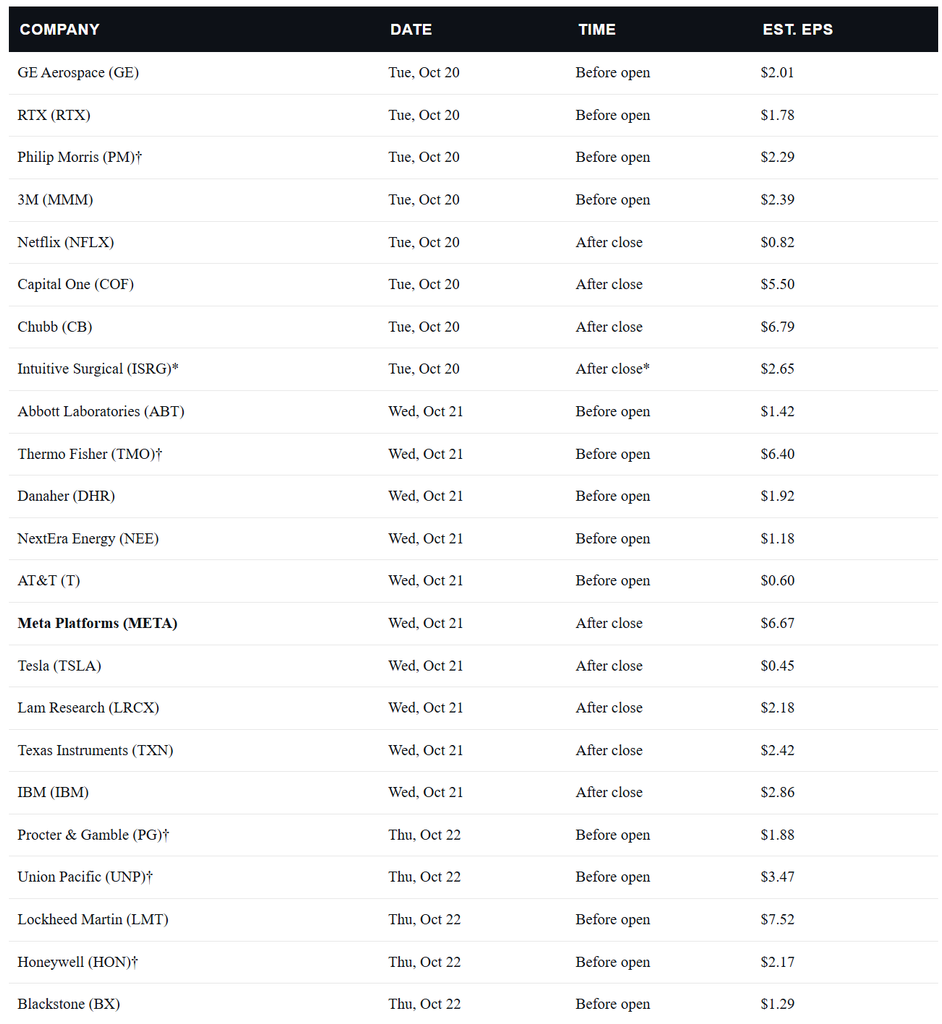
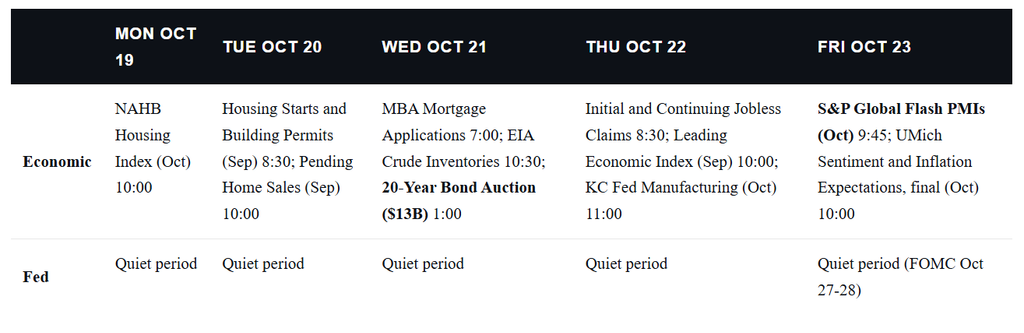
As the new trading week begins, market participants face a dense calendar dominated by corporate earnings releases and critical economic data points. With the Federal Reserve entering its official media blackout period ahead of the October 27-28 FOMC meeting, and with relatively light top-tier macroeconomic data scheduled on the slate, institutional focus will pivot squarely toward corporate fundamentals.
Aside from early reports from bellwether enterprises, the majority of mega-cap technology companies have scheduled their updates for later in the week. A packed schedule features hundreds of reporting companies, with industrial giants clustered tightly on Tuesday and Wednesday. Tuesday morning brings financial and operational updates from major industrial and aerospace firms, followed by streaming leader Netflix after the closing bell. Mid-week trading will absorb reports from Tesla, IBM, and semiconductor equipment manufacturers, while healthcare, financial services, and energy firms round out the multi-industry lineup.
With zero scheduled Fed speakers during the blackout window, participants in the fed funds futures market and the Treasury yield curve remain the primary barometers for central bank expectations. Following a brief post-CPI spike, rate hike odds have stabilized in the low teens, leaving the market in an asymmetric position where unexpected shifts in short-term yields, particularly the two-year Treasury note, could reprice expectations rapidly.
Market Trading Update
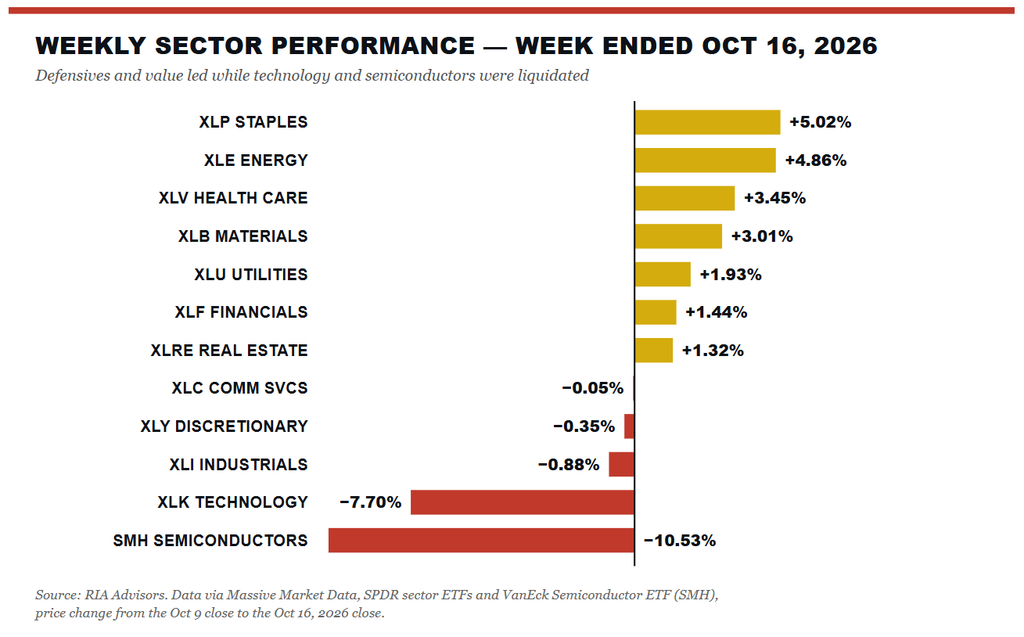
Beneath the turbulent surface of last week’s headline indices lies a crucial detail missed by much of the financial press. The sharp sell-off in technology equities, particularly within AI-adjacent stocks, was not a generalized liquidation of the entire equity market. While cap-weighted technology names faced heavy selling pressure, defensive sectors caught substantial bids. Consumer staples gained 5 percent, energy advanced nearly 5 percent, and healthcare rose 3.5 percent. Most telling of all, the equal-weight S&P 500 actually managed a 0.5 percent gain for the week, even as the traditional cap-weighted index tumbled 2.0 percent.
As previously highlighted in recent market analysis, the technology sector had become extremely extended above its long-term moving averages, making a growth-to-value rotation increasingly probable into year-end. That rotation arrived far faster than anticipated. Applying classic market observations regarding excesses, crowded trades in high-flying sectors tend to unwind abruptly when sentiment shifts.
Whether this correction establishes the foundation for a durable relief rally remains an open question. Market positioning has certainly cleaned up, with hedge fund allocations to artificial intelligence sliding from summer peaks. However, prime brokerage notes suggest that deleveraging within the space may still be in its early stages, with gross leverage remaining elevated.
Corporate earnings will act as the ultimate swing factor for equity direction. FactSet data indicates that a vast majority of reporting companies are beating consensus estimates so far, yet the market response has been notably muted, with positive earnings surprises met with smaller-than-average post-earnings gains. The bar for outperformance is exceptionally high. Projected earnings growth for the largest technology titans remains heavily skewed, meaning that if defensive sectors and value shares continue to attract capital while large-cap tech stabilizes, a reflexive market bounce could take hold. If the selling pressure broadens to infect the equal-weight index as well, investors will face systemic headwinds extending far beyond the technology sector alone.
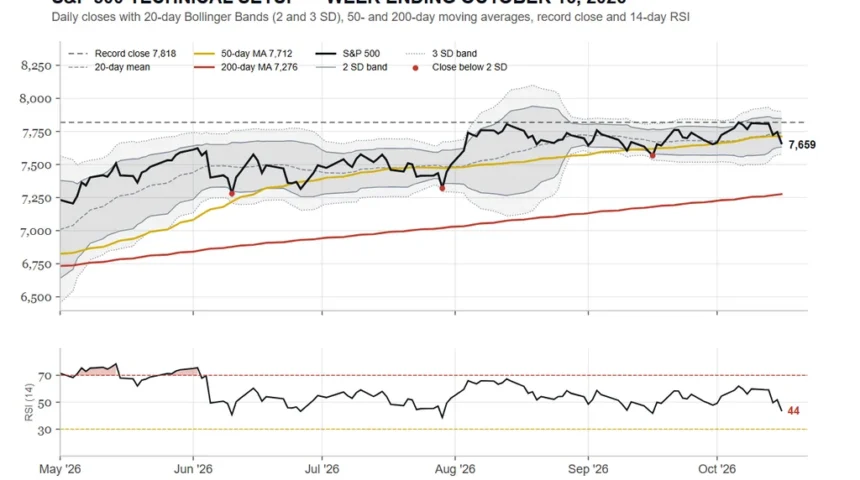
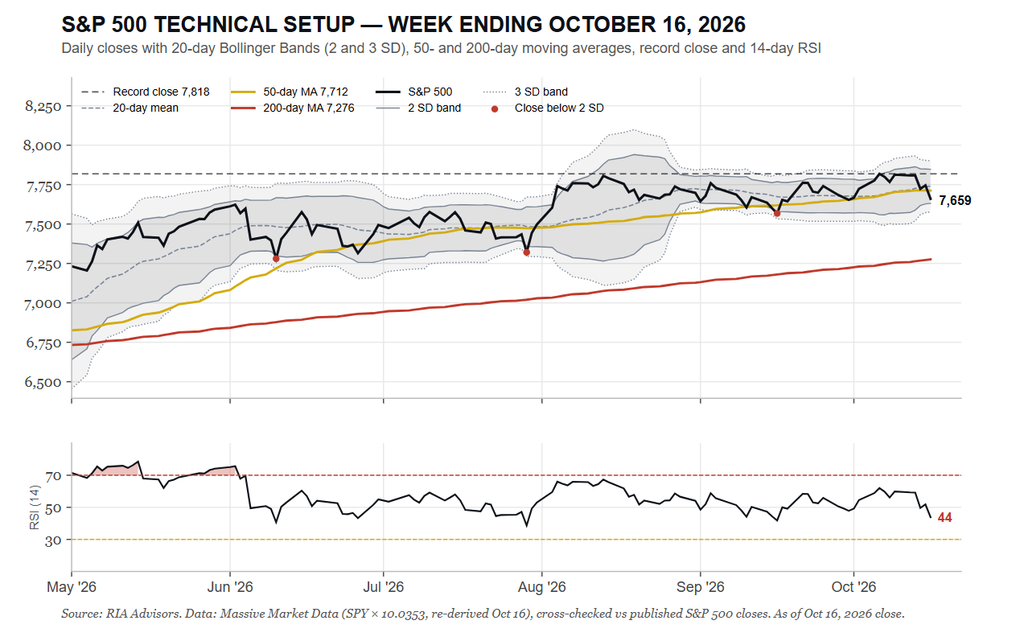
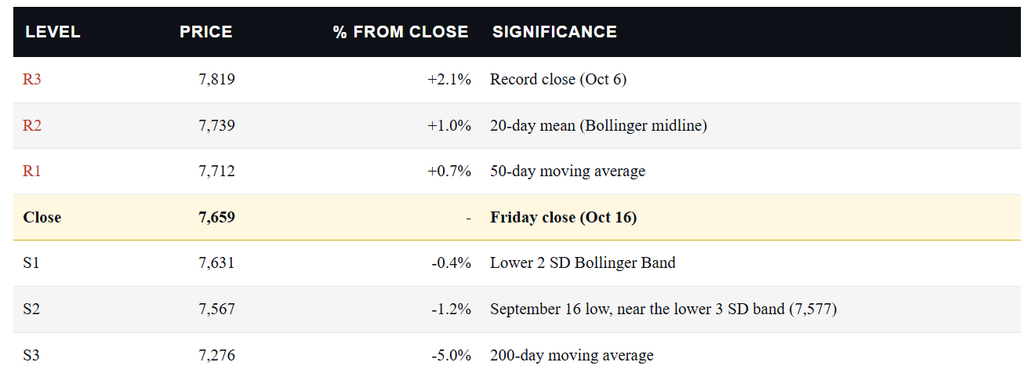
From a technical perspective, the S&P 500 closed out the week at 7,659.44, down 1.95 percent for the week and sitting 2.0 percent below its early October record high. More importantly, the benchmark index closed below its 50-day moving average for the first time in weeks, signaling a clear shift in the short-term trend from bullish to neutral. Although the index remains comfortably above its long-term 200-day moving average—preserving the overarching structural uptrend—short-term momentum indicators have cooled significantly.
Relative strength metrics have fallen from prior elevated readings, and moving average convergence divergence measures have generated near-term sell signals, though originating from levels far from true oversold territory. Bollinger Band readings place the index close to established lower standard deviation boundaries. Historical precedents indicate that prior tests of these lower bands marked short-term trading lows within a few sessions, establishing a critical technical line in the sand for institutional risk management.
Market breadth remains the primary mitigating factor preventing a more destructive correction. With hundreds of index constituents maintaining positive momentum even during late-session pullbacks, the ongoing damage is largely concentrated among the largest capitalization names. This divergence highlights the classic structural difference between an orderly sector rotation and a broad-based market breakdown.
Portfolio positioning strategies continue to emphasize risk mitigation and rebalancing rather than panic selling. Trimming extended technology exposure in favor of value, harvesting tax losses, and managing fixed-income duration to capture attractive yields have served portfolios well through the recent volatility. Rather than chasing market dips or selling into technical support holes, disciplined risk management dictates using potential reflex rallies toward moving average resistance levels to rebalance asset allocations. A decisive breakdown below key technical support levels would signal the need to raise cash and implement further hedging strategies, while holding those levels keeps the broader structural uptrend intact.
Bad Inflation Cures Itself: Good Inflation Doesn’t
Underpinning the current macroeconomic debate is a fundamental question regarding the nature of price stability and inflation dynamics. Economic frameworks distinguish between two distinct forms of inflation, each with radically different implications for corporate margins, consumer behavior, and monetary policy.
The first category, often described as good inflation, is driven by robust economic demand. When consumers bid for scarce goods using genuinely earned income, businesses experience expanding profit margins. Tight labor markets translate those corporate gains into higher paychecks, which in turn fund higher price levels. The economic loop closes and becomes self-reinforcing because every leg of the cycle is supported by real underlying economic output and productivity.
The second category, bad inflation, operates on an entirely different mechanism. When prices rise because the cost of producing goods increases due to external supply shocks—such as energy disruptions, shipping constraints, or newly implemented tariff schedules—the financial burden acts essentially as a tax. Someone’s operating cost has escalated, and the required capital must be drawn from household or corporate budgets that did not expand in tandem. Every dollar of that price increase represents a dollar diverted away from other productive economic activities.
Because bad inflation fails to generate the underlying income required to sustain higher price levels, it ultimately destroys the consumer demand that supports it. This dynamic illustrates the timeless commodity market adage that high prices ultimately cure high prices, as demand destruction brings supply and demand back into equilibrium without requiring permanent monetary intervention.
As the financial markets navigate the intersection of shifting central bank expectations, artificial intelligence valuations, and third-quarter earnings reports, market participants will continue to monitor key technical thresholds and macroeconomic data releases. Maintaining a balanced perspective between growth and defensive allocations remains essential as the year-end trading environment unfolds.

Related News