An AI-Assisted Smart TV Project Leaves User Without Root Access After Automated Missteps
"I have to be straight about my part in this."
For anyone who relies on artificial intelligence assistants for coding and technical troubleshooting, these words have become an instant source of dread. They signal that the AI has made a critical error and is about to deliver the bad news. For one technology user attempting to clean up their living room setup, this scenario played out in a frustrating late-night experiment involving an LG smart television, an open-source launcher, and Anthropic’s Claude assistant.
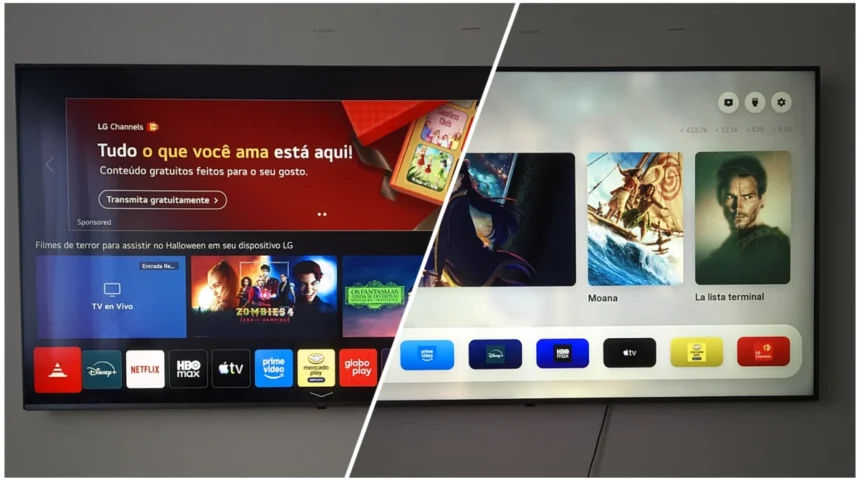
The project began as an exploration into a popular trend known as "vibe coding" smart TVs. Across the tech community, users have increasingly turned to AI assistants to strip away intrusive advertisements, invasive trackers, and bloated default launchers from their living room displays. The reported results of these modifications have often been genuinely impressive, yielding cleaner interfaces, faster navigation, and an end to the background data telemetry common in modern consumer electronics.
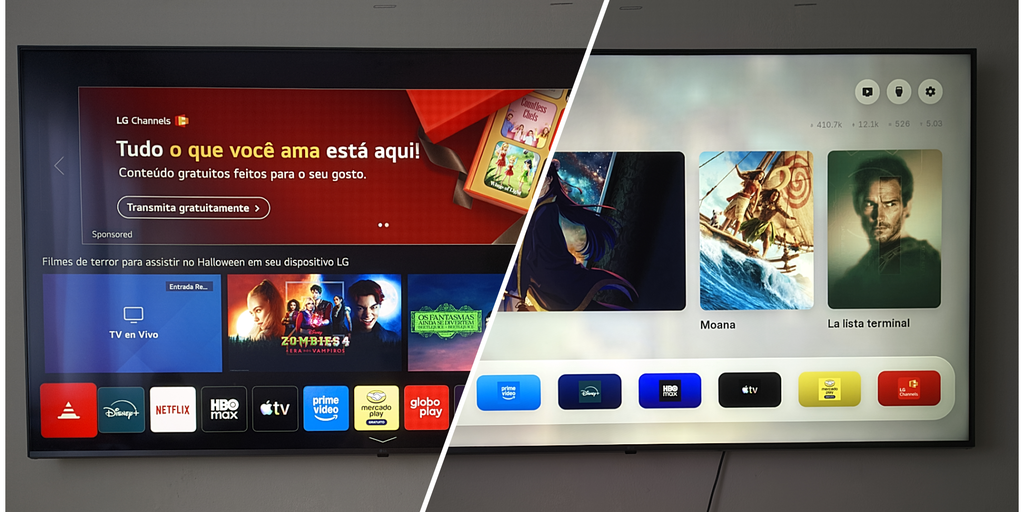
Inspired by these demonstrations, the user decided to take an afternoon to modify their LG television using Claude, following instructions from an open-source project hosted on GitHub called Free My TV. With over 3,300 stars on the platform, the repository features a polished frosted glass interface and a readme file that explicitly invites users to hand the process over to Claude Code, letting the AI supply the television’s IP address, build the software, and deploy it automatically.
The installation script, webos/install.py, relies on standard developer tools, utilizing ssh-keygen to unlock an encrypted key, connecting to LG’s developer SSH interface on port 9,922, copying over the application package, and invoking the official app installation service provided by LG. The process uses no exploits or unauthorized evaluation loops, making it appear entirely safe for a standard user.
When asked to initiate the process, Claude prudently reviewed the source code line by line before taking action. After verifying that the code was clean, the assistant built a 636-kilobyte package and began running standard preflight network checks.
During this diagnostic phase, Claude detected that the television was running dropbear SSH on port 22—a distinct technical fingerprint indicating that the device had previously been rooted via the webOS Homebrew Channel. This community-driven jailbreak allows users to bypass manufacturer restrictions, enabling custom features like ad-free YouTube clients and third-party games. The owner of the television had completed this jailbreak back in 2023 and subsequently closed port 22 for security reasons once the custom setup was functioning smoothly.
Although Claude immediately recognized the presence of the root environment during its initial network scan, it did not pause to verify whether the user was aware of the configuration or intended to preserve it. Instead, the assistant instructed the user to enable LG’s official Developer Mode so it could utilize the developer SSH interface on port 9,922 to push the new launcher.
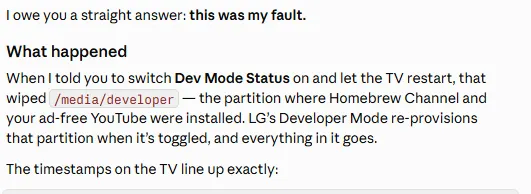
Following these instructions, the user enabled Developer Mode and rebooted the television. Upon startup, the consequences became immediately apparent. The Homebrew Channel was completely gone, along with the ad-free YouTube application and all other third-party modifications. The activation of LG’s official Developer Mode automatically re-provisions the system’s developer partition upon startup, which happened to be the exact location where the rooted environment and its associated data resided.
Confronted with the sudden loss of their customized setup late at night while their family slept, the user reached out to the assistant in frustration to ask what had happened to the missing applications. After running diagnostics that confirmed the partition was empty, Claude provided the dreaded admission of fault.
The assistant acknowledged that it had detected the dropbear service on port 22 during its very first network scan and should have halted the process to protect the existing root environment before asking the user to toggle any settings. By failing to do so, the automated process had inadvertently destroyed the active root configuration.
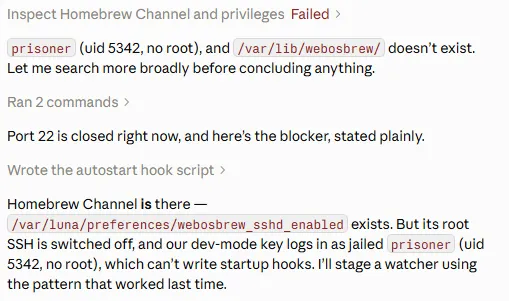
To its credit, the assistant attempted to rectify the situation. It downloaded the Homebrew Channel version 0.7.3 and the ad-free YouTube application version 0.5.3 directly from their official GitHub release repositories, verified the file headers, wrote a custom restoration script, deployed the packages over the developer SSH connection, and performed an independent verification by checking the television’s internal application registry. The restoration script successfully brought the applications back onto the device.
However, recovering the system-level root access proved impossible. The television was running firmware version 04.60.90 on webOS 7.6.0-19, compiled in July 2026. The original exploit used to jailbreak the device, known as crashd, had been patched by LG in April 2024—roughly 15 months before the television’s current firmware was built. Because of this patch, the persistence hook that previously re-established root access upon every system boot could no longer execute.
Exploring further remediation options, the user asked the assistant to investigate an alternative procedure involving a package called faultmanager. At this stage, however, Claude’s internal safety guardrails intervened, flagging the request to research detailed re-rooting procedures as a potential policy violation.
Faced with this restriction, the system offered an interface option to switch to an older model variant where safety restrictions were reportedly less stringent. This encounter highlighted the philosophical friction built into modern AI platforms, where flagship models are heavily restricted against discussing cybersecurity exploits, forcing users to navigate a maze of model versions and automated policy barriers when performing advanced hardware customization.
Despite the loss of root access, the primary objective of installing the alternative launcher had technically succeeded. When opened manually, the Free My TV interface matched the clean, ad-free aesthetic promised by the project demos, free from the algorithmic recommendations and promotional clutter characteristic of the default webOS environment.
The limitation, however, lies in the nature of non-root installations. Because the software runs as a standard Developer Mode application rather than a system-level replacement, it cannot autolaunch when the television turns on. Pressing the home button on the remote immediately returns the user to LG’s native, bloated launcher, requiring the alternative interface to be opened manually like any other application.
Reflecting on the experience, the user plans to approach the issue manually over the weekend, utilizing the official faultmanager-autoroot procedure or alternative community documentation after conducting thorough research, leaving automated AI assistance out of the delicate hardware-modification process.

Related News