Young Airplanes Are Being Torn Apart for Scrap Amid Global Parts and Engine Shortages
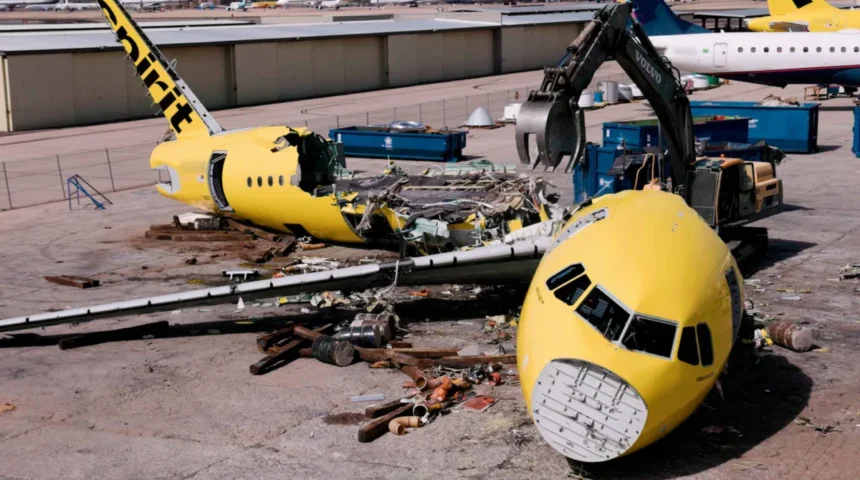
GOODYEAR, Ariz. — An Airbus A320neo, representing one of the most popular and advanced passenger aircraft models in the world, proudly rolled off the factory line in Mobile, Alabama, in July 2022. Painted in a bright yellow livery, it was built for a long operational future, designed to traverse the skies and carry passengers for decades.
Yet, less than four years later, that same plane met a drastic and sudden end. This May, parked at a specialized aircraft asset management facility on the sun-baked outskirts of Phoenix, Arizona, the jet was systematically stripped of millions of dollars in valuable components. Afterward, the steel teeth of an excavator tore relentlessly through its fuselage, reducing a remarkably modern piece of aviation engineering to scrap metal.
Across the aerospace industry, a striking economic and operational reality is taking shape: a growing number of commercial aircraft are being dismantled years—and sometimes even decades—earlier than their anticipated retirement age. According to industry executives and aviation data analysts, this unusual phenomenon is the direct result of a severe, prolonged shortage of aviation parts. Among these, no components are more precious, expensive, or tightly rationed than aircraft engines, a crisis that has exasperated commercial airlines and driven up operating costs for years.
Even after high-value engines are carefully detached, asset recovery firms scour the airframes for any reusable hardware they can salvage, from critical landing gear assemblies down to specialized exterior antennae.
"It’s the first time in my career that involved purchasing an aircraft that’s less than five years since date of manufacture," said Bill Thompson, the vice president leading aircraft and engine acquisitions for the Americas at EirTrade Aviation, an aviation asset management and trading firm. EirTrade purchased the under-four-year-old Airbus A320neo earlier this year.
Thompson noted that his firm paid "single-digit" millions of dollars each for that particular aircraft and another similarly aged model. They ultimately expect to turn a healthy profit by reselling the more than 1,000 individual parts harvested from the airframes before their hulls were crushed.
"I don’t know if you’re going to sell the coffee makers, but you never know. Sometimes you do," Thompson added with a touch of pragmatic industry humor.
‘Don’t fall in love with the metal’
The trend toward early retirement is starkly reflected in global aviation data. Between June 2025 and August of this year, exactly 21 newest-generation commercial aircraft were torn down, according to figures from aviation data and advisory firm IBA Group. These scrapped planes had an average age of just 6.4 years and primarily consisted of advanced Airbus models alongside select Boeing jets. By comparison, the historical average retirement age for narrow-body commercial airplanes sits at 21.7 years, underscoring how drastically market conditions have distorted traditional aircraft lifecycles.
"Anytime that you end up with any period of market softness in aircraft availability, engine availability, it’s going to cause investors to look at other options," explained Simon Goodson, CEO of AerFin, a specialized firm that buys, sells, repairs, and leases aircraft and spare parts. "We always say to our aircraft and engine traders, ‘Please don’t fall in love with the metal.’"
Hundreds of aging aircraft are routinely retired each year as global manufacturers ramp up production rates to meet airline demand, allowing operators to swap out older fleets for newer, more fuel-efficient models. However, the current crisis extends far beyond standard fleet modernization. Faced with agonizingly long delays for replacement parts or protracted repair windows for younger jets, some aircraft owners have concluded that waiting is simply no longer financially viable.
"A year might not sound that long, but does three or four years?" said Dave Querio, CEO of Ascent Aviation Services, a company based in Marana, Arizona, just outside Tucson, that specializes in repairing, modifying, storing, and disassembling aircraft. "That’s the issue for the aircraft that came in in ’23, ’24, and ’25."
In numerous cases, owners can reap significantly more capital by harvesting and selling off a young plane’s components than they can by attempting to sell the complete aircraft on a sluggish secondary market, or by continuing to pay steep storage fees while waiting months or years for maintenance slots to open up.
Querio acknowledged that the sheer scale of the current downturn is unprecedented in his professional experience. "I haven’t seen the volume of younger aircraft being torn down as I’m seeing today," he noted.
Hot engine market
The primary catalyst driving these premature retirements is the extreme scarcity, extended turnaround times, and soaring market prices for jet engines.
A major contributing factor is that cutting-edge, next-generation engines—which are engineered to burn hotter and consume considerably less fuel than their predecessors—are running into heavy maintenance requirements far earlier than airlines or manufacturers originally anticipated.
These unexpected service demands have left major engine repair and overhaul facilities severely backlogged. The bottleneck impacts shops operated by manufacturing giants like GE Aerospace and RTX unit Pratt & Whitney, as well as smaller, independent maintenance facilities. Consequently, airlines and aircraft leasing firms have been aggressively hunting for spare parts and replacement engines wherever they can be sourced, including desert storage yards in locations like Goodyear, Arizona.
This acute supply crunch has poured fuel onto an already white-hot secondhand parts market. According to Simon Goodson, a single engine fan blade can command a price of $50,000, while larger variants can easily exceed $100,000. Some engines powering the Airbus A320neo family feature as many as 20 of these precision-crafted blades. Meanwhile, an internal engine disc can fetch between $1 million and $2 million on the aftermarket.
Compounding the crisis, a major manufacturing defect prompted an extensive engine recall that grounded hundreds of Airbus planes worldwide. The issue centered around the use of contaminated powdered metal during the production of specific components. Spirit Airlines bore the heavy brunt of those operational disruptions in the United States, struggling with grounded capacity years before the carrier ultimately collapsed.
The affected engines are manufactured by Pratt & Whitney, which issued the recall in 2023. Reflecting the intense scarcity of supply, those specific engines are valued at close to $17 million on the high end this year, representing a staggering 60% surge compared to the upper end of their valuation range in 2019, according to IBA data.
To keep their active fleets operating while waiting for their own powerplants to return from congested repair facilities, some airlines have resorted to cannibalizing engines from retired or stored aircraft.
"So you’re just playing Legos and moving engines on and off aircraft," said Mike Stengel, a partner at AeroDynamic Advisory, an aerospace consulting firm.
This constant shuffling has driven the cost of buying or leasing a popular commercial engine to absolute record levels. Leasing a powerplant currently ranges from roughly $160,000 to $180,000 per month, according to IBA data. Meanwhile, competing engines for the A320neo family produced by CFM International—a joint venture between GE Aerospace and France’s Safran—offer little relief, commanding similar monthly rental rates between $130,000 and $180,000.
Spirit Airlines’ ghost planes
The structural pressures leading to the premature destruction of young aircraft predate the financial collapse of Spirit Airlines, but the carrier’s sudden demise has dramatically accelerated the trend.
The four-year-old Airbus jet torn down outside Phoenix in May serves as a prime illustration of the phenomenon. Initially placed into desert storage due to the widespread engine recall, the aircraft languished indefinitely until its owners decided its parts held far more immediate value than its potential future flight capability.
The airline’s ultimate collapse flooded the market with additional grounded Airbus inventory, forcing owners to carefully calculate whether it makes financial sense to wait out long engine repair queues or dismantle the jets for immediate liquidation.
At AerSale’s sprawling facility in Goodyear, dozens of idle yellow-painted Spirit jets remained parked under the scorching desert sun. The site still bore the immediate fingerprints of the airline’s sudden failure. Glenn Zecchin, a former Detroit-based Spirit captain, visited the facility shortly after the company’s collapse to inquire about ferry opportunities and check on the aircraft he used to fly.
"I knew the airplanes were there, and I wanted to see what happened," said Zecchin, who has since transitioned to flying corporate jets.
Inside one parked jet, remnants of daily airline operations remained intact: in-flight menus and safety cards still occupied the bungee-cord seatbacks, while pilot reference manuals rested inside the cockpit.
Not all of these abandoned aircraft are destined for the scrapyard. Some financial entities and leasing companies that owned Spirit’s planes prior to the bankruptcy may opt to sell off usable components while keeping select airframes in long-term preservation, or potentially place them with new carriers willing to swap out Spirit’s tight 28-inch seat pitch for a more spacious cabin layout.
However, remaining grounded incurs continuous storage expenses, which vary depending on the aircraft type. Desert facilities are specifically chosen because their arid climates help preserve metal airframes and prevent corrosion, allowing some stored planes to sit untouched for decades.
For others, the math simply does not favor a return to commercial service. When parts demand is exceptionally high and the logistical wait to restore an airframe to airworthiness stretches too far into the future, owners increasingly choose complete dismantlement.
"After you get rid of all the valuable equipment and sell it back into the aftermarket, what’s really left is just a metal carcass that you will literally take a crane and crush," Stengel explained. The remaining aluminum hull is then sold to industrial recyclers who melt it down for other applications, potentially transforming an advanced passenger jet into raw materials for consumer goods like beverage cans.
Querio noted that while the process can be stark to witness, it represents a calculated financial resolution for asset owners.
"It’s a little melancholy to watch it at times," he said. "But sometimes, it’s kind of a thrill to see how fast an aircraft can be crunched up and sent off to the smelter."

Related News