France Faces Growing Investor Alarm as Civil Unrest Deepens Political and Fiscal Crisis
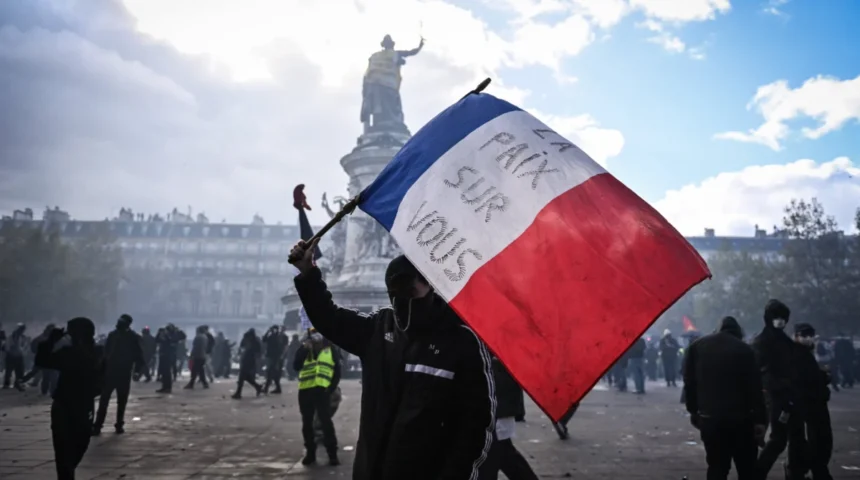
France is grappling with a severe wave of civil unrest that is rapidly escalating investor anxiety over the nation’s fragile fiscal health. The mounting social friction follows a turbulent week that saw French borrowing costs surge to their highest levels since 2002, laying bare the deep-seated vulnerabilities within the eurozone’s second-largest economy.
With additional demonstrations and nationwide strikes slated for the coming weeks, fund managers, economists, and ratings agencies are intensely scrutinizing whether the prolonged disruption will permanently dent economic growth, erode consumer and business confidence, and severely hinder the government’s ability to implement critical budget savings.
Amid this mounting pressure, rating agency Moody’s opted to keep its Aa3 credit rating on France steady—a designation it still characterizes as "high grade"—while firmly maintaining its negative outlook on the sovereign nation.
"The negative outlook reflects the increased risk that the fragmentation of France’s political landscape will continue to impair the functioning of the country’s legislative institutions," Moody’s detailed in its assessment report. However, the agency offered a glimmer of conditionality, noting that it could potentially return France’s ratings outlook to stable if the nation’s political institutions manage to successfully narrow its widening budget deficit.
Can France’s government pass its budget?
The French government faces a steep uphill battle as it attempts to steer its budget deficit down to 5% of gross domestic product by 2027, an ambitious reduction from the projected 5.4% deficit expected for 2026. The National Assembly is scheduled to resume high-stakes debates on the budget’s contentious tax measures on October 27. These measures are specifically designed to generate vital state savings, but they are meeting fierce, unyielding resistance from opposition lawmakers across the political spectrum.
Alain Durré, head of EMEA economic research at Natixis CIB, emphasized that the central government remains fiercely determined to prevent an even sharper, destabilizing rise in borrowing costs. Durré noted that the administration might attempt to enforce its fiscal targets by invoking controversial legislative tools such as Article 49.3—a mechanism that permits the government to force a bill through the assembly without a final floor vote unless lawmakers successfully muster a no-confidence motion—or by relying on executive ordinances to bypass parliamentary gridlock.
Deploying such measures could temporarily calm frayed financial nerves and restore a degree of investor confidence, Durré added. He pointed out that the recent acute pressure on French sovereign debt has been driven predominantly by tactical portfolio reallocations from transient market players, while traditional, long-term buy-and-hold institutional investors are "still sitting on the sidelines."
Despite these potential legislative workarounds, the financial markets remain deeply skeptical. The yield on benchmark 10-year French government bonds, known as OATs, climbed 11 basis points in a single session to hit its highest level since 2002. This sharp sell-off pushed the yield spread over 10-year German Bunds—the definitive benchmark for euro zone sovereign debt—to its widest margin since November 2011.

Charlotte de Montpellier, senior economist for France and Switzerland at ING, warned that the ongoing civil unrest "adds another layer of uncertainty" to the dense web of budgetary and political anxieties already weighing heavily on French assets. She noted that the turmoil "reinforces the perception that any future government will find it difficult to deliver the structural reforms and savings required."
Echoing these concerns, Matthew Ryan, head of market strategy at Ebury, underscored the deep legislative hurdles ahead. "It remains unclear whether the 2027 budget will clear parliament," Ryan said. "Even if it does, it seems set to be so riddled with concessions to both the left and the right that the deficit problem is left insufficiently addressed."
What damage will the unrest do to France’s growth outlook?
The immediate horizon offers little relief, with fresh demonstrations officially planned for October 24, followed by a major union-backed national day of strikes and widespread protests scheduled for November 5. Anti-establishment groups, including remnants of the Yellow Vest movement, are among the prominent voices calling for renewed rallies in major city centers.
In a market note published after the severe violence of the previous weekend, de Montpellier observed that while financial markets can occasionally look past short-lived disruptions, "a lasting loss of confidence can have a bigger impact."
"These events further darken an economic outlook that was already unfavorable," she stated. "We had expected French GDP growth of just 0.3% in 2026 and 0.6% in 2027. If the unrest continues, confidence deteriorates further or market tensions intensify, growth could be even weaker."
Historical precedent illustrates the tangible economic cost of such civil disobedience. According to an INSEE economic estimate cited by de Montpellier, the Yellow Vest protests shaved approximately 0.1 percentage point off French GDP growth in the final quarter of 2018. Similarly, widespread industrial action during the pension reform protests of spring 2023 reduced first-quarter GDP growth by roughly 0.1 percentage point, as measured by the Banque de France.
In her analysis, de Montpellier warned that sustained street violence and infrastructure disruptions risk keeping everyday households away from urban commercial centers, prompting international tourists to postpone travel plans, and forcing cautious businesses to delay essential capital investments.
Alain Durré added that French consumer sentiment was already languishing near historic lows prior to the onset of the latest protests, leaving the domestic economy with virtually no buffer to absorb a fresh macroeconomic shock. He emphasized that the ongoing unrest signals "two key red flags" for professional investors. The first is the tangible risk that prolonged disruption will actively drag down GDP growth. The second is the persistent fear that intense political pressure will ultimately derail government plans for critical spending cuts, widening the national deficit and blowing past the targeted 5% GDP threshold.
Which French sectors are most exposed?
The contagion has quickly spread to the country’s broader equity markets. France’s benchmark CAC 40 index has retreated 4.5% over the past month. Financial institutions like ING have identified retail, hospitality, tourism, and transport and logistics as the economic sectors most directly and severely exposed to the ongoing turmoil.

De Montpellier explained that brick-and-mortar shops and retail shopping centers are facing a direct hit from lower footfall, forced temporary closures, and substantial lost sales. Meanwhile, hotels, cafés, restaurants, and travel services face a loss of consumer activity that patrons are unlikely to reschedule once calm is restored. Transport and logistics networks are similarly vulnerable if blockades and transit strikes persist.
The corporate fallout became starkly apparent when supermarket giant Carrefour saw its shares plunge more than 14% after drastically cutting its profit outlook and slashing planned investments. The company cited the social unrest alongside escalating energy costs as major drags on domestic consumer sentiment. Carrefour CEO Alexandre Bompard told stakeholders that the country is currently confronting an "unprecedented situation."
According to data compiled by ING from France’s network of chambers of commerce, more than 2,000 individual businesses had already been directly impacted by the disruption.
However, financial experts warn that the economic damage will not remain contained within consumer-facing industries. Kevin Thozet, portfolio advisor and investment committee member at Carmignac, noted that the broader financial ecosystem is also feeling the strain.
"For equities, this does not help banks, given the higher cost of equity, while prolonged uncertainty can slow loan growth and create credit problems," Thozet told CNBC via email.
France’s prestigious luxury goods sector, which traditionally generates the vast majority of its sales abroad, presents a more nuanced picture. Luxury titan LVMH maintains relatively limited direct exposure to the domestic French market, with France accounting for just 8% of its total revenue. Nevertheless, Thozet pointed out that sustained demonstrations could severely dampen high-end tourism and luxury tax-free shopping, which typically accounts for roughly 20% of LVMH’s revenue generated within France.
"A further six months of political vacuum is a very long time for markets, the economy and entrepreneurs," Thozet concluded.

Related News