Beyond the Halving: How the 2024 Bitcoin Supply Shock, Wall Street, and Miners Are Navigating Uncharted Territory
There will only ever be 21,000,000 bitcoins. To reach that absolute limit while keeping the decentralized network secure, miners who successfully validate and solve a cryptographic block are rewarded with newly minted bitcoin. Alongside transaction fees, this block reward serves as the primary economic incentive for miners to commit computational power to the network.
When the genesis block was mined in 2009, miners received 50 bitcoins per block solved. If this initial issuance rate had continued indefinitely, the total circulating supply would eventually expand far beyond the hard cap of 21 million. To prevent runaway inflation and enforce absolute digital scarcity, pseudonymous creator Satoshi Nakamoto embedded a rigid monetary policy directly into the protocol: the halving.

The halving stands as one of the most anticipated and culturally significant events in the cryptocurrency ecosystem. Bitcoin participants worldwide track the countdown meticulously, but understanding the mechanics behind the phenomenon requires looking closely at how the protocol manages its supply schedule. There will only ever be 32 halvings before all 21 million bitcoins are fully produced and integrated into circulation. Yet, while the halving is fundamental to Bitcoin’s long-term economic security and scarcity model, it is frequently approached with anxiety by the mining industry, which faces an immediate reduction in revenue.
The Mechanics of Supply Reduction
Every 210,000 blocks—translating to roughly every four years—the reward distributed to miners per block is cut precisely in half. This is the halving. In November 2012, the block reward stepped down from 50 BTC to 25 BTC. Four years later, in July 2016, it dropped from 25 BTC to 12.5 BTC. By May 2020, the reward was cut again, moving from 12.5 BTC to 6.25 BTC.

In practical terms, a halving represents an immediate 50 percent decrease in the rate of new bitcoin supply entering the market. On April 20, 2024, the block reward decreased from 6.25 BTC to 3.125 BTC. Instead of 900 new bitcoin being introduced to the market each day, production dropped to just 450 new coins daily. Historically, this sharp contraction in new supply has triggered profound effects on the price of bitcoin across subsequent market cycles.
For miners, however, a 50 percent decrease in block rewards is effectively a 50 percent drop in top-line revenue, particularly for those operating under Full Pay-Per-Share (FPPS) payout models. Because this protocol change is implemented instantaneously at a specific block height, miners cannot gradually adjust their operations to offset the loss. To stay afloat and maintain profitability, many mining enterprises look to historical data from past halving cycles to anticipate how difficulty adjustments, hashprice dynamics, and market prices will react.

Historical Precedents: Lessons from Past Cycles
Analyzing the trajectory of previous halvings reveals a recurring pattern of supply-induced price appreciation followed by intense network competition. On November 29, 2012, when Bitcoin underwent its inaugural halving, the price of a single bitcoin hovered around $12.25. As the market digested the reality of a sudden supply contraction, prices climbed dramatically. For the first time, the global market experienced the direct effects of absolute digital scarcity. Within just one year, the price surged to $1,129, marking a staggering gain of over 9,000 percent.
Attracted by lucrative profit margins, a wave of new miners flooded the network. This period also coincided with the release of the first Application-Specific Integrated Circuits (ASICs) roughly two months after the 2012 halving, providing an optimal hardware standard for mining operations. Predictably, network difficulty exploded by a factor of 184x. Consequently, individual mining revenue—measured in hashprice, or USD per Terahash per second per day—began to decline. With a larger pool of miners splitting a fixed block reward, everyone’s individual share of the output shrank.

The second halving occurred on July 9, 2016, reducing the block reward from 25 BTC to 12.5 BTC. Once again, market demand outpaced the reduced rate of new supply, fueling a major bull run. Price appreciation ultimately outpaced the growth in network difficulty during this cycle, allowing miners to experience a temporary increase in hashprice before the broader market peaked. Bitcoin’s bull run gained significant momentum roughly a year and a half into the cycle, culminating in an all-time high of just under $19,650 in December 2017 before retracing to a cyclical bottom around $3,500 in March 2019.
The third halving took place on May 12, 2020, coinciding with unprecedented macroeconomic conditions, including the distribution of U.S. COVID-19 stimulus checks and widespread monetary expansion by central banks. Capital flowed heavily into bitcoin as investors sought a decentralized hedge against anticipated inflation. The convergence of rising institutional and retail demand with a slashed supply schedule drove a 561 percent price increase over the course of a single year. Network difficulty initially lagged behind price growth, resulting in a 394 percent surge in hashprice one year post-halving.

These cycles established a predictable rhythm: a massive twelve-month price rally following each halving, followed by a retracement that bottomed out just above the previous cycle’s all-time high, with new price peaks reserved for the subsequent halving cycle. However, this established behavioral pattern was disrupted leading into 2024.
Breaking the Mold: The 2024 Halving and Institutional Integration
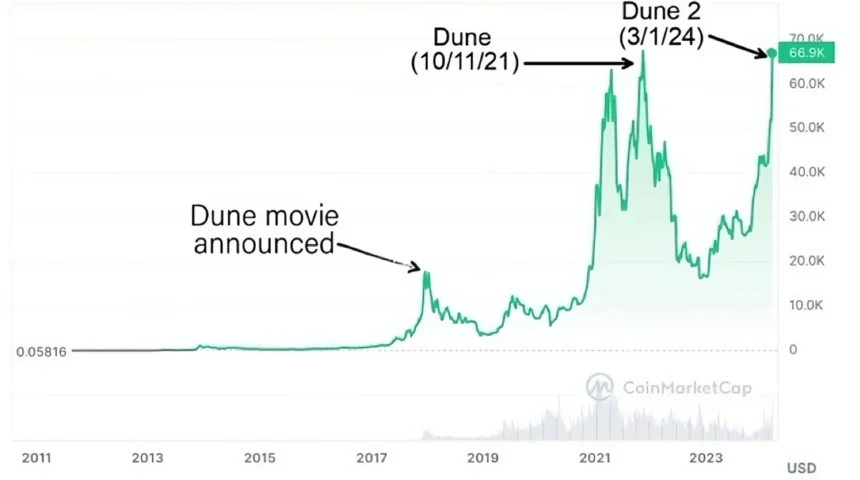
Roughly one month before the April 2024 halving, bitcoin defied historical precedent by surging to a new all-time high of $73,750. In the three previous halving cycles, the asset had never closed a monthly candle near an all-time high just weeks before the supply reduction event. By March 31, 2024, bitcoin closed at approximately $70,300, marking the highest weekly, monthly, and quarterly close in its history. This anomaly suggested that traditional predictive models based on past cycles could no longer be trusted blindly.

The 2024 cycle introduced a fundamental structural shift: the formal entry of Wall Street. On January 10, 2024, the U.S. Securities and Exchange Commission approved multiple spot Bitcoin exchange-traded funds (ETFs). These regulated financial products opened the asset class to pension funds, 401(k) retirement accounts, and retail investors who previously lacked secure, direct avenues for exposure. When retail and institutional clients purchase shares in these ETFs, the underlying funds acquire physical bitcoin, creating continuous baseline demand that intersects directly with the reduced block issuance.
As the block reward dropped to 3.125 BTC, miners absorbed an immediate 50 percent reduction in revenue per block. While some operations faced the threat of going underwater, the broader macroeconomic and structural environment differed vastly from previous eras.

Navigating the Post-Halving Reality
Traditional pricing models and historical comparisons remain useful analytical tools, but their predictive accuracy diminishes when an asset class undergoes structural evolution. During early halving cycles, Bitcoin was largely speculative and poorly understood by mainstream financial institutions. By contrast, the landscape leading into the fourth halving featured sovereign entities utilizing excess hydro energy and geothermal power from volcanoes for mining operations, alongside multi-billion-dollar institutional investment vehicles.
While market participants continue to speculate on future price trajectories using various methodologies, these projections remain educated guesses. The underlying certainty supporting the network is the ongoing global demand for a borderless, decentralized, and strictly limited digital monetary standard. Analysts and market observers emphasize that a deep, foundational understanding of Bitcoin’s protocol mechanics provides more utility than relying solely on rigid mathematical models.

To survive the immediate financial pressures introduced by the halving, mining operations have turned to advanced technological efficiencies. Companies utilize specialized firmware to optimize hardware performance, streamline operational workflows, and reduce overhead costs. Infrastructure solutions such as Braiins OS allow miners to improve the efficiency ratios of standard equipment like the Bitmain Antminer series. Additionally, integrated mining pools offering zero-pool fees and instant Lightning Network payouts help operators manage liquidity more effectively, while remote management tools enable operators to curtail hash rate and power consumption dynamically during periods of high energy costs or low profitability.
As the network adjusts to its fourth halving era, miners and long-term participants continue to balance operational survival with the milestone of navigating a supply schedule where only 32 total halvings will ever occur.

Related News