Exploring the Economics of Independence: Josef Těték’s New Book Argues Bitcoin is the Ultimate Separation of Money and State
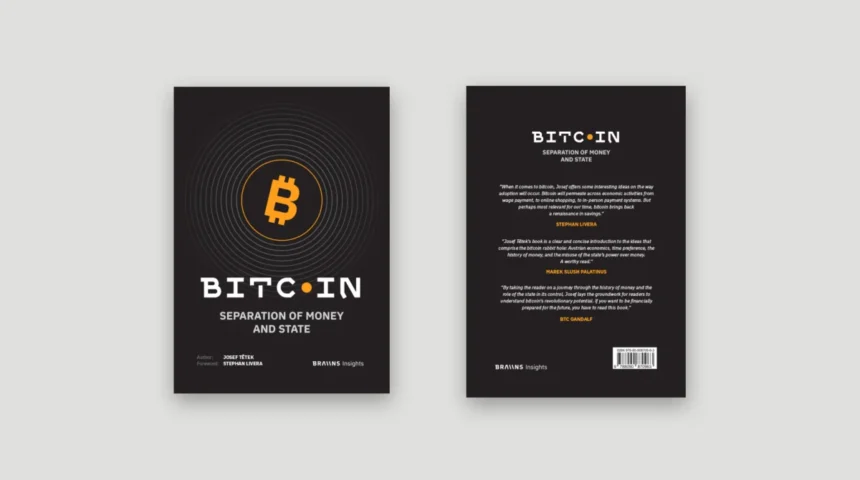
As humanity navigates what many economists describe as a critical juncture in monetary history, the debate over who controls the money supply has taken center stage. In his newly released book, Bitcoin: Separation of Money and State, Czech economist and Trezor analyst Josef Těték offers a comprehensive examination of state-controlled currencies, the historical failures of centralized monetary policy, and the unique position Bitcoin occupies as a decentralized alternative. Through a blend of economic history, Austrian economic theory, and accessible analysis, the book challenges readers to reconsider the fundamental relationship between government and money.
Bitcoin Journeys Start With Why
For proponents of the digital asset, commonly known as Bitcoiners, inquiry often begins with fundamental questions about the nature of modern finance. Why must the state maintain a monopoly on currency? Why do central banks target an annual inflation rate of two percent? And why is inflation frequently described as a regressive tax that disproportionately impacts lower-income households?
In Bitcoin: Separation of Money and State, Těték tackles these foundational inquiries head-on. By drawing upon the principles of the Austrian School of economics—which has long argued against state interference in monetary policy—the author explores the historical consequences of governments holding absolute power over the medium of exchange. For the vast majority of recorded human history, some form of governing authority has controlled the issuance and management of money. According to Těték’s analysis, this centralized control has repeatedly yielded detrimental outcomes for society at large, laying the groundwork for a systematic evaluation of free-market monetary alternatives.

A Historical Precedent of Debasement and Inflation
To understand the arguments surrounding Bitcoin, Těték guides readers through a broad historical overview of money, examining ancient currencies such as the Greek Drachma, the Roman Denarius and Aureus, the Byzantine Solidus, and ultimately, modern paper money. Across these eras, the book demonstrates how centralized monetary decisions ultimately imposed heavy economic burdens on the general populace, underscoring the enduring appeal of hard, decentralized assets.
In ancient times, societies functioned effectively on gold and silver standards until governing bodies required funding for expenditures they could not otherwise afford. This dynamic gave rise to currency debasement—the practice of mixing base metals with precious metals in coins to artificially inflate the money supply. Historical records show that the third century AD witnessed some of the most severe currency debasements in the history of the Roman Empire, eroding purchasing power and destabilizing economic structures.
Eventually, states transitioned away from metallic currency entirely, introducing paper notes intended to represent ownership of gold or silver stored securely elsewhere. While proponents argued this innovation would streamline commerce, the historical results proved turbulent. Těték cites historical research from The Creature from Jekyll Island to illustrate the catastrophic impact of early paper money experiments in the American colonies. By the late 1750s, prices in Connecticut had surged by 800 percent, with inflation reaching 900 percent in the Carolinas, 1,000 percent in Massachusetts, and an astounding 2,300 percent in Rhode Island. As the author notes, these inflationary episodes inevitably ran their course, culminating in equally devastating deflations and deep economic depressions.

This cycle of monetary expansion and contraction persisted long after the Thirteen Colonies established the United States. Těték’s analysis delves into various chapters of American monetary policy, ranging from bimetallism and the establishment of the Federal Reserve System to the controversial Executive Order 6102—which effectively required citizens to surrender their gold holdings to the government—and the eventual, ostensibly "temporary" removal of the gold standard.
The Case for Neutral Money
Positioned against this turbulent backdrop of historical missteps, Bitcoin emerges as a radical departure from traditional monetary evolution. Těték contends that contemporary society is living through the most critical monetary period in human history. For the first time, individuals have access to a currency that operates entirely independently of physical commodities like gold and silver, and which requires no governing committee or centralized authority to dictate financial policy. In this context, disruption is framed not as a threat, but as a necessary correction to centuries of economic mismanagement.
Central to the book’s thesis is the concept of monetary neutrality. Těték posits that money possesses no inherent ability to create wealth; rather, it functions as a mechanism for transferring wealth from producers of goods and services to those who control the issuance of the currency. Just as modern democratic societies have established institutional separations between the state and religion, education, and the media, the author argues that true economic freedom requires a definitive separation between money and state. In this framework, Bitcoin is presented as the world’s first truly neutral monetary network—a digital asset that fulfills the criteria of sound money without relying on the enforcement or goodwill of a governing authority.

Availability and Outreach
Authored by Josef Těték—a prominent bitcoin analyst at Trezor who is well-known for his educational efforts through initiatives like Trezor Academy and his active presence at global cryptocurrency conferences—Bitcoin: Separation of Money and State is designed to reach a wide audience. The publication is currently available in multiple formats to facilitate accessibility and education within the broader financial community.
Readers interested in physical copies can purchase the book through selected retail platforms including the Braiins Shop and Amazon. Additionally, for those seeking digital access or looking to share the material with others, electronic versions and an audiobook narrated by BTC Gandalf have been made available online at no cost. Through these multifaceted outreach efforts, the work continues to contribute to the ongoing global dialogue regarding the future of money, monetary sovereignty, and the expanding role of decentralized digital assets in the modern economy.

Related News