Griffin May Be Right About AI, But Timing the Bubble Could Be a Costly Mistake
By Lance Roberts | October 26, 2026
To paraphrase legendary investor Peter Lynch, timing the artificial intelligence bubble is the hardest part of market navigation, and financial history demonstrates that heading to cash prematurely can ultimately cost an investor far more than the market crash itself.

Citadel founder Ken Griffin told a room full of investors recently that the financial markets are "almost certainly" trapped inside an artificial intelligence bubble. He may well be correct in that assessment, and there are certainly plenty of mainstream media narratives and equity valuation metrics that support that view. However, as is so often the case in market history, being "right" is not the same thing as executing a profitable trade. Successfully timing the deflation of the AI bubble is where fortunes are won or lost, and financial history is littered with brilliant individuals who correctly identified a speculative bubble only to cost their clients a fortune by acting on that insight far too soon.
As Howard Marks famously noted, being right and being early is functionally the same thing as being wrong. While remaining entirely neutral on the ultimate outcome of the technological cycle, analysts face two prevailing arguments that currently dominate Wall Street discussions, both of which contain significant elements of truth. The central question that truly matters for any investor’s portfolio is how to navigate the markets while both of these contradictory truths remain valid, potentially for years to come.
Griffin’s comments at Citadel’s Future of Global Markets conference were not meant as a wholesale dismissal of artificial intelligence. Instead, they served as a clinical description of how every major technological revolution gets financed throughout economic history. Any radical transformation of the global economy is generally intertwined with a speculative bubble, and Corporate America has demonstrated a very uneven ability to extract actual financial value from its artificial intelligence models thus far.

That perspective appears accurate. However, just a day later during an appearance on Bloomberg Television, BlackRock CEO Larry Fink highlighted the opposite risk. Compute power remains scarce and expensive, Fink argued, noting that the faster the industry can build out additional data centers and expand computing capacity, the faster it can bring down overall costs. In Fink’s view, the genuine economic danger lies in slowing down this critical infrastructure buildout, a slowdown that he warns could ultimately jeopardize broader economic health.
The critical takeaway to incorporate into one’s investment strategy is that Griffin and Fink do not actually hold opposing views. Griffin is describing the high price investors are paying for future growth, while Fink is addressing whether the underlying physical infrastructure needs to exist at all. Historically, railroads, electrification, and fiber optics completely transformed the modern economy, yet all three innovations simultaneously destroyed a vast amount of the underlying capital that built them out. Both arguments can exist at the exact same time. Most uncomfortably for equity investors, this dynamic means that a speculative bubble and genuine technological progress can run parallel to one another for a remarkably long time.
Analyzing Griffin’s cautionary stance requires examining the actual fundamentals driving the market. We can start by addressing the popular permabear narrative claiming that artificial intelligence is an unmitigated bubble because it lacks underlying revenue. That characterization is factually inaccurate. Anthropic, for instance, booked $16.3 billion in revenue during the first half of 2026, marking a massive surge from just $1.1 billion a year earlier, according to regulatory filings reviewed by the Wall Street Journal. The underlying issue is not a total lack of revenue, but rather the sheer scale of the capital expenditure bill relative to those incoming funds. The same corporate filings reveal roughly $450 billion in compute commitments scheduled over the coming decade, much of it legally payable regardless of whether the capacity is ultimately utilized, with total obligations reaching up to $750 billion including deals still under active negotiation.
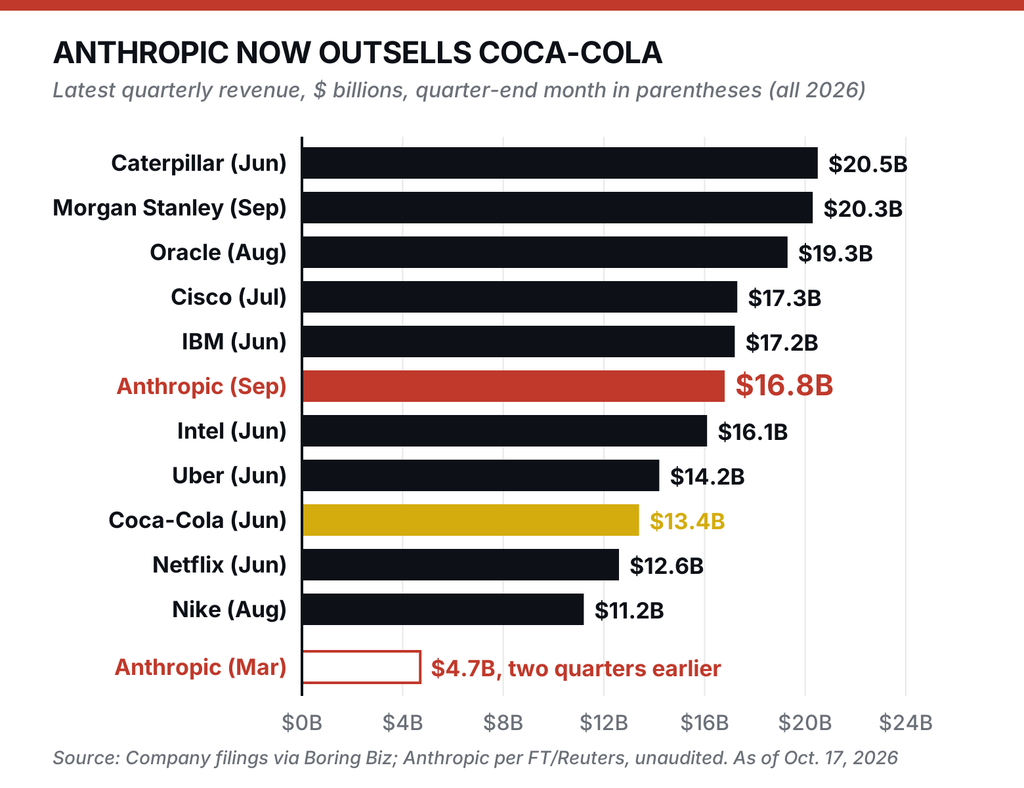
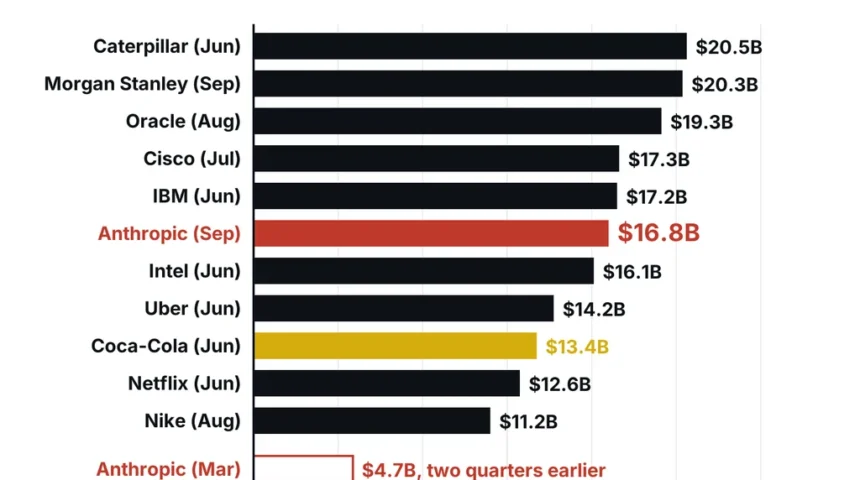
Putting that $16 billion revenue figure into historical perspective is essential before jumping to catastrophic conclusions. Anthropic did not commercialize its first product until 2023, whereas a legacy giant like Coca-Cola has been selling soda since 1886. Yet during the September quarter alone, Anthropic booked $16.8 billion in revenue, eclipsing the quarterly figures of established enterprises like Coca-Cola, Netflix, Uber, or Intel, and more than tripling the $4.7 billion reported just two quarters prior.
Annualizing that stellar quarterly performance pushes the revenue run rate near $67 billion, which already exceeds the roughly $45 billion a year average of its signed commitments over the next decade. Furthermore, the financing structure of the broader AI buildout is undergoing a fundamental evolution. While hyperscalers initially funded early data center development entirely from internal free cash flow, Goldman Sachs’ credit team now projects that project finance combined with direct hyperscaler debt issuance will hit roughly $720 billion by 2027, up significantly from approximately $37 billion of project finance in 2025. Because artificial intelligence capital expenditures currently drive roughly half of overall S&P 500 earnings growth, the immediate risk is not necessarily that spending sharply declines and crushes corporate earnings, but rather that spending simply stops accelerating at its previous breakneck pace.
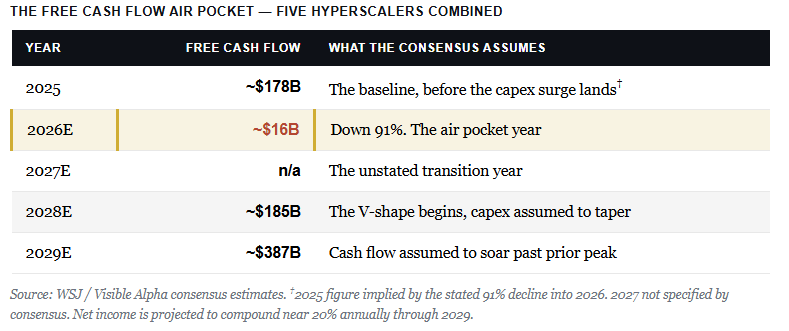
A temporary decline in free cash flow is not automatically a warning sign for the broader market. What truly matters is the underlying reason why free cash flow is contracting. A corporate entity burning through cash reserves because customers are abandoning its platform or profit margins are collapsing is facing a severe operational problem. Conversely, a highly profitable enterprise choosing to intentionally pour its cash reserves into building new capacity has made a deliberate long-term investment decision. Consensus estimates suggest that the combined free cash flow of the five major hyperscalers will drop roughly 91% over the course of the year to about $16 billion before recovering to roughly $185 billion in 2028 and nearly $387 billion by 2029 once the heaviest phases of physical construction are completed. The contraction in free cash flow is entirely real, but the decisive factor is whether the financial returns on that massive spending materialize before corporate debt obligations come due.
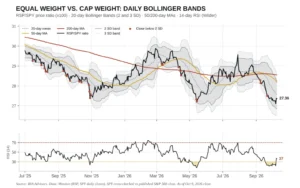
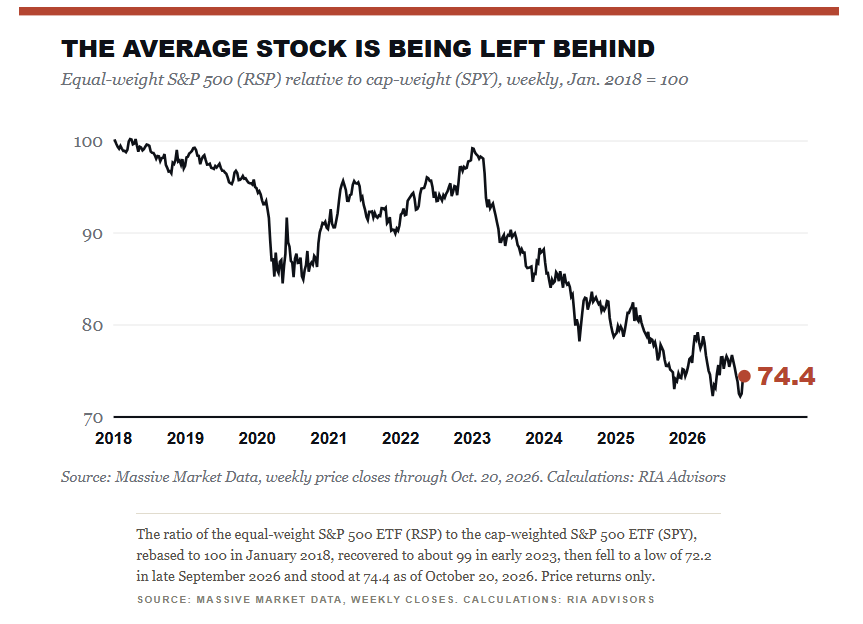
Market breadth presents another major analytical hurdle. A healthy equity market is typically characterized by average stocks keeping pace with market-value giants. However, since January 2018, the equal-weight S&P 500 index has lost about 26% relative to the traditional cap-weighted index, with the vast majority of that relative damage accumulating after the artificial intelligence trade took definitive hold in 2023.
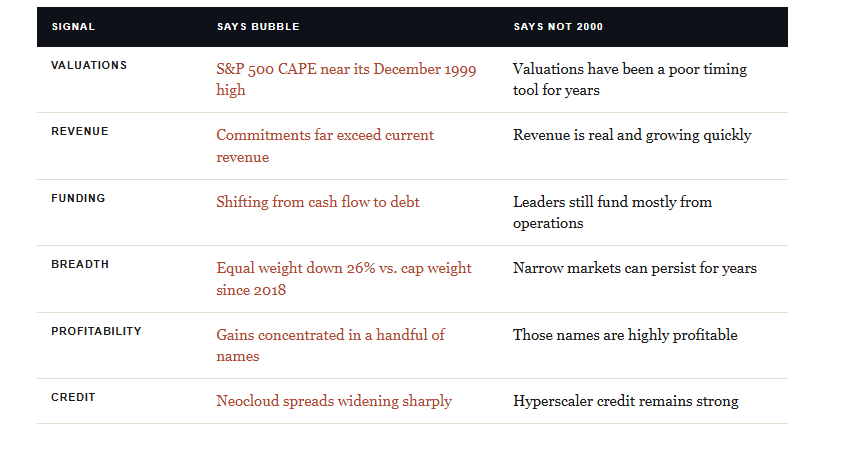
Evaluating whether this environment mirrors the dot-com mania of 2000 requires nuanced historical comparison. Reviewing multiple market indicators reveals a mixed picture when compared against 1999, with some metrics looking remarkably similar while others appear far more resilient. A critical distinction is that the undisputed leaders of the current cycle are not speculative ventures that went public with mere months of cash reserves; instead, modern leaders like Microsoft, Alphabet, Amazon, and Meta generate staggering amounts of net profit and fund the vast majority of their ambitious capital spending directly from ongoing business operations.
The broader macroeconomic productivity argument also warrants serious consideration. During the early 1980s, personal computers began appearing everywhere in offices and homes, yet they did not show up in official economic productivity statistics in a meaningful way until the mid-1990s. Flat productivity growth figures today may simply indicate that artificial intelligence is still in its infancy rather than serving as evidence of a systemic failure, which remains the primary argument for market bears.
Weighing both sides of the argument leaves the definitive answer to whether this is a bubble as a tentative "maybe." This conclusion is not an analytical dodge, but rather an honest reflection of what available empirical evidence indicates.
Assuming for a moment that Ken Griffin is entirely correct in his assessment, the logical question for an investor is whether they should immediately liquidate their equity portfolio. Historical precedent answers with a definitive no, or at least not yet. Recognizing an asset bubble is an independent skill, but mastering the exact timing required to take defensive action is an entirely different discipline. This artificial intelligence cycle will prove no different.
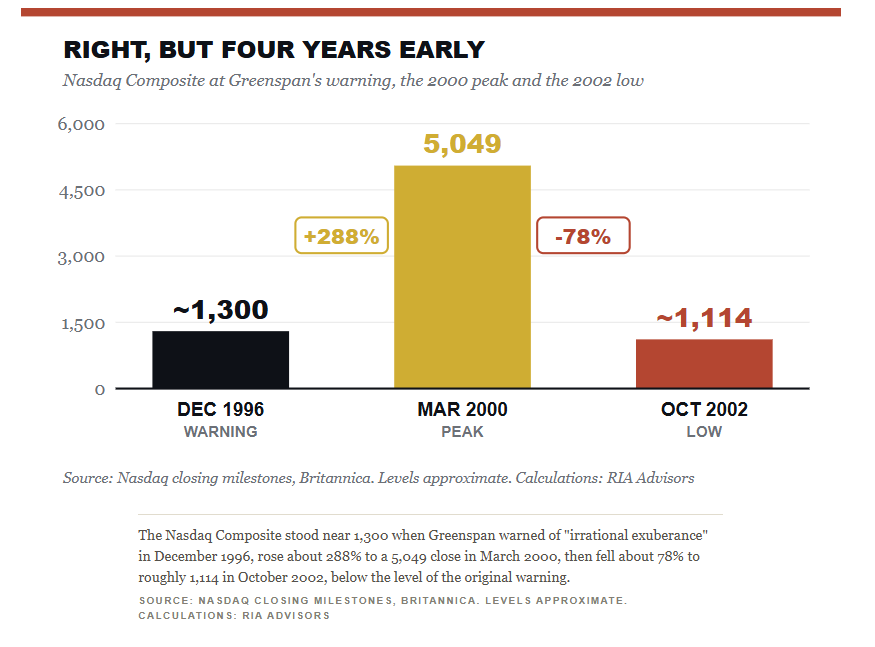
Federal Reserve Chairman Alan Greenspan famously warned of "irrational exuberance" on December 5, 1996, at a time when the Nasdaq was hovering near the 1,300 mark. Greenspan’s macroeconomic assessment was ultimately 100% accurate. The practical problem for investors who heeded his warning by immediately selling their portfolios was that the Nasdaq continued to nearly quadruple in value, ultimately closing at 5,048.62 on March 10, 2000. Only after that breathtaking multi-year advance did the speculative exuberance finally shatter, resulting in a devastating 78% decline in the index by October 2002. While the official warning eventually came to fruition, it required investors to sit on the sidelines for more than three years watching other market participants accumulate massive wealth, a psychological burden most individuals cannot tolerate, frequently leading them to buy back in near the absolute market peak.

A more recent parallel can be found in the market environment leading up to 2020. Numerous analysts argued that the equity market was locked in an extended bubble backed by stretched valuation metrics. By January 2020, long-term market valuations sat nearly 90% above historical medians, with only an external catalyst missing to inject widespread fear into a complacent investor base. When the COVID-19 pandemic struck weeks later, it served as that exact catalyst, triggering a swift 35% market correction. Yet an investor who liquidated their portfolio in late 2019 out of fear of a bursting bubble and failed to re-engage following the pandemic washout incurred a massive opportunity cost.
An investor who moved entirely to cash in October 2019 would require a market correction far worse than the 2008 financial crisis simply to break even with an investor who maintained their equity exposure. Even an investor who sold during subsequent bubble warnings in early 2021—and saw their caution partially vindicated by the 2002 bear market—would still require stocks to plunge roughly 44% today just to catch up to the patient investor. Being early on a bubble call is not a minor miscalculation; the financial penalty compounds with every passing year that the speculative cycle continues to inflate.
Valuations remain critically important because they provide valuable insight into long-term expected returns, even if they serve as notoriously poor short-term market timing tools. Both of these investment realities remain true simultaneously, which is precisely why portfolio management decisions should rarely be framed as a simplistic binary choice between being fully invested or holding 100% cash.
The bearish case cannot be dismissed lightly, as historical equity bubbles inevitably break, leaving severe destruction in their wake. The largest equity bubble drawdowns in financial history have ranged from 57% to 99%. Following the dot-com crash, the Nasdaq required 15 years to regain its previous 2000 peak, while Japan’s Nikkei average took approximately 34 years to recover.
This underlying vulnerability means every individual investor must evaluate their personal financial circumstances, particularly regarding their investment timeline. The mathematical reality of staying invested works remarkably well for an investor with a 20-year horizon, but presents severe risks for someone retiring in three years. Time is an irreplaceable asset, and while a 50% market drawdown is mathematically survivable at age 40, taking a similar hit at age 65 while actively drawing income from a portfolio can permanently fracture a retirement plan. An individual’s personal timeline, rather than macroeconomic bubble forecasts, should dictate their portfolio risk tolerance.
Participation in a potential bubble without a clear framework carries significant hazards, yet abandoning the equity market entirely carries an equally steep historical penalty. The optimal approach involves maintaining market participation governed by strict, pre-determined rules established during periods of calm rather than being formulated in the heat of a sudden market drawdown.
Investors should avoid viewing portfolio management as a simple light switch that flips between fully invested and entirely in cash, instead opting to adjust risk exposure incrementally as conditions evolve. Setting clear position limits in writing before deploying capital helps manage exposure to high-flying sectors, while systematic rebalancing on a fixed calendar schedule enforces disciplined profit-taking. Focusing capital on established enterprises that fund their technological investments through organic free cash flow rather than heavy debt issuance provides an added layer of safety. Furthermore, defining strict exit parameters in advance—such as monitoring moving averages, credit spreads, and broader market liquidity—ensures that investors retain control when monetary conditions eventually shift.
Ultimately, market bubbles always end. The central challenge facing investors is ensuring their capital remains intact and productive when the cycle finally turns.

Related News