Digital Marketing in Fintech and Financial Services: Performance, AI Integration, and the Rise of Answer Engine Optimization

A comprehensive new study sheds light on the evolving digital marketing strategies of the financial services and fintech sectors, highlighting both the successes of current practices and the emerging challenges of technological integration. Conducted by the Fin.Tech Marketing Community in partnership with digital marketing agency Accuracast, the research surveyed 105 marketing leaders to gauge the current state of digital marketing across the industry.
The findings illuminate several key industry trends, demonstrating that while foundational digital marketing techniques continue to deliver reliable, positive results, modern strategies are pivoting heavily toward answer engine optimization (AEO) and artificial intelligence (AI). However, the study also underscores significant governance gaps in how organizations deploy these new technologies, pointing to a disconnect between rapid adoption and formalized strategic oversight.
Digital Marketing Performance Meets Expectations
According to the study, digital marketing performance within financial services and fintech consistently meets baseline expectations. The vast majority of survey respondents reported performance levels that either matched or exceeded their initial projections. Specifically, between 17.5% and 52.5% of marketing leaders cited early positive or strong measurable gains across various marketing functions, demonstrating that standard digital tactics remain fundamentally sound.
Among the various applications, audience personalization and marketing analytics currently yield the strongest measurable results. Approximately one-third of respondents reported witnessing a significant commercial impact from these capabilities, reflecting the industry’s ongoing push toward data-driven, highly targeted customer interactions.

Conversely, sales and marketing alignment holds the highest future expectations. While only 25% of surveyed marketing leaders currently report a strong impact from this alignment, an impressive 60% anticipate high returns over a three-to-five-year horizon. This suggests that bridging the traditional gap between revenue-generating sales teams and brand-building marketing departments remains a primary strategic objective for the coming years.
Strategic planning is already shifting to capture these expected payoffs. AEO and AI search visibility attracted the most targeted new investment for the year, cited by 32.5% of respondents. Interestingly, this heavy investment is occurring despite limited early return on investment data. Only 27.5% of participants reported positive improvements from AEO initiatives, while 22.5% noted no measurable results yet, indicating that firms are betting early on a rapidly changing search landscape.

AEO fundamentally alters how companies approach online visibility. Rather than optimizing purely for traditional keyword rankings, the practice involves structuring, writing, and marking up web content so that AI-powered answer engines, large language models, voice assistants, and featured snippets can easily extract, summarize, and cite the information as a direct answer.
Impact Concentrates at the Top of the Funnel
The research reveals that the tangible benefits of digital marketing in financial services remain heavily concentrated at the top of the marketing funnel, particularly in building brand awareness and attracting prospective customers. When asked to identify the single area of digital marketing with the greatest positive effect on outcomes, 25.64% of respondents pointed to audience targeting quality and relevance. Another 23.08% cited the speed and volume of content output.

Beyond primary impact areas, broader metrics also reflect this top-of-funnel emphasis. Roughly 38.46% of participants noted meaningful positive impacts on engagement rates with priority accounts or key segments, while 33.33% highlighted improvements in brand perception and credibility among target audiences.
In stark contrast, bottom-of-funnel metrics show considerably less progress. Customer acquisition cost optimization and customer retention were each cited by just 17.95% of respondents as areas of significant improvement. Furthermore, internal operational efficiency was virtually overlooked as a primary benefit, with zero respondents listing it as their top advantage and only 15% citing it as a secondary benefit. This distribution indicates that marketing budgets and digital efforts remain predominantly geared toward visibility and initial acquisition rather than long-term retention or cost reduction.

Paid Search, Organic, and Email Lead as Top Channels
When examining the channel mix, paid search, organic search, and email continue to form the bedrock of financial marketing operations. Each of these channels was credited by 20% of respondents for delivering strong and measurable return on investment. Furthermore, organic search leads pilot activity, serving as the primary testing ground as teams experiment with AEO integration.
Looking further ahead, however, expectations and investment plans are notably fragmented across different channels, with no single platform emerging as a universal growth driver. Content syndication—the practice of republishing or distributing existing content on third-party websites or external platforms—exhibited the widest variance in opinion. While 20% of respondents plan no investment in the tactic, nearly 30% expect it to evolve into a primary customer acquisition channel over the next three to five years.

Owned media ranked lowest among primary growth drivers, with only 11.76% of respondents expecting it to lead acquisition efforts. Instead, half of the surveyed marketing leaders place owned media in a supporting role behind paid channels and third-party media platforms, reflecting the structural difficulty of driving organic traffic entirely independently in a crowded digital marketplace.
Few Firms Have a Formal AI Integration Strategy
While AI adoption is widespread across financial marketing functions, the depth of strategic integration varies wildly. Three-quarters of survey respondents reported utilizing AI capabilities across multiple operational areas, while an additional 19.4% have deployed AI in isolated pockets, largely driven by individual employee initiative rather than top-down mandates.

Despite this broad usage, formal strategy lags behind. More than 44% of marketing leaders admitted to using AI consistently in various functions without a formal, overarching integration strategy. Industry analysts note that this deficit points directly to looming vulnerabilities in governance, cross-departmental alignment, scalability, and the ability to capture the full organizational value of these advanced tools.
Performance measurement displays a similarly divided landscape. Just over 34% of respondents track defined key performance indicators for AI on a regular schedule, while an equal percentage rely entirely on informal indicators. The remaining organizations either depend on directional judgment, lack standardized metrics altogether, or consider themselves too early in their AI adoption lifecycle to properly assess results.

Overall sentiment toward AI remains cautiously optimistic. Approximately 32.5% of finance marketers view aggressive AI adoption as a positive indicator of corporate innovation, while 27.5% remain indifferent.
This internal technological shift coincides with a massive external transformation in how consumers discover and evaluate financial services. The soaring adoption of conversational AI platforms like ChatGPT has turned these chatbots into major sources of information, effectively creating entirely new channels for marketing outreach and discovery.

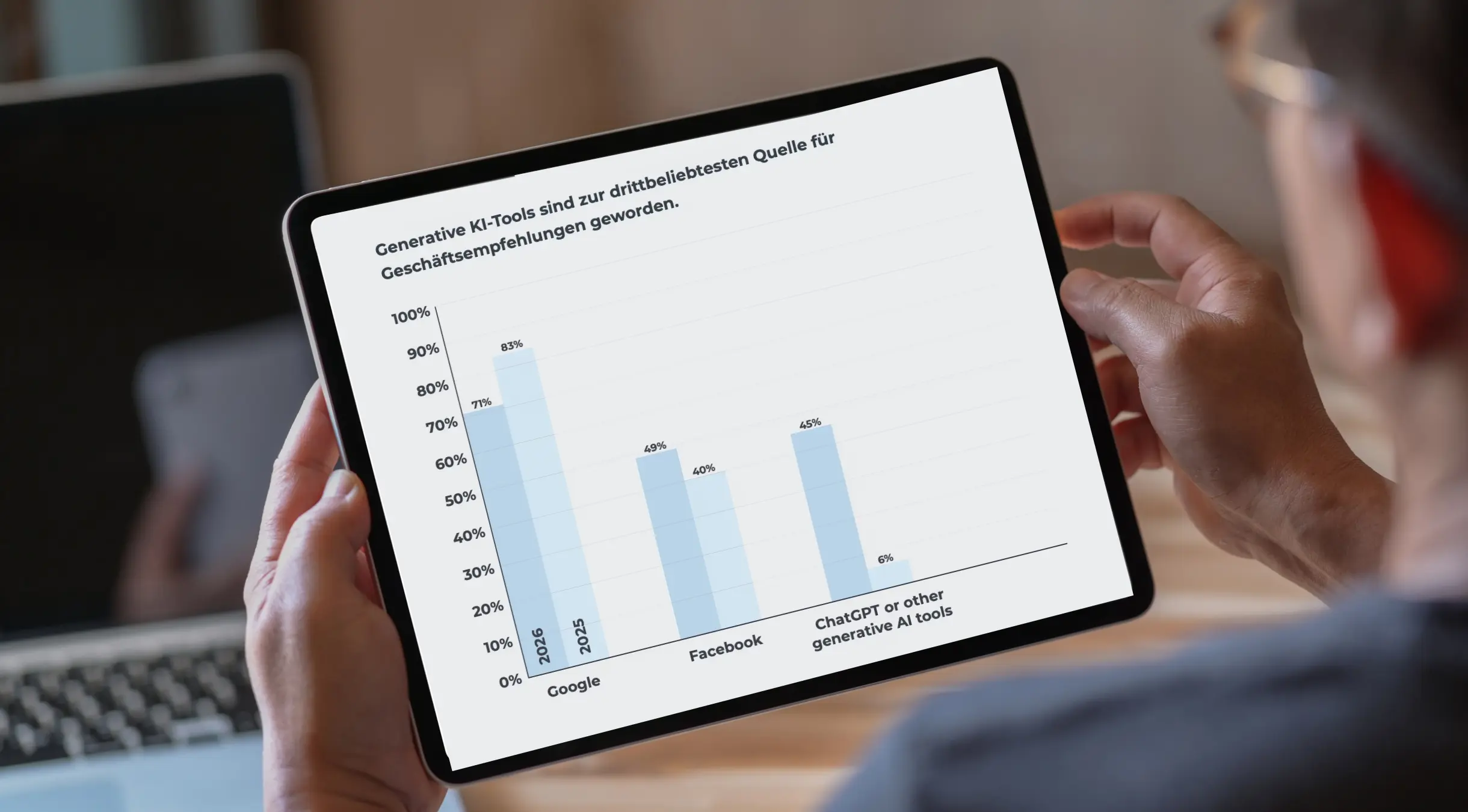
Recent market data underscores this behavioral shift away from traditional search mechanisms. According to a 2026 report by Swiss software firm hypt, consumer usage of large language models for search surged dramatically from just 6% in 2025 to 45% in 2026. Concurrently, reliance on traditional search engines for local recommendations dropped from 83% down to 71% over the same period.
This migration from classical search engines to generative AI assistants is projected to accelerate globally. Industry forecasts from research firms like Gartner anticipate a continuous decline in traditional search engine volume as consumers increasingly turn to conversational virtual agents, forcing financial services and fintech marketers to fundamentally rethink their digital visibility strategies for the years ahead.

Related News