Huawei’s Fintelligent AI Solution Tackles Control and Scalability Challenges in Modern Banking
The rapid acceleration of artificial intelligence across the financial sector has brought efficiency to unprecedented heights, but it has also forced institutions to confront a fundamental question: How much control does a bank really have over the AI it uses?
To understand the core operational challenge, one can picture a typical scenario unfolding inside a modern commercial bank. A relationship manager sits at a desk, carefully reviewing a comprehensive credit memo drafted entirely by an artificial intelligence agent. Before the banker can safely rely on the automated assessment, several critical questions must be answered. The banker needs to know precisely which historical customer records and data points informed the underlying assessment, and they must verify whether the AI agent rigorously adhered to the bank’s most current lending policies.
This scenario becomes exponentially more complex as digital transformation spreads across an entire enterprise. Once other departments—from wealth management to compliance—begin building and deploying their own autonomous agents, keeping track of them transforms from a routine administrative task into a full-time job. As adoption accelerates organically, different teams risk duplicating expensive work, accidentally relying on conflicting versions of internal policies, and struggling to monitor and attribute computing costs across disparate departments.
Managing that fragmented work across departments is a primary challenge that Huawei aims to address with its newly launched Fintelligent AI Solution, which provides a shared, centralized foundation for developing, deploying, and operating AI agents across financial institutions.
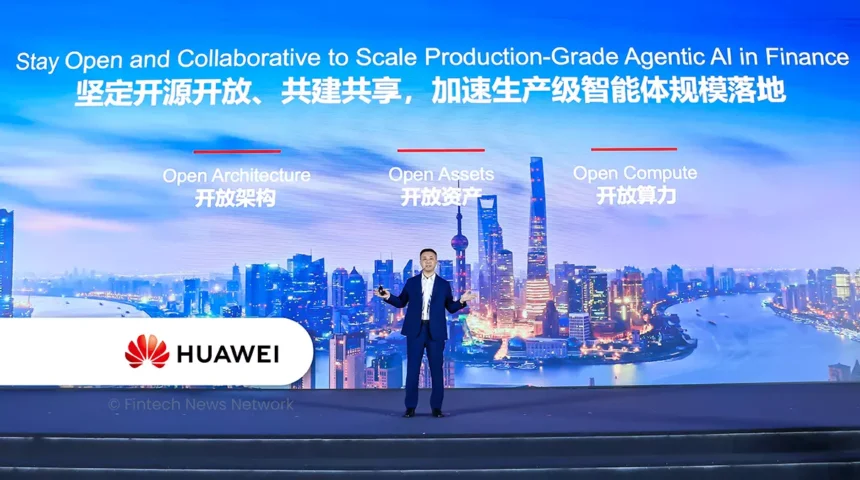
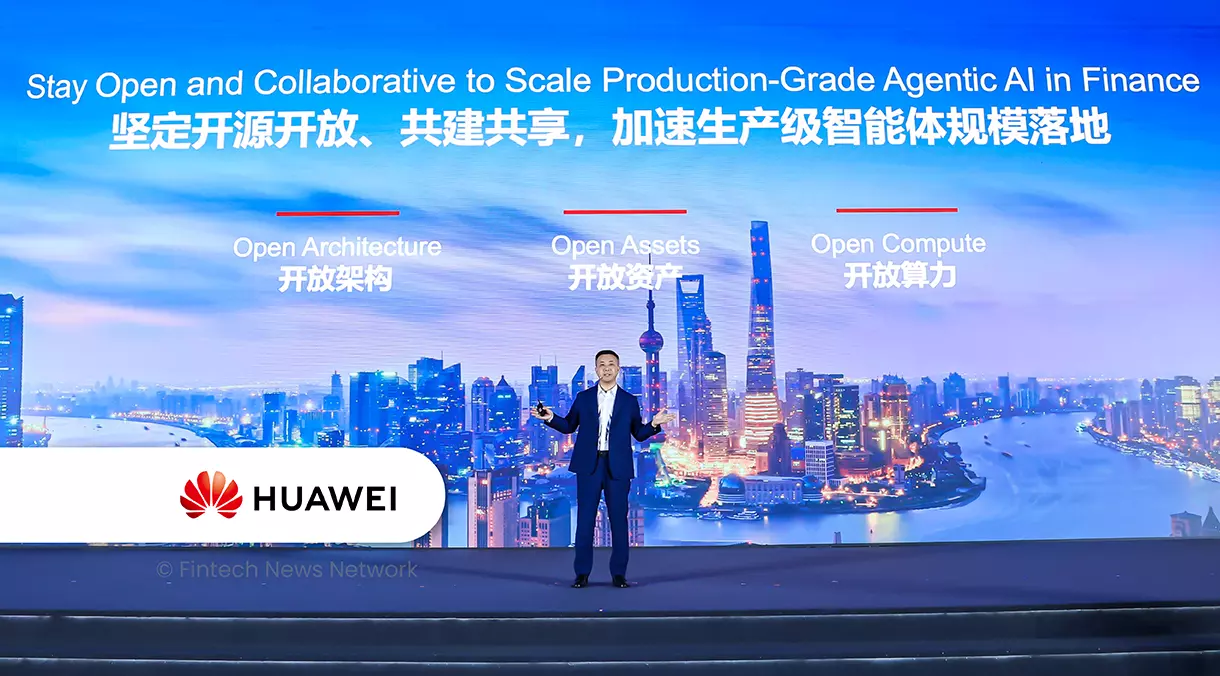
Huawei officially launched the comprehensive solution at the Global Finance Summit during HUAWEI CONNECT 2026, held in Shanghai on 18 September 2026. Jason Cao, CEO of Huawei Digital Finance BU, presented Fintelligent as a strategic mechanism for banks to retain absolute control over how they develop and leverage artificial intelligence. Explaining the core philosophy behind the architecture in the company’s official launch announcement, Cao emphasized the necessity of institutional autonomy in the digital age, stating that every financial institution should own its AI and keep the choice and evolution of AI firmly in its own hands.
For a commercial bank, this vision translates into retaining meaningful choice over its foundational AI architecture and underlying models, building a repository of reusable institutional knowledge and specialized agent assets, and maintaining the long-term operational capacity to govern and improve those systems as technology evolves. Huawei’s approach fundamentally includes making the individual agents and specialized knowledge developed within one business unit readily available for other teams to discover and reuse.
To achieve this, Fintelligent connects these diverse capabilities through an open hybrid AI architecture anchored by three core operational components known as the Agent Factory, the Token Factory, and the Data-Knowledge Factory.
Managing Agents Across the Bank
The pressure to establish robust governance frameworks comes at a time of widespread, yet uneven, industry adoption. Recent research published by Cambridge in 2026 found that approximately 81% of surveyed financial-services firms were actively adopting artificial intelligence at some level of operation. However, the survey also revealed a stark disparity in strategic impact: just 14% of those organizations considered AI to be genuinely transformational to their overarching organizational strategy and competitive advantage.
A prominent industry example of large-scale deployment is visible at DBS, where an advanced AI credit-memo tool currently supports roughly 1,500 employees worldwide. The system is designed to handle more than 70 distinct tasks and data-gathering processes traditionally associated with preparing complex credit documents. Despite the heavy lifting performed by the technology, human oversight remains absolute. Relationship managers and credit risk managers thoroughly review the automated drafts and retain full professional responsibility for the final, submitted memo.
As financial institutions run these advanced applications across multiple departments simultaneously, they face an urgent operational imperative to establish clear accountability: defining precisely who owns each deployed agent and strictly regulating which internal core systems it is authorized to access.
Huawei’s Agent Factory is built around openJiuwen, an open-source agent platform designed to provide a shared, secure foundation for banks to develop, run, manage, and govern autonomous agents. Through openJiuwen, institutions are supported in creating an internal Agent Marketplace. This marketplace allows different departments to share, audit, and reuse specialized agents and technical skills developed across the entire institution, cutting down on redundant software development and reducing integration friction.
Regulatory scrutiny surrounding these deployments is also intensifying globally. Under the Monetary Authority of Singapore’s (MAS) comprehensive AI risk guidelines, issued on 7 October 2026, financial institutions remain strictly accountable for artificial intelligence used in their services and customer touchpoints, even when an outside technology vendor supplies the underlying software or infrastructure.
The MAS framework explicitly expects financial institutions to maintain meticulous inventories of their AI use cases and apply proportionate risk controls, with a heavy emphasis on continuous human oversight. Under the regulatory timeline, institutions are expected to meet the expectations outlined in Sections 3 and 4 of the guidelines starting 7 October 2027, followed by full compliance with Sections 5 and 6 by 7 October 2028.
Managing the Cost of AI at Scale
Operating artificial intelligence at enterprise scale introduces unique financial and computational hurdles. Preparing a complex due diligence report, for instance, can involve processing massive volumes of lengthy documents, whereas a banker simply checking a specific account detail during a live customer conversation requires an immediate, low-latency response. Because workload demands vary so wildly, the choice of appropriate AI models and computing resources must depend heavily on the specific job at hand.
To help banks manage escalating AI operating costs, performance bottlenecks, and infrastructure capacity, Huawei introduced the Token Factory solution, branded as TokeNexus. TokeNexus supports comprehensive token planning, production, scheduling, and mathematical optimization. In the context of large language models, tokens represent the fundamental units of content processed by the AI.
To accommodate varying institutional risk appetites, Huawei’s architecture describes both public-cloud and on-premises deployment options. This flexibility allows banks to carefully weigh different deployment approaches against their specific workload, data security, and performance requirements.
The need for strict financial oversight is underscored by wider industry findings. The same 2026 research from Cambridge discovered that 76% of surveyed large financial institutions struggled significantly to measure the actual return on investment and business value of their AI deployments. For credit teams assessing the financial return of an automated workflow, calculating value requires comparing the direct cost of producing a memo against the hours of staff time saved on preparation, while carefully accounting for the ongoing hours bankers still spend reviewing, editing, and correcting the automated drafts.
Keeping Agents Aligned with Bank Knowledge
One of the most persistent operational risks in enterprise AI deployment is information drift. Internal policy updates must reach autonomous agents just as reliably and quickly as they reach human staff members. If an agent continues to operate using an older, archived document, it could inadvertently apply lending rules, compliance thresholds, or risk tolerances that the bank has already formally replaced.
To mitigate this risk, Huawei’s Financial Agentic Data Solution—a key component of the Data-Knowledge Factory—supplies financial agents with accurate data and real-time knowledge drawn directly from verified institutional records, corporate documents, and updated policy rules. The system’s underlying data pipelines are engineered to continuously supply relevant, up-to-date material as the bank’s internal information landscape shifts.
Beyond traditional credit and lending workflows, Huawei envisions a broader path toward agent-assisted fraud operations. In this model, the nuanced experience and institutional memory of human investigators can be captured as reusable knowledge to support complex case analysis and refine automated detection rules as sophisticated fraud patterns continue to evolve in the wild.
Preserving Business Rules in Legacy Systems
When financial institutions attempt to modernize their technological backbone, they often encounter deep-seated complications regarding legacy software. Business rules that have been embedded for decades within a bank’s software can dictate precisely how it assesses a customer’s loan eligibility. Consequently, software developers must find reliable ways to preserve that intricate institutional logic when they eventually replace or overhaul the underlying application.
Huawei’s AI Coding Solution is designed to assist developers by extracting those deeply buried business rules as structured knowledge that can be directly utilized in modern replacement software. While extracting these rules helps developers preserve vital institutional knowledge during complex IT modernization projects, the newly deployed replacement applications still require rigorous validation before going live.
Ultimately, these practical operational questions give real-world meaning to the concept of truly owning artificial intelligence. The ultimate test for any modern financial institution is whether it retains the autonomy to choose its own technology, safeguard its proprietary business knowledge, and continuously improve its core capabilities as digital adoption expands across the enterprise.

Related News