CISA Issues Urgent Warning as Hackers Chain Plex Flaws in "Plex2Shell" Attacks to Breach Media Servers

The United States Cybersecurity and Infrastructure Security Agency (CISA) has issued an urgent security warning, alerting organizations and individuals that malicious cyber actors are actively exploiting a severe chain of vulnerabilities affecting the widely used Plex Media Server.
Referred to collectively by security professionals as "Plex2Shell," the security issue involves four distinct vulnerabilities within the popular media suite. When chained together in a coordinated exploit, these flaws enable a remote attacker to compromise a server by obtaining the owner’s administrative token and subsequently executing arbitrary code with elevated privileges on the underlying host system.
Plex Media Server is deployed globally by millions of users to organize personal digital libraries—including collections of movies, television shows, music, and photos—and stream that media locally to home devices or remotely over the internet. Because these servers are frequently exposed to the public internet to facilitate remote streaming, the discovery of a critical, actively exploited exploit chain has raised significant security concerns across both consumer and enterprise environments.
In response to the active exploitation campaigns observed in the wild, CISA has officially added the Plex2Shell vulnerabilities to its authoritative Known Exploited Vulnerabilities (KEV) catalog. Under the federal directive, civilian federal agencies are required to prioritize patching affected systems or apply necessary mitigations by October 23, ensuring that vulnerable servers are protected before threat actors can scale their operations.
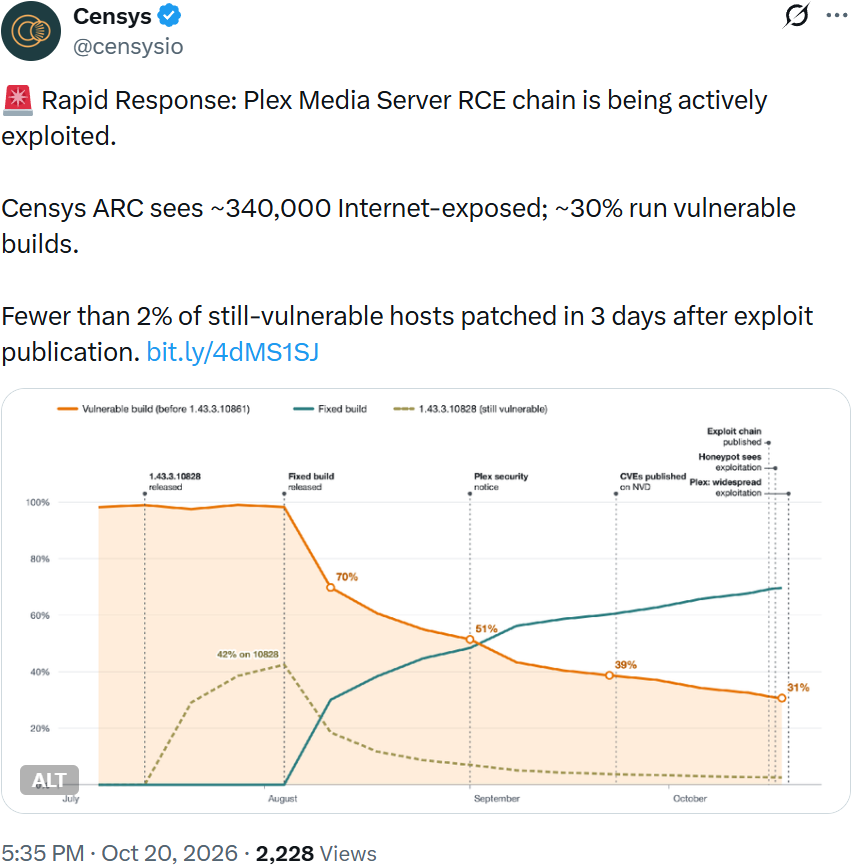
The underlying security flaws were originally discovered by independent security researcher Zach Main, who responsibly reported the vulnerabilities to Plex developers on July 27. While individual components of the flaw range from medium to high severity when evaluated on their own, Main assigned the full, multi-step exploit chain a critical severity score of 9.8 out of a possible 10.0, highlighting the severe risk posed to unpatched infrastructure.

Following the responsible disclosure timeline, Zach Main published full technical details regarding the Plex2Shell vulnerabilities on October 16. Just three days later, on October 19, the security researcher released a proof-of-concept (PoC) exploit to the public, demonstrating how the flaws could be chained together to compromise a target system.
However, malicious actors had already begun capitalizing on the vulnerabilities even before the public release of the proof-of-concept code. On October 17, threat intelligence reports began to emerge indicating that Plex2Shell was actively being exploited in the wild. Initial telemetry showed that these early attack waves primarily targeted exposed Plex honeypots set up by security researchers, with the attackers deploying unauthorized cryptocurrency miners onto the compromised media servers.
The Plex2Shell exploit chain impacts all versions of Plex Media Server released prior to version 1.43.3.10861. Plex formally addressed the security issues by releasing the patched version to users on August 4, giving administrators a crucial window to update their software before technical details and exploit scripts became widely available.
Hackers Also Target Siemens Software Center and Enterprise Infrastructure
The warning regarding Plex Media Server comes as CISA continues to expand its Known Exploited Vulnerabilities catalog to address other high-profile campaigns targeting enterprise software and network security appliances. Alongside the Plex vulnerabilities, CISA recently added an uncontrolled search path element flaw affecting the Siemens Software Center (SSC), tracked officially as CVE-2026-110936.
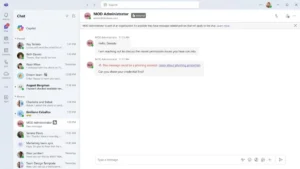
The German technology conglomerate issued an urgent security advisory on October 19, warning system administrators that malicious hackers were actively leveraging the vulnerability in targeted cyberattacks. According to Siemens, these campaigns have been linked to a sophisticated, multi-payload ClickFix delivery platform known as Romulus, which has increasingly been utilized by threat actors to facilitate initial access and malware deployment.
Recent threat analysis published by operational technology (OT) cybersecurity firm Forescout indicates that the Romulus platform may operate as a privately managed panel, a commercial cybercriminal delivery service, an affiliate-based framework, or modular software that has been independently copied and adapted between various threat actor groups. In its advisory, Siemens shared comprehensive indicators of compromise (IoCs) alongside remediation guidance to help organizations identify potentially compromised systems. Administrators managing the platform have been strongly urged to update the Siemens Software Center to version 4.0.9.8 or any later iteration to neutralize the risk.
In addition to the Siemens Software Center flaw, CISA has incorporated another critical security issue into its KEV catalog: CVE-2026-106931. This vulnerability involves an operating system command injection flaw impacting the SiteGuard Server Edition web application firewall (WAF).
Both the product vendor and Japan’s CERT issued warnings late last week after detecting active exploitation of CVE-2026-106931 in the wild, with attackers exploiting the flaw to execute unauthorized commands with system root privileges. To mitigate the vulnerability, the vendor has instructed users to upgrade SiteGuard Server Edition for Apache httpd, Nginx, and IIS to version 8.00 Update 5, and SiteGuard Server Edition for Apache httpd and Nginx on FreeBSD to version 7.00 Update 6 or later.
These concurrent waves of active exploitation across media servers, industrial software managers, and web application firewalls underscore the persistent threat landscape faced by system administrators, where newly disclosed vulnerabilities are rapidly operationalized by malicious actors within days—or even hours—of public technical disclosures.

Related News