OpenAI’s Alexander Embiricos Discusses ‘Dots,’ AI Personal Assistants, and the Future of Autonomous Software at TechCrunch Disrupt
The always-on AI personal assistant, operating quietly in the background even when users are not actively prompting it, has quickly emerged as the tech industry’s defining answer to how everyday consumers will actually interact with advanced deep learning models. While early market traction saw startups like Instinct achieve overnight viral success, major platform players have aggressively entered the fray, with Meta throwing the full weight of its marketing apparatus behind its assistant, Muse.
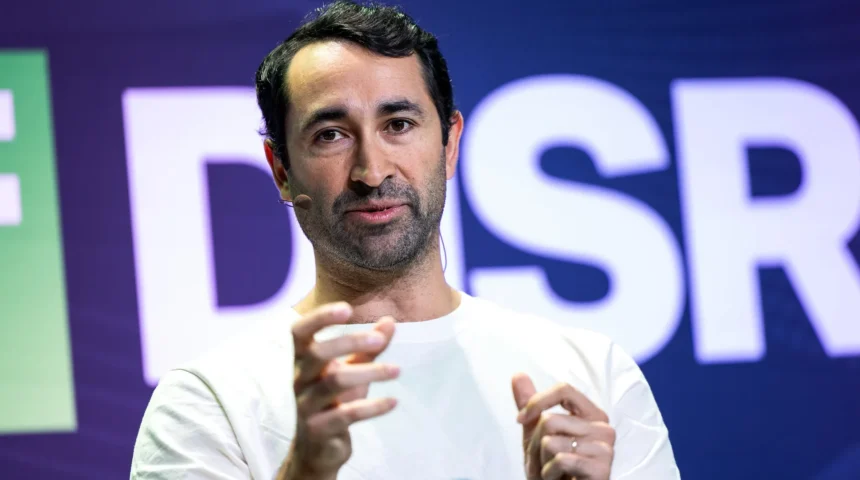
OpenAI was naturally unwilling to be left out of this transformative shift. The company officially launched "dots," its own conversational, agentic assistant offering, during its developer conference in late September. Alexander Embiricos, who leads OpenAI’s enterprise product team, took the stage at TechCrunch Disrupt this month to unpack the origins of the product. His presentation began by addressing a broader industry phenomenon: why so many major technology companies are gravitating toward cutesy mascots and humanized avatars to represent their trillion-parameter matrix multiplication machines.
"There’s kind of this convergent evolution happening," Embiricos said, reflecting on the industry-wide race to build persistent AI assistants. "As we were working on the product, we realized if we could frame this as, it’s an entity and it’s a single conversation, not many different conversations… it starts to become intuitive."
The assistant is currently made available through the ChatGPT desktop and mobile applications, restricted strictly to subscribers on the Pro tier or higher, with subscription plans starting at $100 a month. Once users link the software to their personal calendars, email accounts, computer interfaces, and other digital tools, the autonomous agent actively attempts to streamline their workflows and handle routine administrative burdens.
Embiricos points out that tech-savvy users could technically achieve much of dots’ core functionality using OpenAI’s existing Codex application, a specialized coding tool released earlier this year. However, leveraging Codex for everyday personal management requires significantly more manual effort, configuration, and active hand-holding. Illustrating the shift toward truly passive software, Embiricos recalled celebrating a milestone when his wife began leaving her computer running all night so that her AI agents could continue working while she slept.
"On the product team, what I think about is, how do we make this intuitive and useful to people?" he told Disrupt attendees. "A lot of that isn’t building some new piece of tech into the product; it’s how you frame it to the user and how it feels."
Translating that vision into reality meant repackaging the raw, complex functionality of OpenAI’s underlying models into a far more accessible consumer package. This strategy mirrors the path the company took when it spun ChatGPT Work out of the agentic coding tools originally engineered for software developers. Even the product’s name—a clever nod to the negative space nestled inside OpenAI’s corporate logo—was intentionally chosen to evoke a sense of everyday familiarity, aiming "to feel like just something that could eventually be ubiquitous." Asked when he discovered that rival AI entrepreneur Elon Musk conveniently owns the corresponding dot.com web address, Embiricos admitted with a laugh, "I found out very late."
The foundational premise of a persistent agent is that it operates independently without requiring constant prompting from the user. For OpenAI, this operational model translates directly into higher token usage and consumption. For users, it promises a much more proactive assistant—one that, in Embiricos’ words, is "sort of thinking about you and thinking how to help you."
In practical testing, the assistant’s capacity to think ahead is frequently apparent and often genuinely useful, though the technology is still navigating growing pains. The system is designed to flag impending calendar conflicts and approaching deadlines, but it does not always deliver these warnings in a timely fashion.
"The first time it told me about one of those [conflicts]—this is like early in development—it told me three minutes before the thing," Embiricos said of his personal experience with dot. "It’s like, ‘Hey, this thing is coming up. You might want to do something about it.’ I only have three minutes!"
While Embiricos expects the timing and predictive accuracy to improve steadily over time, the proactive approach remains the bedrock of the product’s philosophy. He shared an anecdote circulating within the tech community involving an engineer at a drone delivery startup. According to the story, the startup suffered an unexpected system outage; by the time the human engineer noticed the failure, their dot had already detected the disruption, independently analyzed the root cause, and approached the user with pre-packaged, actionable solutions to resolve the issue.
Giving Dot the Keys
As with nearly every emerging application for AI agents, the rollout of these systems highlights a persistent tension between the deeply personal data an AI model requires to be genuinely useful and the exact boundaries of how much private information users are comfortable exposing to a technology corporation. Meta’s Muse, for instance, has faced intense public scrutiny for the detailed profiles it builds regarding users’ friends and family members. While this data allows the software to suggest hyper-personalized activities—such as knowing what kind of restaurant a user might enjoy with a specific acquaintance—it also creates a wealth of data that could significantly benefit Meta’s core advertising business. Naturally, this raises questions about whether dots collects similar telemetry.
"Yes, we have a thing that we built into dots, which we call proactive research," Embiricos acknowledged. "On a cadence, it will think about what it knows about you, what is the conversation that it’s had, and then what have you given it access to that it can think about, and then it will go and research, ‘What could I do to be more helpful to you?’ And then, basically, it will propose that."
It remains difficult to entirely decouple the data collection requirements of an autonomous agent from the business models of its parent corporation. Other market entrants, such as Hark—a startup developing its own standalone AI personal assistant—have explicitly marketed themselves on the premise that they do not harvest user data to fuel targeted advertising businesses in the manner of OpenAI or Meta.
Regarding dots, OpenAI maintains that the agent operates under the exact same foundational privacy controls as standard ChatGPT. Users retain the ability to disable model training, thereby preventing OpenAI from utilizing their conversational logs to refine future AI models, and can explicitly dictate what local resources and files the agent is permitted to access on their computer. Even so, these privacy controls lack granular flexibility, and the application itself can sometimes behave aggressively. For instance, the software currently refuses to accept restricted, read-only access to certain cloud drives, demanding broader permissions to function optimally.
"What I think we need to do is basically build out super, super, super granular controls," Embiricos said. At the same time, he pointed to the balance between model intelligence and administrative discretion as a complex hurdle, noting that OpenAI deliberately chose a cautious path at launch.
"This is actually something we kind of got some flack about when we launched," Embiricos recalled. "We had really conservative defaults over what the agent would do, and it would ask for permission a lot. I remember knowing that we were going to see that feedback, but thinking, ‘This is okay, we can tune that over time.’"
Can Personal AI Agents Scale?
Beyond data privacy, the broader existential question facing the AI agent market is whether these systems can successfully scale across the entire economy. Autonomous agents are undeniably novel and entertaining when utilized by a select group of early adopters, and anecdotes of clever agents securing elusive restaurant reservations abound. However, traditional businesses are often ill-equipped to deal with automated agents, and in many cases, actively dislike interacting with them.
Consumers share a similar fatigue—as evidenced by the growing plea to halt automated AI agents from cold-pitching professionals—and Embiricos counts himself among the skeptics of agent-to-agent communication. Revealing that he still employs a human assistant because OpenAI’s corporate partners prefer interacting with a person, Embiricos stated plainly, "I personally never intend to have a meeting with someone else’s agent."
If the broader artificial intelligence industry proves correct in predicting that autonomous agents represent the inevitable future of computing, the critical question remains whether society can reach that destination without overwhelming the fragile technological infrastructure that modern commerce, businesses, websites, and global payment networks currently rely upon.
"At OpenAI… we’re not always moving the fastest in terms of shipping the next ability for the agent to work with the world," Embiricos noted. "When we do, we’re doing it really closely in collaboration with the rest of the ecosystem. I probably can’t say too much here, but we’re deep in lots of conversations with payment processors."
Granting an AI personal assistant the direct authority to spend money through formal partnerships with major payment networks would represent a potentially lucrative industry first for OpenAI, but it also asks a tremendous leap of faith from everyday consumers. For many users, giving an autonomous software agent read-and-write access to an active email inbox already feels like a monumental risk—leaving bank accounts firmly off-limits. At least for now.

Related News