Bitcoin Holds Near $81,500 as Federal Reserve Leaves Rates Unchanged in Rare Split Decision
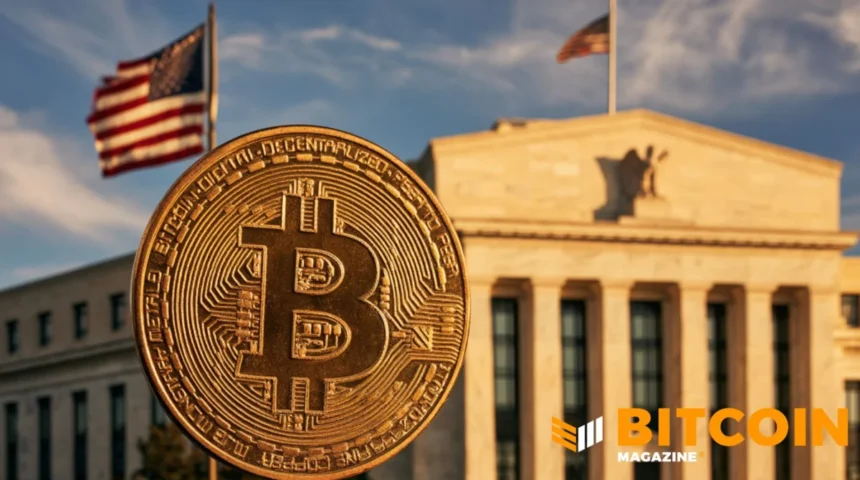
The Federal Reserve opted to leave its benchmark interest rate unchanged on Wednesday, maintaining the federal funds target range at 3.75% to 4% while steering clear of definitive forward guidance. Against the backdrop of this monetary policy pause, the price of bitcoin displayed typical volatility, hovering around the $81,000 threshold as market participants digested both the central bank’s decision and the significant internal divisions behind it.
The policy decision passed by a 10-2 vote, but the nature of the dissents carried just as much weight in the financial markets as the outcome itself. Federal Reserve Governor Lisa Cook and Cleveland Fed President Beth Hammack both voted against the majority, advocating instead for a quarter-point rate increase. This divergence marked a notable moment in modern central banking history: it represents the first time since 1992 that a sitting Fed governor and a regional bank president have dissented together on the exact same side of a policy vote.
Following the conclusion of the meeting, Fed Chair Kevin Warsh addressed reporters to field questions about the central bank’s stance. Coming just days before the midterm elections, Warsh firmly asserted that political considerations played zero role in the Federal Open Market Committee’s decision-making process. Furthermore, Warsh has consistently maintained a philosophy against offering explicit forward guidance in the absence of a pronounced economic crisis. By leaving investors without explicit roadmaps for future meetings, the central bank’s approach places the onus directly on market participants to interpret incoming macroeconomic data independently.
The committee’s post-meeting statement also featured notable textual revisions. Policymakers opted to drop previous language concerning specific timelines or conditions under which a future rate hike might support a return to the central bank’s 2% inflation target. In its place, the Fed inserted a broad advisory line stating that a continuous stream of incoming information will guide its future policy stance. Additionally, the committee upgraded its assessment of economic momentum, describing broader domestic growth as strong—an upward revision from previous descriptions labeling it as solid.
These shifts in tone and language point toward an underlying tilt in favor of monetary tightening. Current fed funds futures pricing, alongside the central bank’s own internal dot plot projections, increasingly leans toward the possibility of a rate increase as early as December, with some market pricing models placing those odds at nearly three out of four. Stubbornly hot inflation figures have continued to loom over the economy, and the two dissenting officials are emblematic of a faction within the system eager to take decisive policy action to cool price pressures.
Bitcoin Price Reaction
The immediate reaction of the bitcoin price to the Federal Reserve’s announcement was relatively restrained. In the immediate minutes following the policy release, bitcoin experienced a brief upward spike to roughly $81,700 before pulling back sharply below $80,500. Shortly thereafter, the leading cryptocurrency stabilized and recovered toward the $81,000 mark. Because the majority of market traders had widely anticipated a rate pause, the muted price action ultimately came as little surprise to institutional desks and retail participants alike.
Historically, bitcoin’s initial response to major Federal Reserve announcements tends to be modest, with the true directional trend frequently materializing over the subsequent 24 hours. Spot Bitcoin exchange-traded funds registered notable activity around the announcement, drawing $110 million in net inflows on October 26 and a further $176 million on October 27. These figures suggest that institutional capital continues to view market dips as buying opportunities, even as other market observers point to large-scale holders selling into periods of price strength.
This ongoing tug-of-war encapsulates the central tension defining cryptocurrency markets at this stage of the cycle. Bitcoin currently trades roughly one-third below its October 2025 all-time high, which was recorded near the $126,000 level. A prolonged path of higher interest rates inherently works against a risk-on asset class that historically thrived during prolonged periods of cheap money and aggressive central bank liquidity. Consequently, market participants have spent months adjusting to the reality that the era of ultra-easy monetary policy may be permanently receding into the past.
While some short-term traders interpreted the Fed’s steady rate decision as evidence that policymakers intend to move cautiously and deliberately, others view the approaching December meeting as the ultimate test of the central bank’s resolve. For the time being, market participants are closely watching the $80,000 level on bitcoin. This psychological and technical price point has reliably held as a firm support floor during recent trading sessions, and a clean, sustained break below it would expose the market to deeper downside corrections.
As Chair Warsh and his colleagues have repeatedly emphasized, the central bank intends to wait for incoming macroeconomic data before making its next move. For bitcoin investors, navigating the intersection of monetary policy and digital asset markets means they will simply have to wait alongside the broader traditional financial system.
Midterms Up Next
Beyond macroeconomic indicators and central bank policy decisions, bitcoin faces its next major political milestone on November 3, when voters across the United States head to the polls for the midterm elections. While crypto policy has not entirely dominated the mainstream national campaign trail, the digital asset industry has exerted unprecedented financial influence throughout the electoral cycle.
The broader cryptocurrency industry deployed approximately $176 million across more than 100 midterm congressional races. The overarching objective of this substantial expenditure is the cultivation of a robust, bipartisan bloc of lawmakers in Congress capable of protecting the sector’s interests and fostering a clear regulatory framework following the administration of former President Donald Trump. Fairshake, the digital asset industry’s largest political action committee, spearheaded this strategic effort, directing resources and campaign tactics much as it did during the 2024 election cycle.
At the time of writing, bitcoin continues to trade in a stable channel, changing hands at $81,478 as market participants balance shifting macroeconomic signals against upcoming political developments.

Related News