Federal Reserve Credibility Tested as Crude Oil Surges and Big Tech Capex Defies Central Bank Control
By RIA Team | October 30, 2026 | 6 min read
A phrase quietly embedded in recent Federal Reserve documentation has begun to draw intense scrutiny from market strategists and economists alike. Across each of the first three Federal Open Market Committee (FOMC) meetings under current leadership, a definitive pledge has anchored the official policy statement: "The Committee will deliver price stability."
While appearing straightforward at first glance, this absolute promise represents a distinct departure from historical central bank communication. Traditionally, the Federal Reserve Chair and the FOMC are remarkably cautious about utilizing definitive verbs when addressing macroeconomic outcomes. Historically, central bank officials prefer to outline current economic and financial conditions before carefully stating their intentions or policy frameworks. They maintain a distinct shyness toward making ironclad promises because the Fed’s actual toolkit has clear boundaries when it comes to directly impacting absolute price levels and broader economic activity.
To understand the core limitation of monetary policy, one need only look at the two primary drivers of contemporary inflation and economic expansion: global crude oil prices and massive artificial intelligence-related capital expenditure spending.
Crude oil prices have climbed past the $100 per barrel threshold, registering an approximate 70% surge over the trailing twelve-month period and a 14% jump in a single month, driven almost entirely by the ongoing geopolitical conflict involving Iran. The Federal Reserve possesses no mechanism to manage international military conflicts or directly suppress energy-driven inflation. The central bank itself acknowledged this structural vulnerability earlier in the year. In its July policy statement, the FOMC explicitly attributed elevated inflationary pressures "in part" to "supply shocks that have driven price increases in certain sectors, including energy"—a specific acknowledgment that was subsequently dropped from the September statement, even as the underlying market reality persisted.
Simultaneously, the corporate landscape is witnessing an unprecedented capital spending boom. Across major technology enterprises including Alphabet, Microsoft, and Amazon, projected calendar 2026 capital expenditure guidance approaches a staggering $600 billion, with Alphabet management already signaling plans for a significant acceleration in spending heading into 2027. This tidal wave of corporate investment not only keeps gross domestic product metrics elevated but also places persistent upward pressure on domestic price levels and overall inflation.
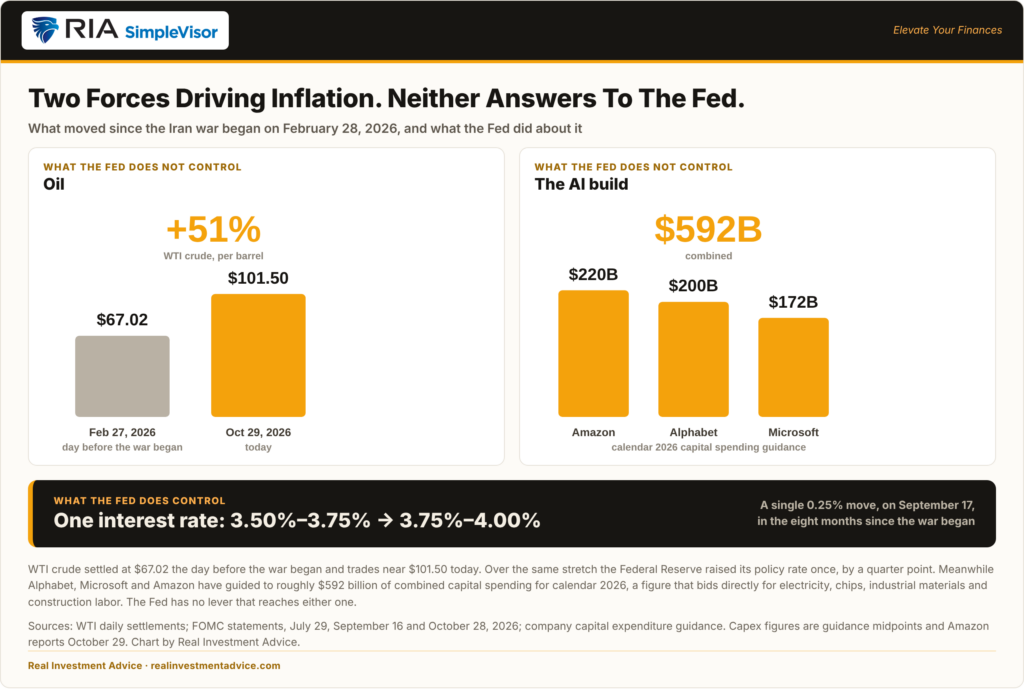
The fundamental disconnect lies within the asymmetrical nature of central bank authority. The Federal Reserve maintains direct control over the overnight interest rate. It does not control the geopolitical choke points of global energy transit, nor does it dictate whether a handful of mega-cap technology corporations allocate $600 billion or $400 billion toward infrastructure buildouts in a given fiscal year. By issuing an absolute guarantee of price stability, the central bank runs a severe risk of breaking a foundational promise, dealing a potentially significant blow to the institutional credibility that leadership is working so hard to establish and preserve. A more accurate reflection of central bank capabilities would adjust the phrasing to state that the Committee aims to deliver price stability, maintaining honesty regarding the limits of monetary policy.
What To Watch Today
As the final trading session of October unfolds, market participants are processing a wave of major corporate earnings and critical economic data releases. Major oil conglomerates are wrapping up the heavy-weight reporting week. Before Friday’s opening bell, ExxonMobil and Chevron are scheduled to report quarterly results alongside major pharmaceutical player AbbVie, providing fresh insight into corporate health and energy sector cash flows.
On the macroeconomic front, the Bureau of Labor Statistics is releasing the Employment Cost Index for the third quarter, offering key metrics on labor compensation trends and wage growth. Additionally, the Chicago purchasing managers’ index for October will provide a final regional manufacturing gauge before the weekend.
Following Wednesday’s decision by the Federal Reserve to hold benchmark interest rates steady, market participants will also parse commentary from regional Fed leadership, with St. Louis Fed President Alberto Musalem scheduled to speak. Because Friday marks the final trading day of October, traders should anticipate heightened volatility and volume into the closing bell driven by month-end portfolio rebalancing flows.
Market Trading Update and Alphabet’s Earnings Volatility
Recent market strategy discussions have highlighted the merits of trimming extended value equities while selectively accumulating beaten-down technology shares in measured thirds, with cash-rich platforms sitting at the forefront of that allocation strategy. The dramatic post-earnings selloff in Alphabet shares immediately tested that thesis. Opening sharply lower, the stock faced its worst single-session decline since March 2020.
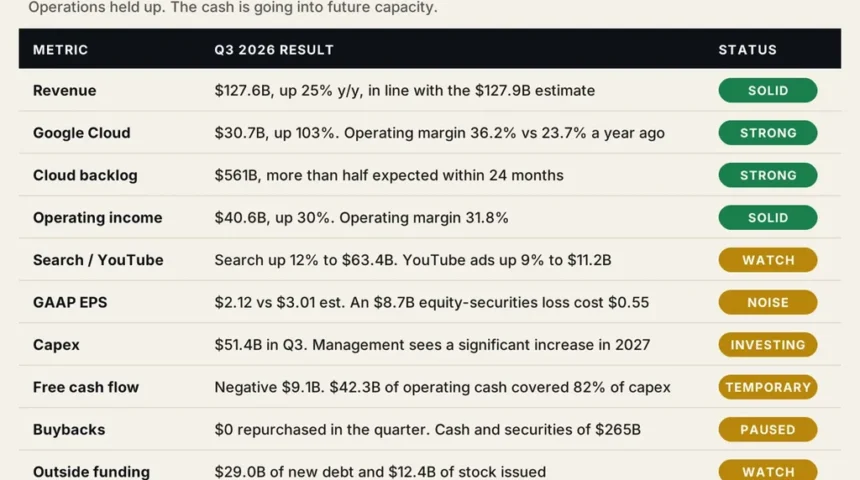
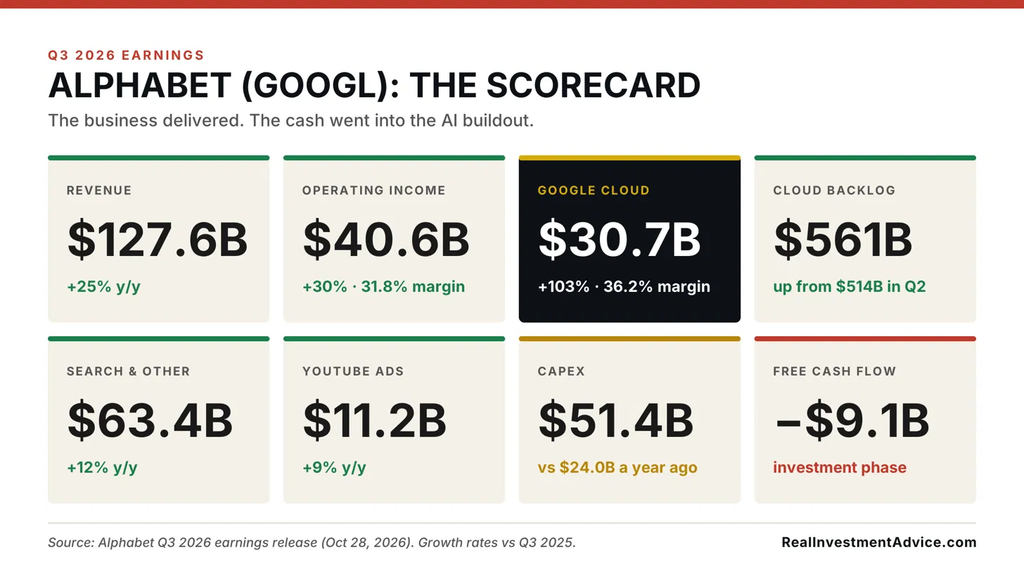
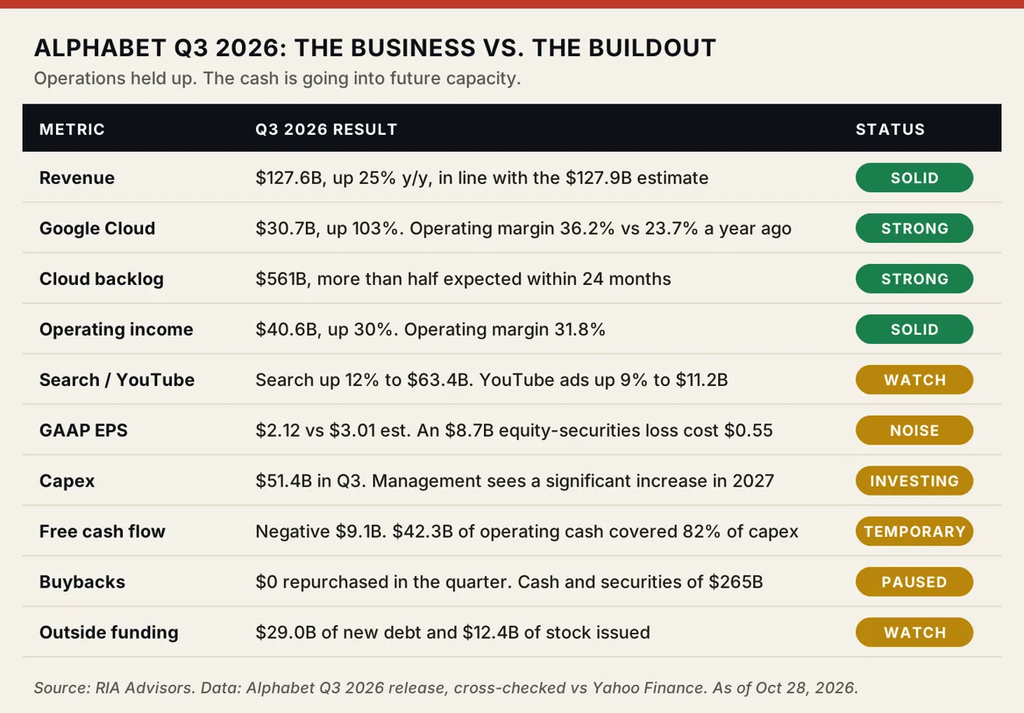
A balanced evaluation requires separating headline accounting adjustments from underlying operational performance. On the positive side, Google Cloud revenue doubled to $30.7 billion, while its operating margin expanded dramatically from 24% to 36% over the past year, supported by a growing cloud backlog reaching $561 billion. The headline GAAP earnings miss—reporting $2.12 per share versus expectations of $3.01—was largely a byproduct of an $8.7 billion paper loss on equity investments. That figure represents an accounting mark-to-market valuation rather than any structural deterioration in the core operating business.
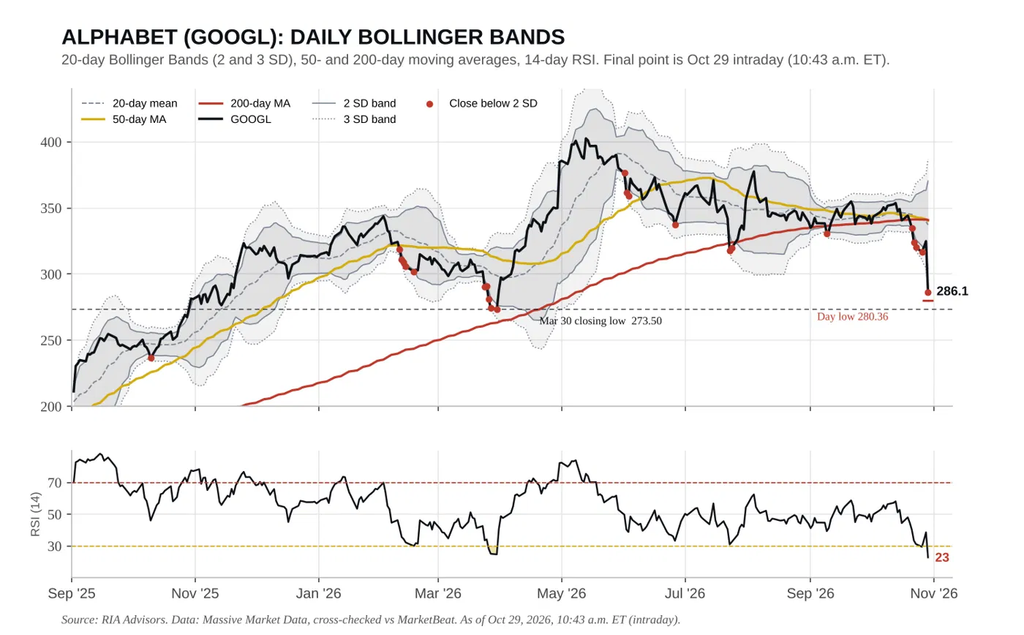
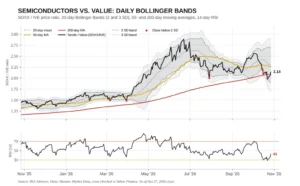
Technical indicators suggest the selling pressure reached an extreme inflection point. Trading data indicates the stock moved significantly below its short-term moving averages, registering relative strength index readings that historically align with major capitulation events. Heavy early-session volume underscored a classic flush, where initial selling was systematically absorbed by institutional buyers near session lows.
The primary catalyst for market unease centered on capital expenditures. Quarterly capex climbed to $51.4 billion, with management signaling further significant increases ahead, pushing free cash flow temporarily into negative territory at $9.1 billion. Simultaneously, share repurchases were paused as the company issued new debt and equity to fund its expansive infrastructure initiatives.
However, this dynamic reflects an aggressive investment cycle rather than an operational crisis. Alphabet’s robust operating cash flow still covered the vast majority of quarterly capital expenditures, and the company maintains a massive cash and marketable securities war chest. While negative free cash flow represents the short-term cost of building future capacity, the primary long-term consideration will be how future depreciation expenses flow through reported earnings once these massive data center and AI assets are fully integrated.
As technical trends continue to navigate shifting moving average dynamics, disciplined risk management remains paramount. Investors executing staged accumulation strategies face critical support levels, with sustained closes above previous consolidation lows serving as key technical confirmations before committing additional capital.
Alphabet Advertising Revenue Performance
For the past two years, a primary bear thesis directed against Alphabet suggested that conversational artificial intelligence assistants, such as Gemini, would siphon users away from traditional search engines and subsequently erode core advertising revenues. The latest financial disclosures provided little empirical support for that narrative.
Google Search and associated revenues expanded by 12% to reach $63.35 billion. YouTube advertising revenue climbed 9% to $11.21 billion, while the Google Network third-party publisher business grew 1% to $7.46 billion. Total advertising revenue reached $82.0 billion, representing a 10.5% increase compared to the same period in the prior year.

Overall, Alphabet achieved a 25% year-over-year revenue growth rate for the quarter. While advertising contributed substantially to that top-line expansion, the rapid acceleration of non-advertising segments, particularly cloud computing services, highlights an ongoing corporate diversification. As the business model continues to evolve, the central debate for market participants centers less on the internal revenue mix and more on the long-term profitability profile as artificial intelligence infrastructure matures.

Related News