Small Caps Trade Like Bond Proxies as Retail Investors Pile Into Equities and SpaceX Blasts Off on Record Earnings
By RIA Team
October 22, 2026
Financial markets continue to navigate a complex macroeconomic landscape, highlighted by shifting correlations in small-cap equities, record equity allocations among retail investors, and a blockbuster public debut earnings report from SpaceX. While major indices like the S&P 500 have frequently notched record highs over recent months, smaller companies have painted a distinctly different picture, exhibiting unique structural sensitivities to interest rate fluctuations.

The Russell 2000 Index of small-cap stocks has fallen 8.2% since late June, struggling to find momentum and failing to make a new high over a four-month stretch. However, these smaller equities have demonstrated stronger trading sessions recently as bond yields have retreated from prior highs. Market analysts note that this correlation is far from accidental. Understanding why small-cap stocks have become closely linked to bond yields highlights fundamental differences between smaller enterprises and their large-cap counterparts, particularly concerning interest-rate sensitivity. Small companies typically face distinct structural financial pressures that most large corporations are insulated from, ranging from floating-rate debt exposure to tighter refinancing schedules.
Given the prolonged environment of elevated interest rates, small caps have underperformed the broader equity market. Yet, they remain positioned for potential outperformance if yields continue on a downward trajectory. Conversely, financial strategists caution that if yields decline rapidly due to escalating credit concerns or a sudden economic growth scare, the theoretical yield benefit to small-cap companies could diminish or even turn detrimental.
Market data underscores this evolving relationship. The rolling 30-day correlation between the Russell 2000 and 7- to 10-year Treasury yields has averaged 0.41 throughout 2026, marking a significant shift from an average of just 0.11 over the preceding four years. This correlation even peaked at an impressive 0.87 in May. Prior to this year, the relationship frequently oscillated around zero and spent extended periods in negative territory, plunging as low as -0.83 during the banking stress of March 2023.
Market Trading Update and Retail Investor Sentiment
Shifting focus to broader market dynamics, recent discussions among analysts have centered on the sustainability of the current equity correction and the behavior of individual investors. Prominent Wall Street voices, including Michael Wilson, have argued that ongoing market corrections may not fully conclude until market-leading megacap stocks experience a meaningful pullback. Against this backdrop, updated retail stock allocation data provides critical insight into where market risk currently resides.
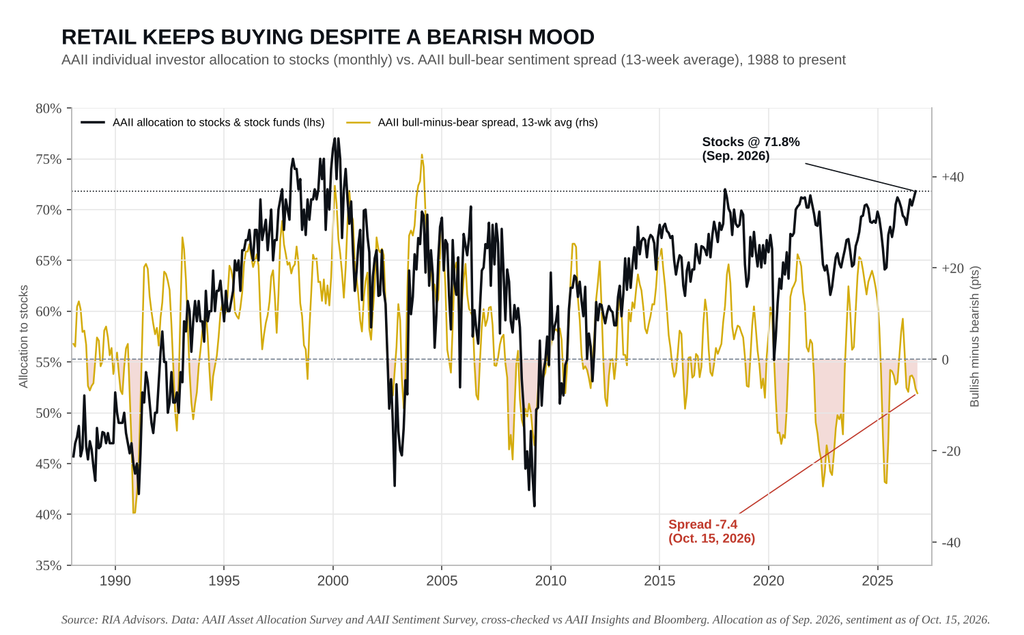
According to data highlighted by Bloomberg’s Simon White, individual investors—often referred to as "Main Street"—are currently holding a staggering 71.8% of their portfolios in equities. Outside of a brief 72% reading recorded at the end of 2017 just prior to the market volatility event known as "Volmageddon," one must look all the way back to the peak of the 2000 tech bubble to find a comparable level of equity exposure among retail participants. A notable divergence has emerged on sentiment charts, where equity allocation lines continue to climb upward while the bull-minus-bear sentiment spread has rolled over into negative territory.
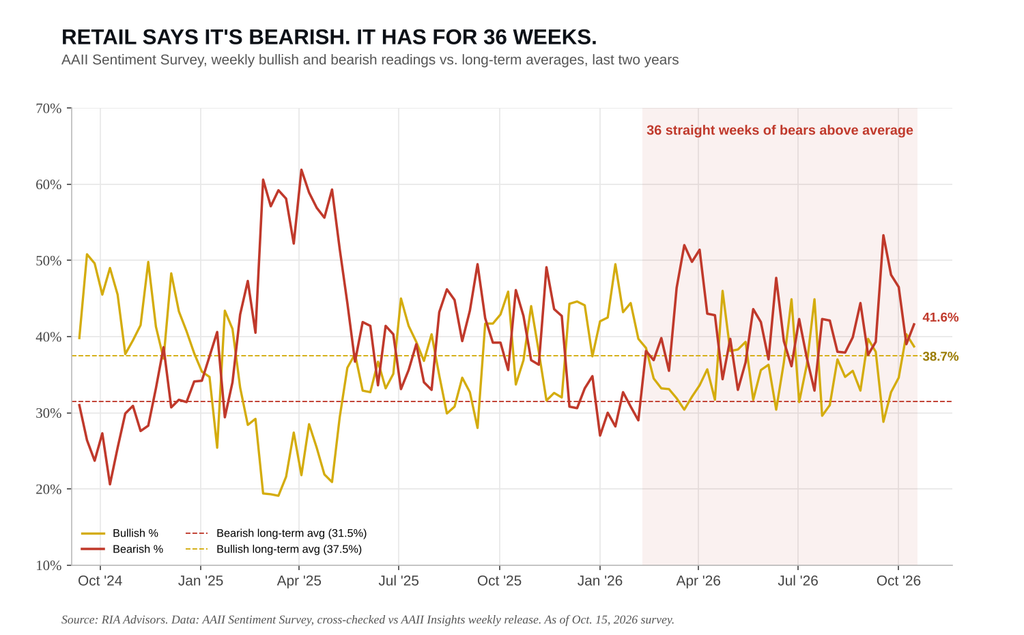
Investor anxiety remains palpable. Recent American Association of Individual Investors (AAII) survey data shows that bearish sentiment rose to 41.6%, comfortably outpacing the 38.7% of respondents identifying as bulls. In fact, bearish sentiment has now remained above its long-term historical average of 31.5% for 36 consecutive weeks. While contrarian investors traditionally view high levels of pessimism as a classic buy signal, market veterans emphasize that sentiment only truly matters when it directly alters investor behavior. When market participants express fear in surveys while keeping their brokerage accounts fully deployed, that underlying apprehension acts less like a protective cushion and more like a trigger waiting for a catalyst.
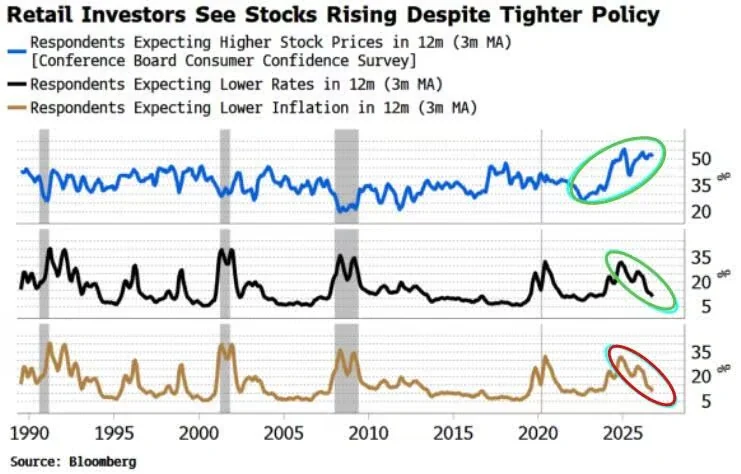
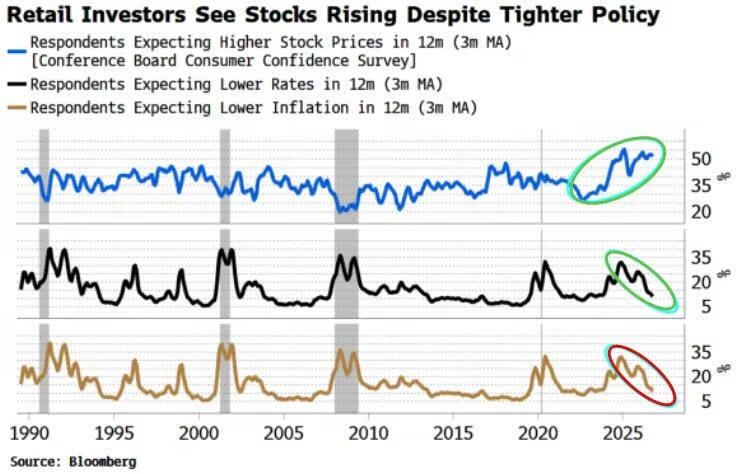
Data from the Conference Board reveals a similar psychological split among consumers. More than half of all survey respondents expect stock prices to trade higher over the next 12 months, hovering near a 35-year high for that specific sentiment series. Simultaneously, the share of respondents anticipating lower interest rates and reduced inflation has declined sharply in recent months. Retail investors continue to expect higher stock prices even as the broader macroeconomic policy backdrop grows increasingly restrictive.
Furthermore, growing concerns have been voiced by prominent market veterans—including Michael Burry, Jeremy Grantham, Seth Klarman, Ray Dalio, and Ken Griffin—who have increasingly characterized current valuations in the artificial intelligence sector as a bubble. The true consensus in the current environment lies not within economic forecasts, but rather in market positioning. When nearly all market participants are already fully invested on the long side, the pool of marginal buyers becomes remarkably shallow the moment an unexpected shock hits the system.
Portfolio managers advise caution rather than wholesale liquidation, emphasizing the importance of trimming exposure to overcrowded trades. Technology weightings are being maintained at target levels without adding new capital, while ongoing rebalancing continues to shift funds away from megacap strength toward market sectors that have already undergone corrections. For investors whose equity exposure has crept past 70% simply because multi-year market gains made that level feel normal, trimming back to established targets while market liquidity remains strong is considered a prudent risk-management strategy.
SpaceX Launches On Strong Earnings
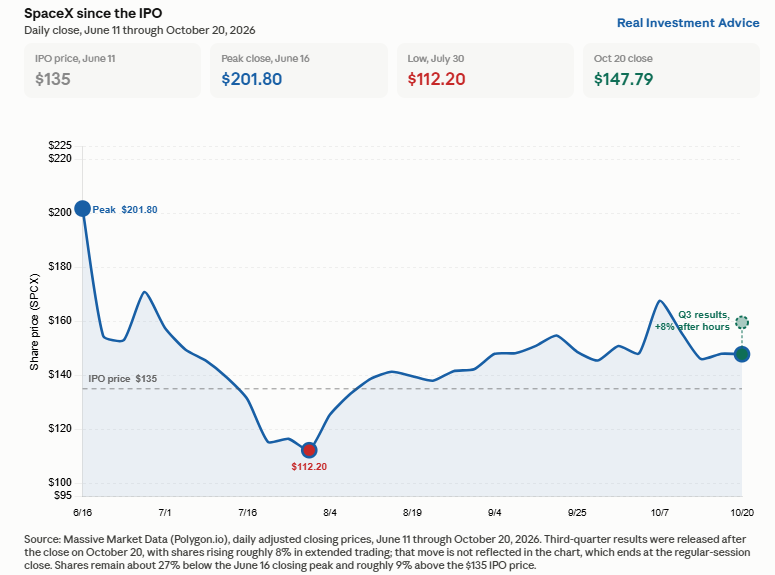
In corporate news, SpaceX shares rallied roughly 8% following the company’s inaugural quarterly earnings report as a publicly traded entity. The aerospace and technology giant posted quarterly revenue of $14.58 billion, representing a dramatic 161% increase compared to $5.6 billion during the same period a year prior, and easily outpacing Wall Street consensus estimates of $12.87 billion. Net income reached $4.4 billion, a stark turnaround from the $1.1 billion net loss recorded in the prior-year quarter.
Despite exceeding revenue expectations, corporate expenditures also surpassed analyst projections. Capital expenditures reached $19.6 billion for the quarter, outstripping revenue by approximately $5 billion. The vast majority of this spending—totaling $16.4 billion—was channeled into the company’s Super Intelligence business initiatives, bringing its total capital expenditures for the first nine months of the year to $48.1 billion.
This unusual financial combination of record profitability alongside capital expenditures exceeding 134% of total revenue highlights specific accounting mechanics. Under standard accounting principles, capital expenditures convert cash into tangible property and equipment rather than being immediately recognized as an expense. Instead, these costs filter onto the income statement gradually through depreciation over the estimated useful life of the underlying assets. For example, a major data center depreciated over a six-year period contributes only a fraction of its total cost to annual expenses rather than absorbing the full expenditure at the time of purchase.

Consequently, SpaceX’s free cash flow declined by roughly $10 billion during the quarter. However, the company entered the period bolstered by a robust balance sheet containing approximately $100 billion in cash and marketable securities generated from its initial public offering, ensuring it will not require external capital markets borrowing for the foreseeable future. Additionally, corporate leadership noted that Tesla and SpaceX have established special committees to evaluate a potential future merger.
Are Bonds Pricing In A Fed Policy Mistake?
The financial markets have also been transfixed by anomalous behavior within the fixed-income sector. Economic forecasters evaluating early October data would have anticipated surging bond yields following higher-than-expected September Consumer Price Index figures and a sharp 1.3% monthly rise in Producer Prices, which far exceeded the 0.5% consensus forecast. Compounding these inflationary pressures, crude oil prices climbed by $10 during the first two weeks of the month. Against this backdrop, with the 10-year U.S. Treasury yield hovering near 5.25% at the start of October, professional bond traders would have reasonably projected yields climbing toward 5.50% or higher.
Yet, reality defied expectations. On October 14, following the release of the hot CPI report, the 10-year Treasury yield briefly spiked to 5.33% before reversing sharply. Just days later, the yield dropped markedly to 5.03%, with the 30-year yield experiencing a comparable decline. The bond market rallied directly into the teeth of hostile inflation data.
Highlighting this anomaly, former PIMCO CEO and renowned fixed-income expert Mohamed El-Erian raised a central question on social media: why are U.S. government bond yields falling despite hotter-than-expected inflation prints? While market analysts have proposed various rationalizations—including artificial intelligence-related structural shifts—financial strategists suggest that the most compelling explanation may lie elsewhere. Increasingly, the bond market appears to be pricing in the rising risk that the Federal Reserve is being maneuvered into making a severe policy mistake.

Related News