Worried Consumers Keep Spending: Why Economic Resilience Defies Traditional Metrics
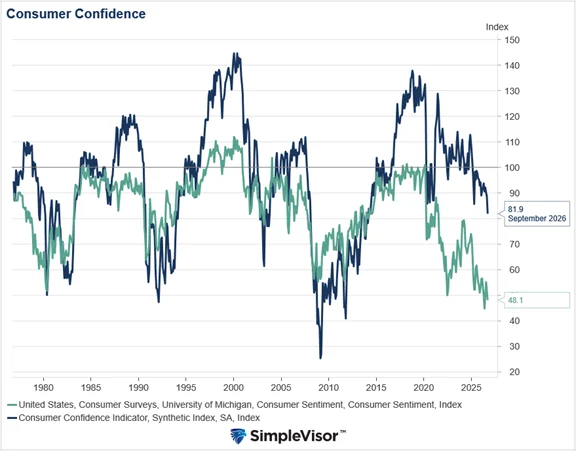
For nearly four years, economists have consistently predicted that the American consumer would finally break under the weight of macroeconomic pressures. To their credit, the warning signs have been hard to ignore. Sustained high inflation, the fastest Federal Reserve monetary tightening cycle in decades, and more recently, surging gasoline prices and elevated borrowing costs should, by all historical accounts, be taking a severe toll on retail sales and consumer spending.
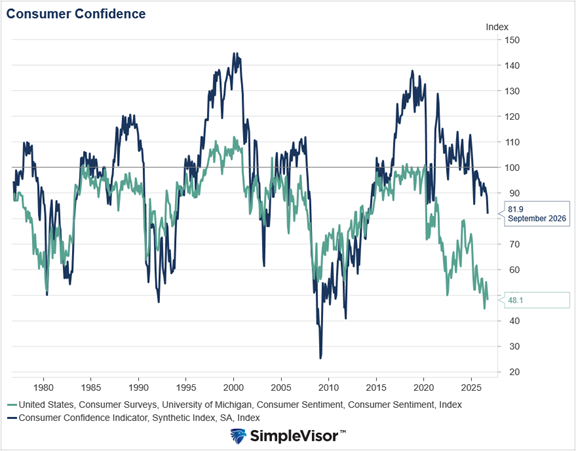
In some respects, these persistent headwinds are clearly weighing heavily on the psychological state of households. The University of Michigan Consumer Sentiment gauge currently languishes near a fifty-year low, while the historically less politically biased Conference Board Consumer Confidence Index has dropped back to levels last seen in 2014. Consumers are deeply pessimistic about the economic trajectory, their personal finances, and the broader outlook.

Yet, despite this profound gloom and the numerous rational reasons for households to retrench, real personal consumption expenditures (PCE) grew at a solid 2.6% annualized rate through September. The fundamental bottom line of the current economic cycle remains remarkably consistent: consumers keep worrying, but they keep spending.
To better understand this ongoing resilience, financial analysts built a comprehensive Consumer Health Index. This proprietary metric combines granular monthly and quarterly data tracking income, labor market dynamics, credit availability, actual spending patterns, and shifting price levels to determine how much consumers can realistically afford to spend. By comparing this foundational index directly against real PCE—representing what consumers are actually paying at the cash register—analysts can uncover vital clues regarding the true origin of consumer purchasing power and gauge its long-term durability.
Building Our Consumer Health Index
The proprietary health index incorporates 19 distinct monthly and quarterly data series spanning historical records back to 2007. These metrics are sourced directly from premier federal and international reporting agencies, including the Bureau of Economic Analysis (BEA), the Bureau of Labor Statistics (BLS), the Census Bureau, the Federal Reserve, and the Energy Information Administration (EIA). These diverse statistical inputs fall naturally into four broad analytical groups covering employment health, wage growth, credit access, and inflation-adjusted costs.
To maintain accuracy as economic conditions shift, the underlying components are re-weighted on a monthly basis depending on how closely they track real personal consumption expenditure growth over the prior three-year period. This dynamic adjustment allows the model to adapt seamlessly as the primary drivers of consumer spending evolve. Notably, consumer sentiment surveys were deliberately excluded from the index entirely, as statistical analysis shows they have maintained virtually zero correlation with actual consumer spending behavior over the past decade.
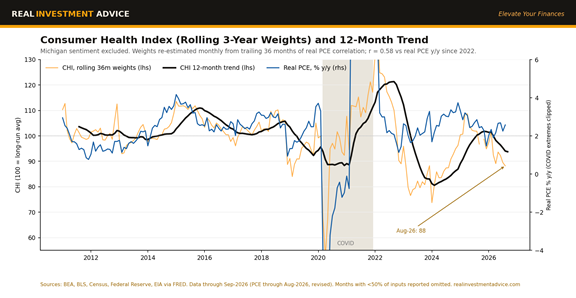
Since 2022, this rigorous health index has demonstrated a statistically relevant 0.58 correlation with real PCE growth. However, the current widening gap between the underlying economic health of the typical household and actual spending levels is an unusual phenomenon, bearing a striking resemblance to the prolonged divergence observed throughout 2023 and 2024.
The Gaps: 2023-2024 And Today
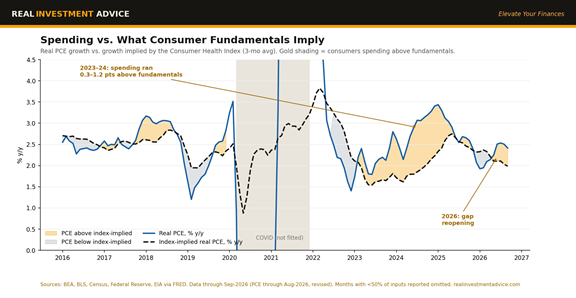
To properly highlight both the emerging spending gap and the historical discrepancy seen in 2023 and 2024, analysts translated the health index directly into the real PCE growth rate it logically implies. Historical tracking reveals specific periods when consumers consistently spent significantly more than their fundamental economic inputs suggested they should.

According to this quantitative model, consumers are once again spending at a pace that easily outstrips what their incomes, job security, and rising everyday costs would mathematically predict. This persistent over-consumption naturally raises a critical question for economists and market participants alike: exactly what mechanisms are filling the financial gap?
What Explains Consumer Resilience
While the standard health index accurately captures the typical household’s primary income stream, several secondary sources of spending power exist entirely outside of traditional wage metrics. These auxiliary economic pillars have played an outsized role in keeping retail activity robust despite stagnant underlying fundamentals.
First, household savings rates have drifted lower, acting as an immediate shock absorber that allows families to maintain their accustomed lifestyles even as costs climb. Second, asset wealth has experienced extreme concentration among high-earning demographics, creating a wealth effect where affluent consumers continue to spend freely, powered by elevated stock market portfolios and home equity gains, effectively masking weakness among lower- and middle-income segments. Third, government transfer payments and growing population gains have injected fresh liquidity into the broader economy, supporting baseline aggregate demand even when organic wage growth slows down.
What Could Change
A critical vulnerability embedded within these current spending sources is that the national savings rate has very little room left to decline further. As historical market analyses have repeatedly demonstrated, low savings rates eventually revert upward toward historical norms over time.
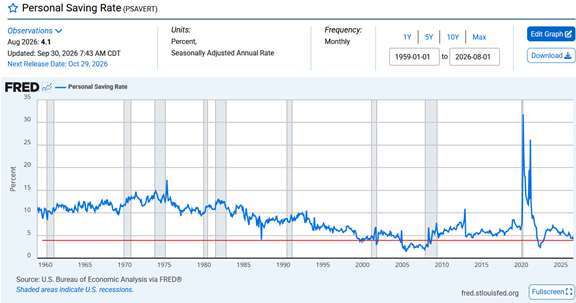
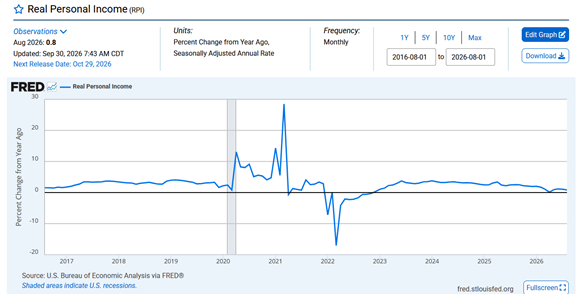
If households reach a point where they can no longer draw down their savings or spend beyond their means, consumer outlays must inevitably begin to track underlying personal income much more closely. With real personal income, excluding government transfers, growing at a sluggish pace of less than 1%, any normalization or upward tick in the national savings rate will almost certainly act as an immediate drag on retail spending.
Several other catalysts could theoretically close the widening gap between economic fundamentals and consumer behavior. However, it is just as important to consider that the gap could also close from below. If persistent inflationary pressures ease, gasoline prices retreat from recent highs, interest rates decline, and real incomes finally begin a sustained recovery, the consumer health index itself would rise to meet spending, rather than spending collapsing to meet a weaker index.

Ramifications For Both Scenarios
The ultimate resolution of this economic divergence carries profound implications for financial markets and monetary policy. If spending eventually converges downward to match the weaker signals of the consumer health index, the macroeconomic landscape will likely look very different. A sharp deceleration in retail sales would likely translate into compressed corporate profit margins, particularly for consumer-discretionary sectors, lower earnings expectations, and mounting economic anxiety as the broader labor market reacts to softer corporate demand.
Conversely, if the consumer health index rises to meet current spending levels through an organic recovery in wages, falling borrowing costs, and lower commodity prices, the expansion could prove remarkably durable. Such a scenario would validate the "soft landing" narrative, supporting sustained equity valuations and reducing immediate recession risks.
Summary
Ultimately, the modern American consumer has proven far more resilient than in past economic cycles, but this durability is not rooted in a fundamentally healthier typical household balance sheet. Instead, ongoing economic resilience has been artificially sustained by a falling savings rate, record wealth concentration among high earners, growing transfer income, and steady population gains. Proprietary indices tracking true consumer health clearly show spending outpacing fundamental economic drivers, mirroring the exact dynamics observed throughout 2023 and 2024.
The primary difference today is that the substantial savings buffer that cushioned consumers during those prior years is now largely exhausted. Consequently, the modern consumer’s resilience increasingly rests on the continued strength of the stock market and the stability of the labor market. Investors and market participants should closely monitor key indicators going forward, including the national savings rate, monthly employment reports, interest rate trajectories, and gasoline prices. These critical metrics will ultimately determine whether consumer spending slows down to align with underlying economic health, or whether economic fundamentals finally recover to justify the ongoing pace of consumption.

Related News