Hedge Funds Slash Tech Positions While Retail Buyers Step In: Decoding the Market’s Latest Tug-of-War
By Michael Lebowitz | October 27, 2026 | 8 min read
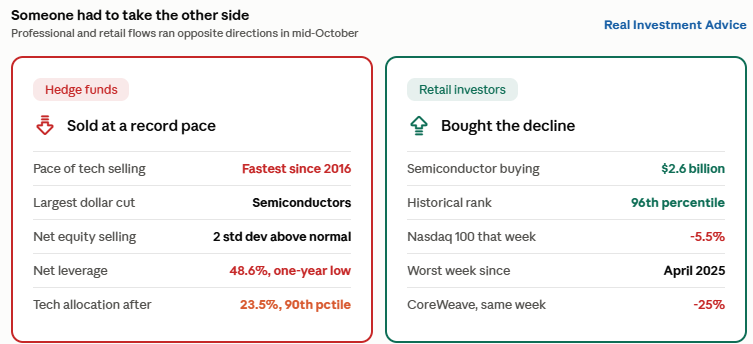
According to Goldman Sachs’ prime brokerage division, institutional hedge funds cut their technology sector positions in mid-October at the fastest pace observed since 2016. This aggressive liquidation has played a central role in explaining the recent weakness in the Nasdaq 100, which recently endured its most difficult weekly performance since April 2025. Furthermore, Goldman’s institutional flow data indicates that global artificial intelligence stocks have entirely surrendered every dollar of net buying that hedge funds had accumulated since the beginning of 2025. While observers might quickly interpret this sharp reversal as a sign that hedge funds are bracing for a broader market downturn, the underlying data reveals a more nuanced and complex picture.

Despite the rapid reduction, technology shares still account for 23.5% of Goldman Sachs’ global prime book, maintaining an exposure that sits comfortably in the upper 90th percentile over the past five years. While total technology allocations remain substantial, what proves far more telling is the velocity of the recent reductions. To that end, hedge fund net leverage fell to a one-year low of 48.6%, suggesting that institutional managers adopted a more defensive posture by trimming leverage while simultaneously managing to hold onto their core exposure to leading technology stocks.
This distinction carries significant weight for market participants. Executing a record pace of selling from a 90th-percentile allocation does not constitute a true capitulation; rather, it reflects a crowded trade becoming marginally less crowded. On one hand, considerable room remains for further deleverage and liquidation should the overarching artificial intelligence financing narrative deteriorate further. On the other hand, this trimming leaves ample capacity for hedge funds to scale their leverage back up into the technology sector should conditions stabilize.
Meanwhile, retail investors—frequently characterized by institutional circles as the "dumb money"—moved in the opposite direction, snapping up $2.6 billion worth of semiconductor shares during the exact same week that hedge funds were aggressively shedding them. A weekly inflow of $2.6 billion represents a 96th-percentile reading in historical context. When institutional professionals exit a crowded trade while retail participants step in to absorb the selling pressure, historical market precedent has often interpreted the dynamic as a bearish signal. However, recent market history demonstrates that the retail cohort has frequently found itself on the correct side of the trade more often than not.
What To Watch Today: Earnings and Economic Data
The corporate earnings calendar for Tuesday, October 27, 2026, brings a heavy slate of Q3 reports from prominent, market-moving corporations. Among the companies reporting before the opening bell are industrial bellwether Boeing, consumer giant Coca-Cola, logistics provider UPS, healthcare operator HCA Healthcare, financial data provider S&P Global, and digital payments pioneer PayPal. Meanwhile, the afternoon schedule features key post-close reports from Visa, Seagate Technology, NXP Semiconductors, Waste Management, and online brokerage Robinhood Markets, all drawing heavy scrutiny from analysts assessing corporate health heading toward the year-end.
Concurrently, economic data takes center stage as the Federal Open Market Committee convenes for day one of its two-day policy meeting. The morning data docket highlights September Durable Goods Orders, which are forecasted to show a 1.5% month-over-month increase following a flat reading previously, alongside durable goods excluding transportation. Additional morning releases include the S&P/Case-Shiller Home Price Index for August, the Conference Board’s Consumer Confidence index for October, and September New Home Sales figures. The Treasury department is also slated to auction off 5-year Treasury notes in the early afternoon. Notably, Federal Reserve officials have entered their customary pre-meeting blackout period, leaving the official FOMC rate decision and subsequent press conference scheduled for Wednesday afternoon as the primary macro catalysts of the week.
Market Trading Update and Seasonal Shifts
Following previous discussions regarding the market’s primary buyers stepping back—with the S&P 500 hovering near its 100-day moving average at 7,605—attention turns to historical calendar patterns as year-end seasonality prepares to swing in favor of the bulls.
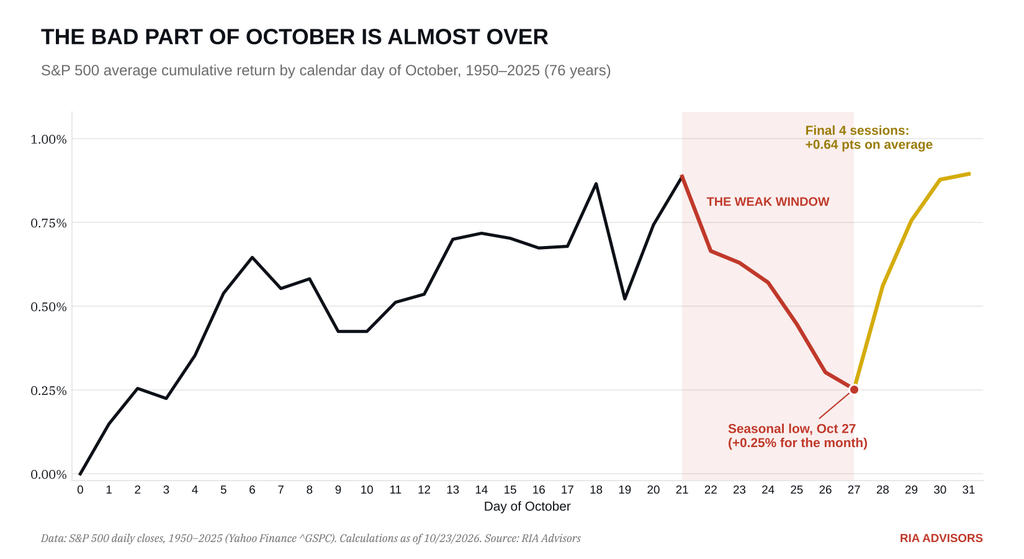
Historical observations indicate that the stretch from October 21st through the 27th has historically marked the weakest period of the month since 1950. On average, the S&P 500 surrenders approximately 70% of its October gains during this specific window, typically carving out a cyclical bottom around October 27th. The final four trading sessions of the month then characteristically recover those losses and accumulate further ground. The current market action followed this script almost precisely, with the benchmark index sliding 1.7% from an October 21st close of 7,757 down to Friday’s finish at 7,623.68.
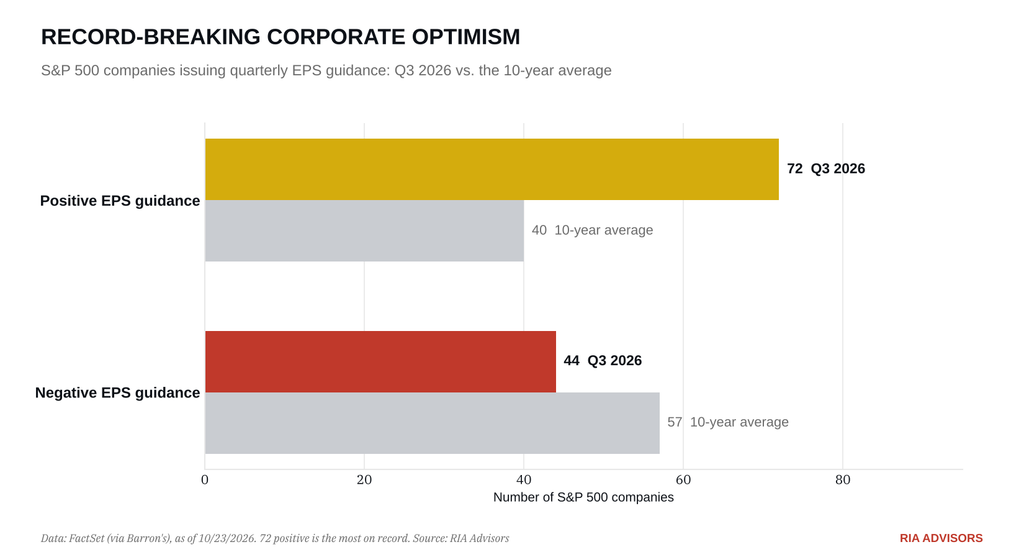
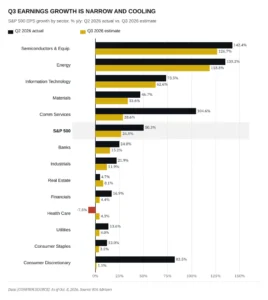
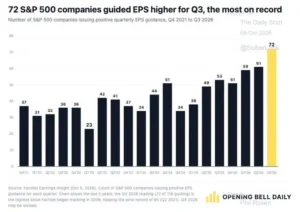
Underlying corporate fundamentals provide robust support for this expected seasonal turn. FactSet data shows that 24% of S&P 500 companies have reported Q3 results, with an impressive 83% beating consensus estimates—outperforming the 5-year average of 78%. Blended third-quarter earnings growth currently sits at an elevated 29.5%. More telling is the corporate sentiment: a record 72 companies issued positive earnings-per-share guidance for the quarter, dwarfing the 10-year average of 40. Meanwhile, only 44 companies guided lower, well beneath the historical norm of 57. The primary caveat remains the magnitude of the beats, as the aggregate earnings surprise sits at just 2.1% compared to a 5-year average of 7.5%, indicating that Wall Street analysts have finally adjusted their models to align more closely with reality.
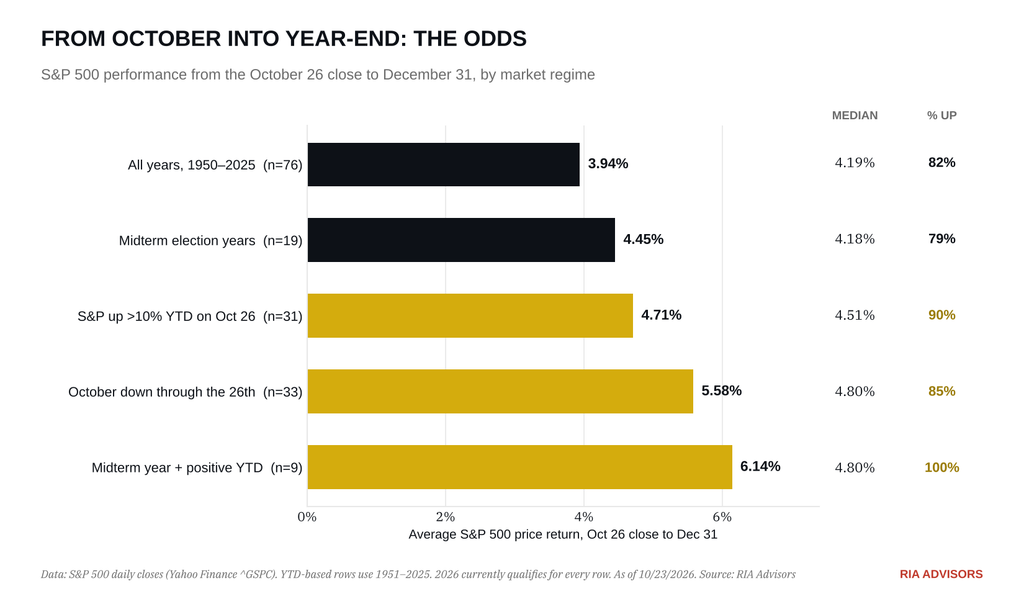
Looking ahead from the October 26th close through December 31st, the S&P 500 has historically posted an average gain of 3.94% since 1950, finishing higher 82% of the time. This year presents several favorable statistical overlays: 2026 is a midterm election year, the index maintains a year-to-date gain of 11.4%, and October is running slightly negative month-to-date. Each of these historical regimes elevates the average expected return to a range between 4.5% and 5.6%. In fact, across all previous midterm years featuring a positive year-to-date return, the market has finished higher on every single occasion.
Applied to Friday’s closing levels, these long-run historical averages point toward an approximate target of 7,925, which sits comfortably above the record highs established on October 6th. However, historical averages must not be mistaken for guaranteed forecasts. The worst historical outcome during this period occurred in 1973, which saw a 12.4% drawdown. A more relevant modern analog may be found in 2018—another midterm year—when the Federal Reserve hiking interest rates into a backdrop of rising yields generated a 5.7% loss over the identical calendar window. With the FOMC decision looming and the benchmark 10-year Treasury yield trading near 5.0%, the ongoing risks associated with monetary policy tightening warrant careful respect.
The established trading playbook remains clear. The 100-day moving average at 7,605 serves as the critical line in the sand. If this technical level holds firm through the upcoming Federal Reserve announcement and the heavily anticipated earnings reports from major tech leaders, market participants can utilize the seasonal tailwind to rebalance portfolios back toward growth assets. Conversely, should that level fail, market observers will look toward the September 16th low of 7,564 or the 200-day moving average at 7,293 before considering adding fresh risk exposure, maintaining strict stop-loss protocols below the 200-day average under any scenario.
Healthcare Emerges as a Safe Haven Amid Sector Rotation
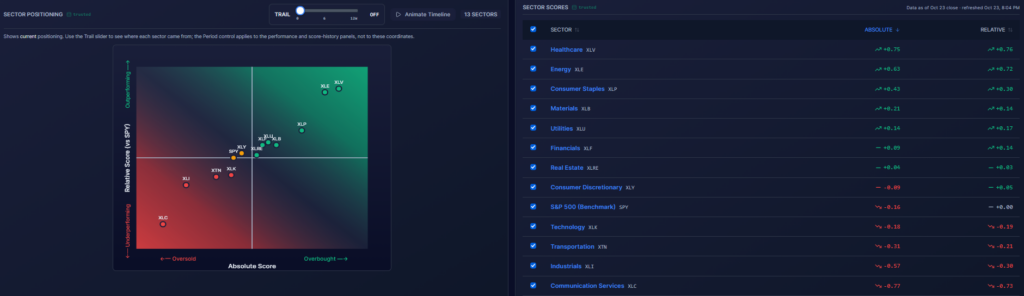
The broader rotation away from the technology sector is manifesting in distinct ways across equity markets. Approximately a month ago, technology occupied a dominant position on sector performance charts, boasting absolute and relative momentum scores well into the 80s and low 90s. With the notable exception of energy, nearly every other market sector found itself oversold, with many suffering from deep oversold conditions. In less than four weeks, however, the healthcare sector has pivoted into an overbought status, joining the energy sector, which continues to hover in overbought territory amid geopolitical tensions surrounding the conflict involving Iran.

Meanwhile, interest-rate-sensitive equities remain clustered around fair value, while technology, alongside energy-sensitive transportation and industrial stocks, sits slightly within oversold territory. Healthcare stocks offer unique defensive characteristics, remaining largely insulated from sensitivity to shifting interest rates or broader economic fluctuations. Consequently, amidst the ongoing tech sell-off, healthcare has emerged as the sector where investors feel most comfortable deploying capital.
Conversely, rate-sensitive groups such as utilities, consumer staples, and real estate have shown improving relative strength but remain hesitant to take up leadership roles while bond yields remain elevated and the trajectory of the ongoing bond market rally remains uncertain. Similarly, facing high interest rates and the prospect of additional Federal Reserve tightening, investors have shown reluctance to heavily back economically sensitive cyclical sectors. For the time being, healthcare stands out as the market’s preferred safe haven, though its overbought status suggests it could become ripe for a secondary rotation in the weeks ahead.
Key questions persist regarding whether technology financing pressures will intensify and push the sector deeper into oversold territory, or if falling bond yields might ultimately catalyze a recovery in rate-sensitive asset classes. Additionally, the energy sector remains vulnerable; while it may sustain its overbought condition until the crisis involving Iran subsides, a durable peace agreement could quickly spark an underperformance cycle that pushes energy stocks toward the lower end of market rankings.
Evaluating the Artificial Intelligence Bubble Debate
Prominent market figures, such as Ken Griffin, have recently expressed strong convictions that financial markets are "almost certainly" operating inside an artificial intelligence bubble. While such assessments may be fundamentally correct, and while various media narratives continue to support that viewpoint, the eternal challenge of active portfolio management is that being conceptually "right" does not automatically translate into a profitable trade. Successfully timing the deflation of an asset bubble is where investment performance is ultimately determined, and financial history is filled with brilliant minds who correctly identified market excesses only to inflict heavy losses on their clients by acting far too early.
As Howard Marks famously noted, being right and being early amount to the exact same outcome as being wrong. While the underlying arguments surrounding high artificial intelligence funding costs versus actual revenue generation are worthy of rigorous debate, the singular question that truly matters for everyday portfolio management is how to navigate an environment where conflicting realities can coexist for extended periods.

Related News