Equity Risk Premium Vanishes as Wall Street Confronts Lofty Valuations Ahead of Q3 Earnings
By Lance Roberts | October 10, 2026

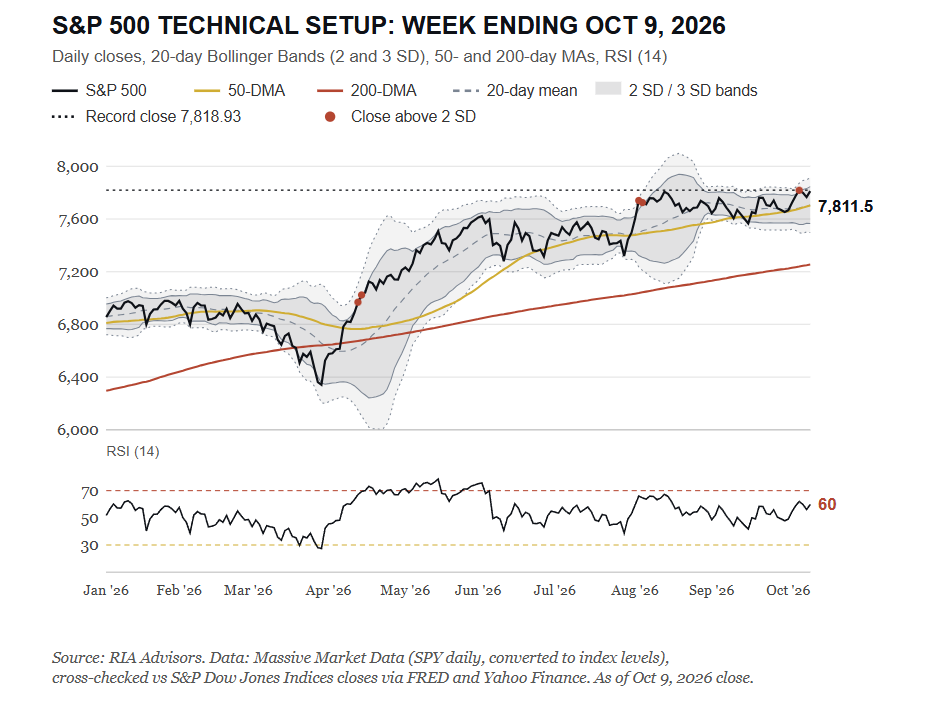
As the fourth quarter gets underway, the U.S. stock market finds itself navigating a delicate financial landscape characterized by record-adjacent index levels, a severely compressed equity risk premium, and an exceptionally high bar for the upcoming corporate earnings season. The S&P 500 gained 1.1% over the course of the week, closing out Friday at 7,811.51 and sitting just a fraction below its record high of 7,818.93 reached earlier in the week. Meanwhile, the Dow Jones Industrial Average added 0.9%, the Nasdaq Composite climbed 0.6%, and small-cap equities slipped nearly 1%.
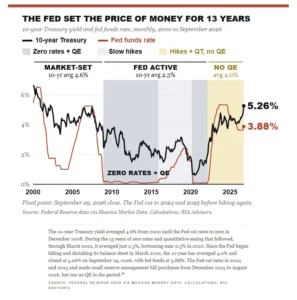
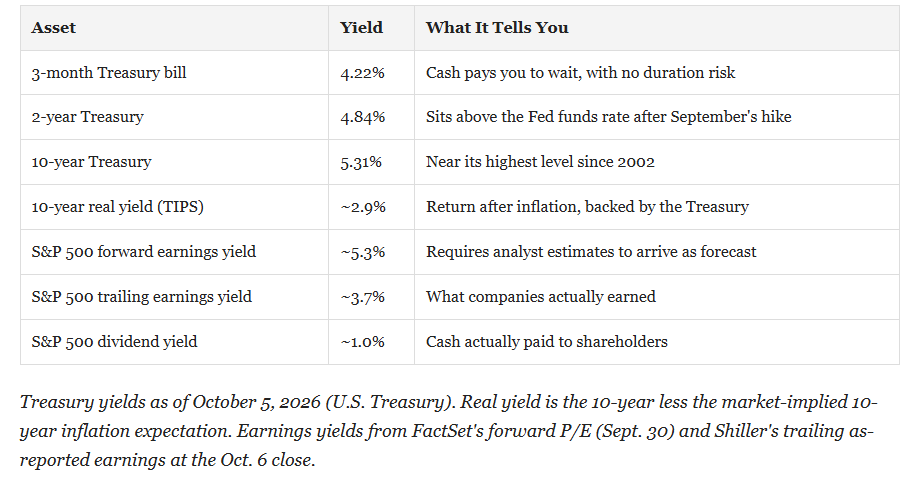
Underneath these headline figures, however, macroeconomic crosscurrents are challenging long-held market assumptions. Most notably, the 10-year U.S. Treasury yield touched its highest level since 2002 mid-week before stabilizing around 5.25% following strong demand at government debt auctions. This dramatic shift in fixed-income yields has radically altered the relative attractiveness of asset classes, pushing the equity risk premium to its narrowest spread in a generation and forcing institutional investors to re-evaluate the risk-return proposition of equities at current valuations.
Market Brief: Earnings Season Opens on a Raised Bar
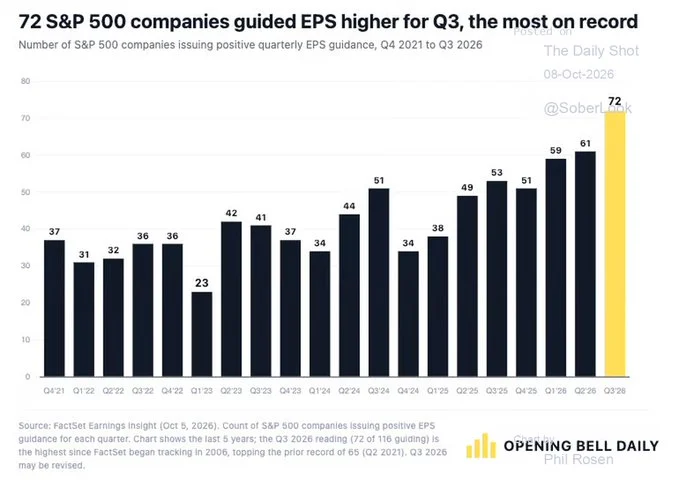
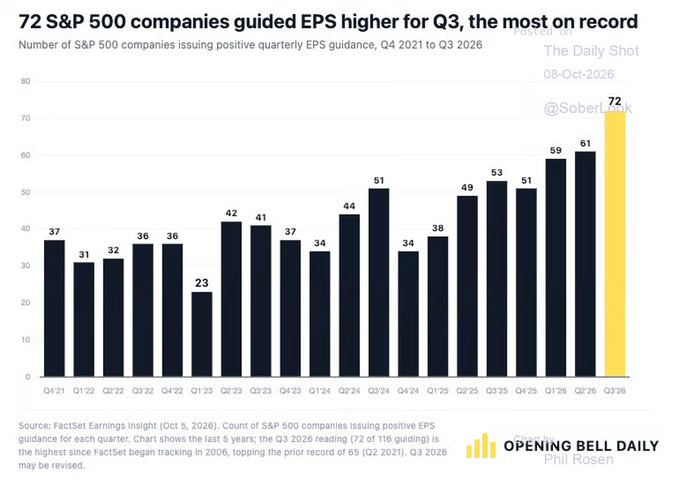
The primary catalyst dominating trading desks is the formal kickoff of the third-quarter earnings season, which begins in earnest with major financial institutions reporting their quarterly results. Traditionally, Wall Street analysts lower their expectations heading into an earnings cycle to ensure companies can comfortably beat consensus estimates. This quarter, however, defied historical norms. According to data compiled by FactSet, Q3 earnings estimates actually rose 1.4% over the course of the quarter, contrasting sharply with the five-year historical average of a 2.2% downward revision. A record number of 72 companies issued positive guidance, pushing expected earnings growth to a striking 29.6%.
Historical trends suggest actual performance often climbs even higher. Actual earnings growth has topped end-of-quarter estimates in 37 of the last 40 quarters, implying that final Q3 growth figures could easily surpass 35%. Early reports are validating this momentum, with 84% of the initial 19 reporting companies beating estimates.
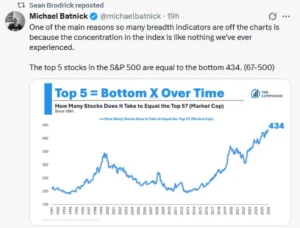
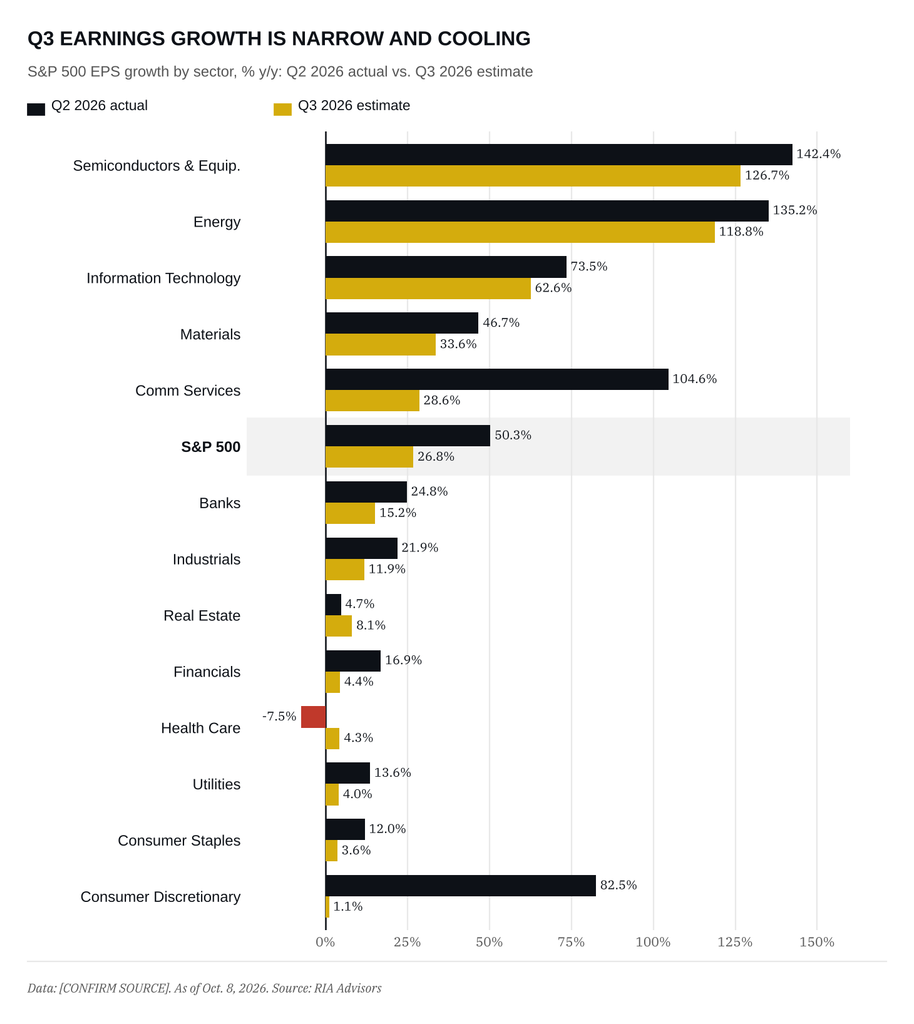
Yet, the concentration of this growth remains a critical vulnerability. The projected gains are heavily concentrated in specific sectors, with semiconductors expected to deliver 126.7% earnings growth, energy anticipated to grow by 118.8%, and broader technology projected at 62.6%. In contrast, sectors such as consumer discretionary, utilities, health care, and financials are expected to range between a modest 1% and 4.4% growth. Consequently, the earnings tape remains as narrow as the price tape, leaving the broader market heavily reliant on a small cohort of high-performing leaders.
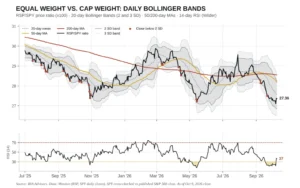
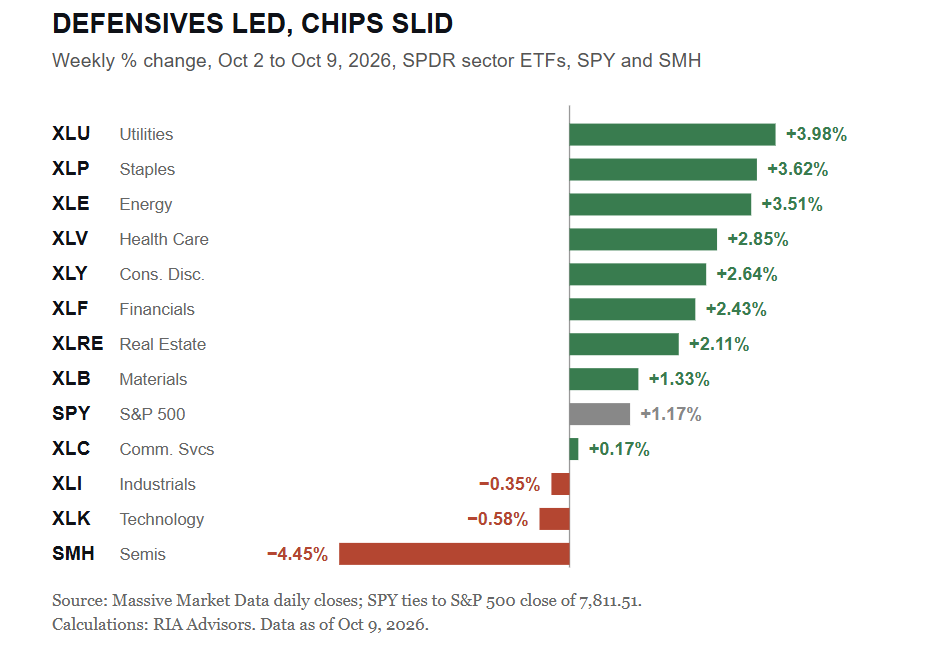
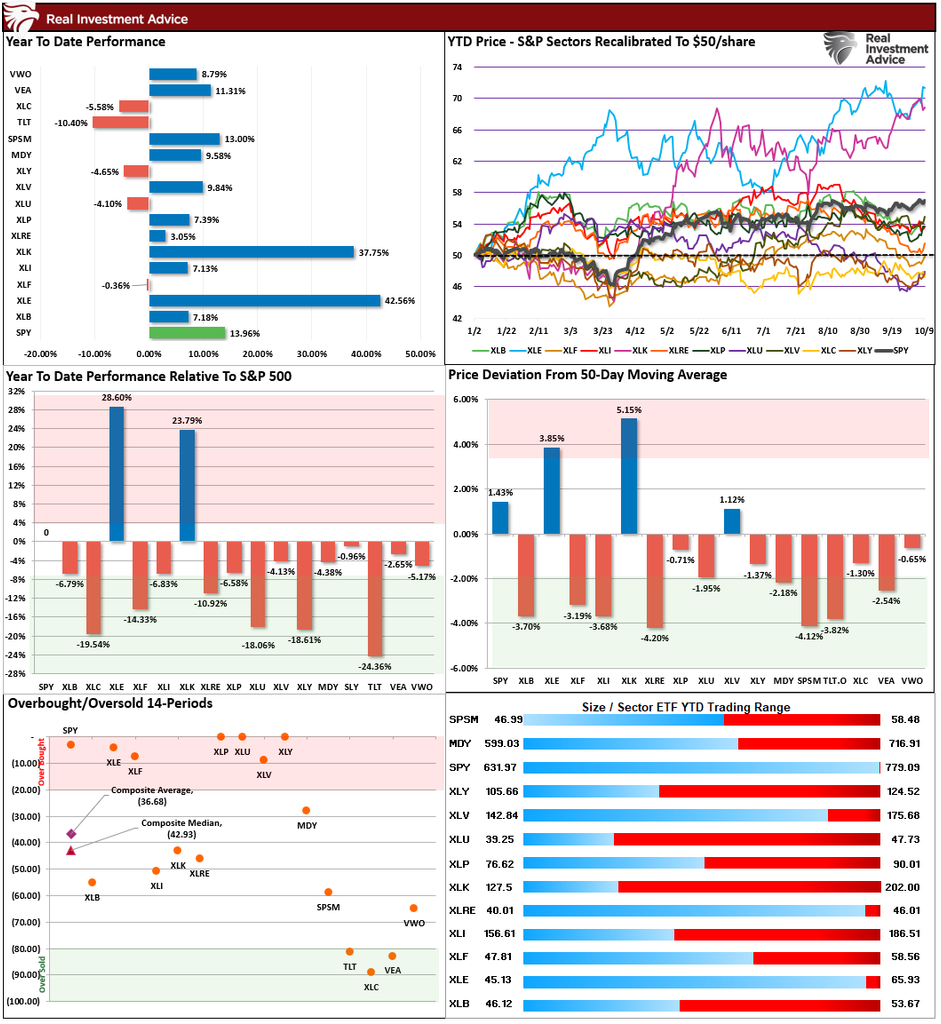
Market positioning reflects this underlying tension. During the week, investors gravitated toward defensive and value-oriented sectors like utilities, consumer staples, and energy, while technology shares faced selling pressure and the semiconductor exchange-traded fund fell 4.5%. Notably, the equal-weight S&P 500 outperformed its cap-weighted counterpart by gaining 1.6%. Outside of energy, market participants actively bought sectors anticipating modest growth while trimming exposure to the high-flying segments expected to deliver triple-digit expansions.
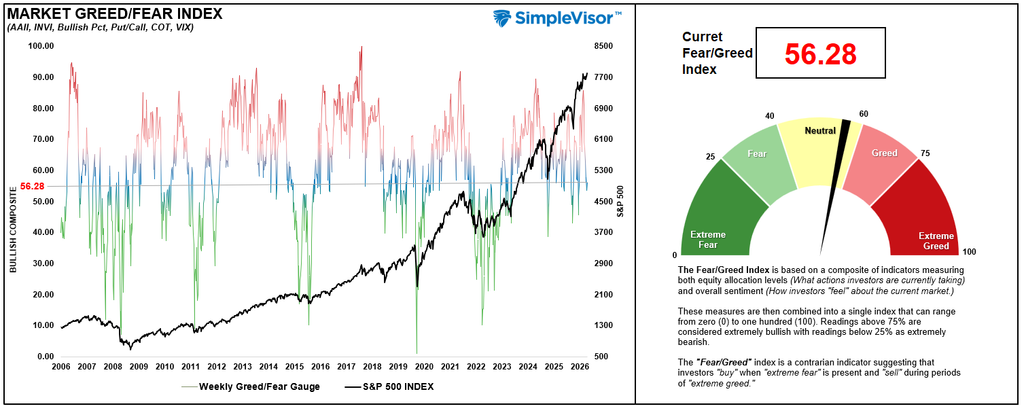
Federal Reserve policy adds yet another layer of complexity. Minutes from the September Federal Open Market Committee meeting revealed that most participants anticipate another interest rate hike by year-end, despite signs of slowing payroll growth at 29,000 and core personal consumption expenditures inflation registering at 3.0%. With consensus leaning heavily in one direction on both earnings and monetary policy, contrarian indicators suggest investors should remain vigilant as the financial sector results provide the first real test of market breadth.
Technical Backdrop: MACD Turns Up Just Below Record Highs
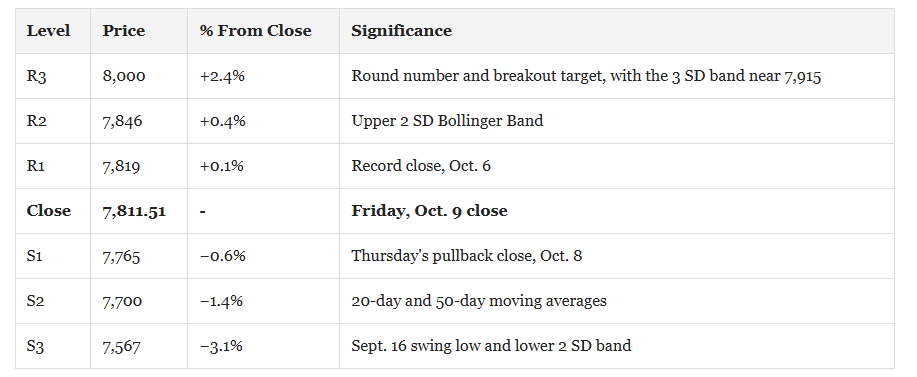
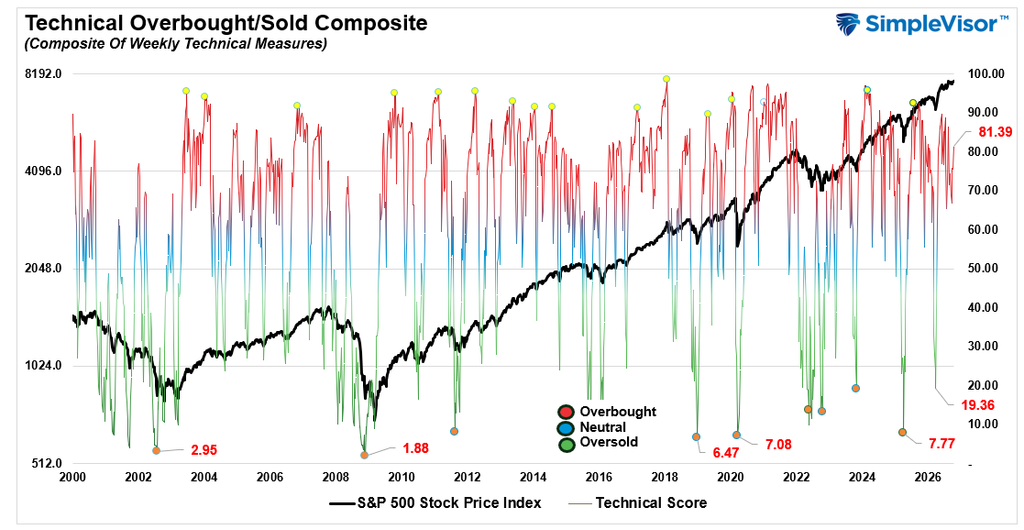
From a technical perspective, the S&P 500’s close at 7,811.51 keeps the primary upward trend intact. The index resides roughly 1.4% above its 50-day moving average near 7,700 and 7.7% above its 200-day moving average near 7,250, with both key trendlines continuing to slope upward.
Following a two-month consolidation range between 7,570 and 7,800, the index has pushed toward the upper boundary of its historical channel. Trading ranges that resolve near cyclical highs typically favor continuation, though the narrow foundation of the current advance warrants caution. The considerable distance to the 200-day moving average provides ample cushion for a normal market correction without threatening the broader bull market structure.

Momentum indicators have shown renewed vigor. The 14-day Relative Strength Index advanced to 59.8, leaving room before reaching the traditional 70 overbought threshold. Furthermore, the Moving Average Convergence Divergence indicator crossed back above its signal line, delivering a fresh buy signal following September’s choppy trading. The upper Bollinger Band near 7,846 serves as the immediate overhead resistance level.
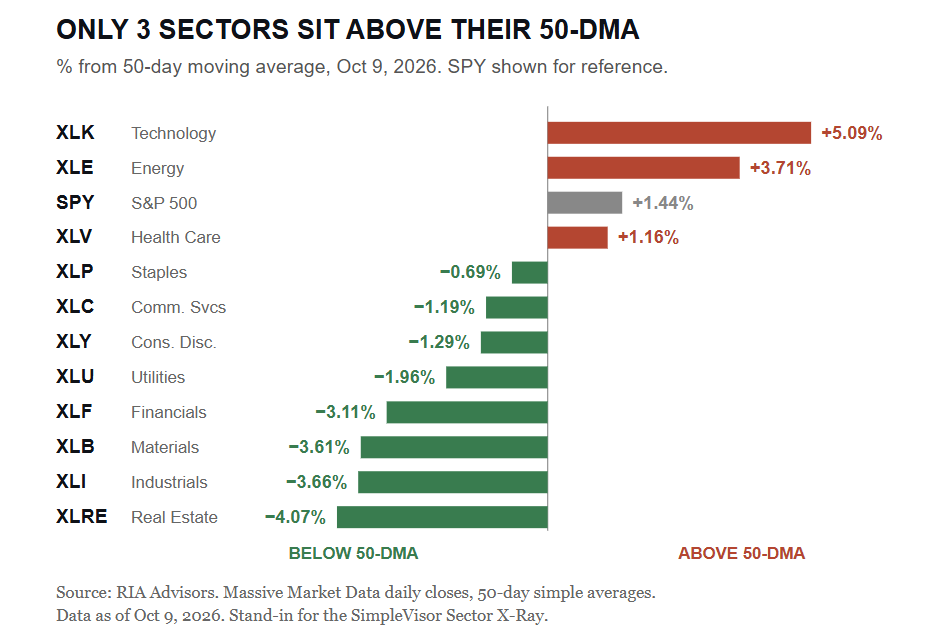
Market breadth, however, reveals a more fractured internal structure. Only three of the eleven primary sector exchange-traded funds currently trade above their respective 50-day moving averages, led by technology, energy, and health care. While laggard sectors such as real estate and utilities have closed some of their deficits relative to their moving averages, the broader market continues to rely heavily on a concentrated group of mega-cap names. Furthermore, quantitative risk measures highlight a high count of negative-beta stocks within the index, reinforcing the reality that a narrow leadership group is driving index performance rather than a synchronized, broad-based advance.
Key Catalysts and Upcoming Data
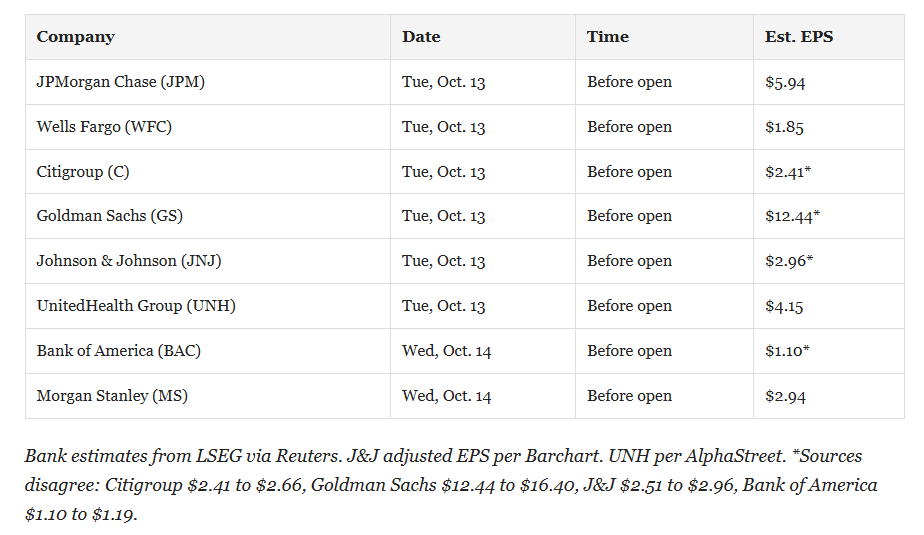
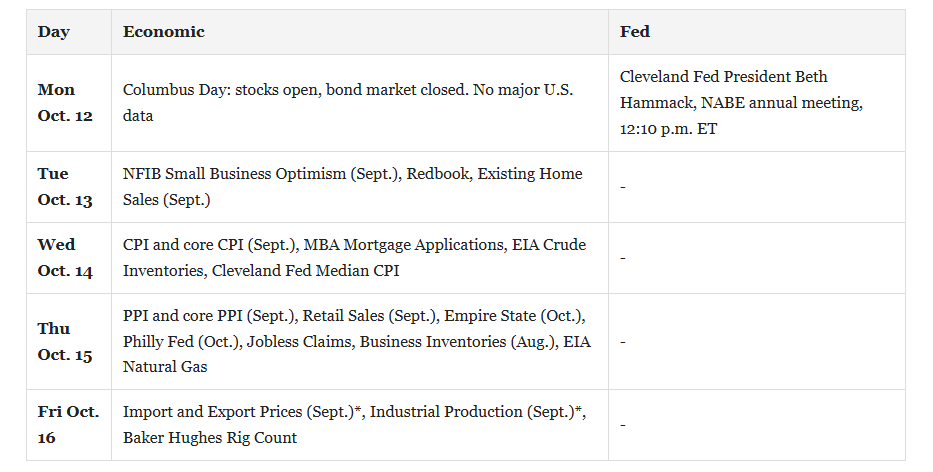
The economic and corporate calendar for the upcoming week introduces several high-stakes events. Q3 earnings reports from major financial institutions—including JPMorgan Chase, Wells Fargo, Citigroup, and Goldman Sachs—will set the tone for the reporting season. Investors will closely scrutinize net interest income, loan growth, and credit quality metrics to gauge the health of the broader economy in an elevated interest rate environment. Later in the week, reports from Taiwan Semiconductor Manufacturing Company and ASML will offer vital insights into artificial intelligence demand and the hardware supply chain.
On the macroeconomic front, the central focus will be the release of the Consumer Price Index inflation report. With inflation prints serving as a primary determinant of Federal Reserve policy, a softer-than-expected reading would bolster the case for a monetary policy pause and potentially ease benchmark yields. Conversely, a hotter inflation print would likely reignite expectations for further monetary tightening, posing additional headwinds for equity valuations that currently offer little yield advantage over government debt.

Equity Risk Premium Has Vanished
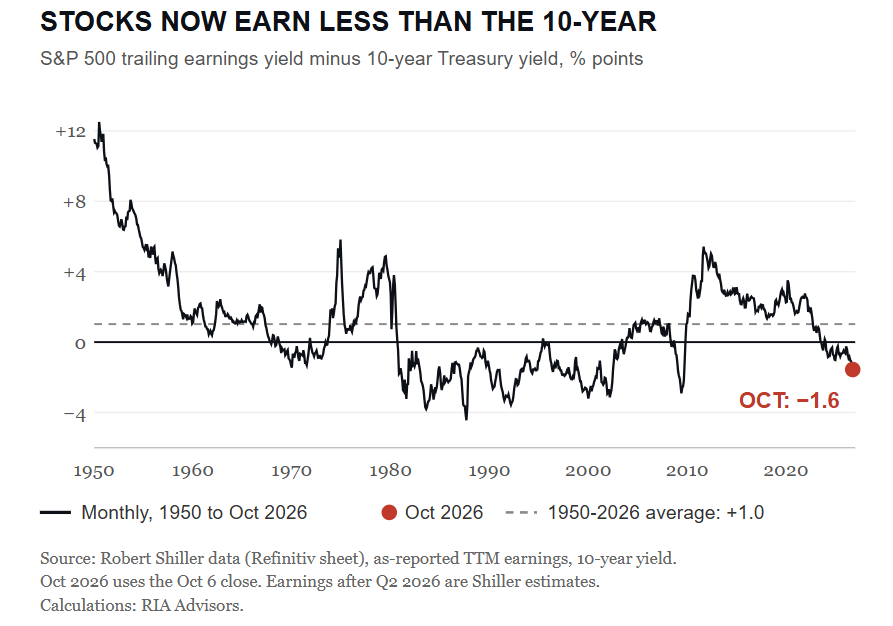
While seasonal tailwinds and positive corporate earnings revisions support a constructive outlook through the end of the year, macroeconomic fundamentals present a compelling counter-narrative regarding long-term valuations. With the 10-year Treasury yield hovering above 5%, risk-free government debt offers returns that equities have not matched relative to their earnings yields since 2002. Consequently, the equity risk premium—the additional return investors demand for holding stocks instead of bonds—has compressed to historic lows.
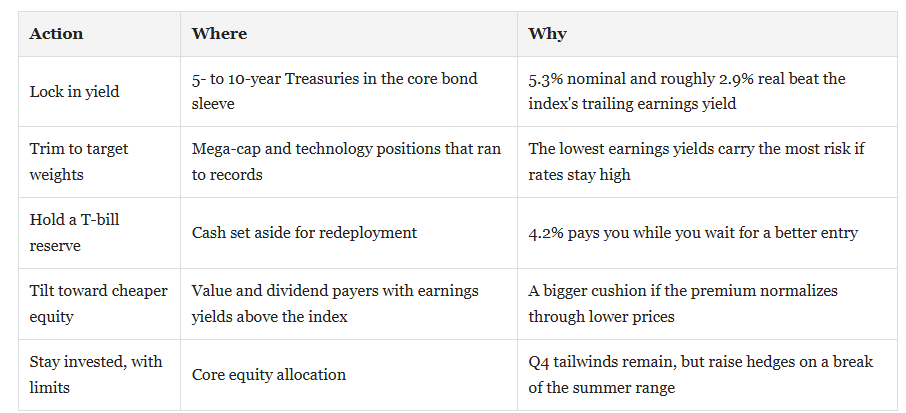
Comparing the earnings yield of the S&P 500 to the yield on the 10-year Treasury illustrates this structural shift. Based on trailing as-reported earnings from Robert Shiller’s long-term datasets, the index trades at a price-to-earnings ratio near 27, translating to an earnings yield of approximately 3.7%. With the 10-year Treasury yielding over 5%, each dollar invested in the broad market currently yields roughly 1.6 percentage points less than a risk-free government bond. Even when utilizing forward operating earnings estimates from FactSet, which imply an earnings yield near 5.3%, the premium for taking on equity market risk remains virtually nonexistent.

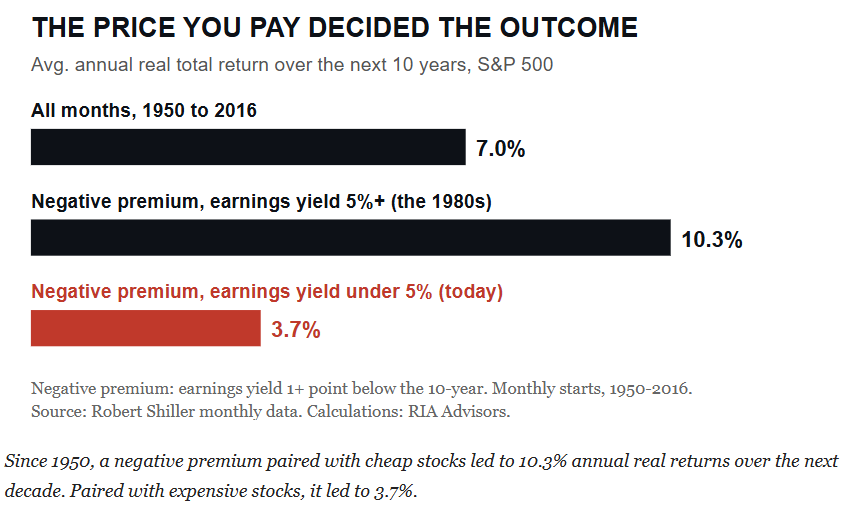
Historical analysis of market cycles since 1950 reveals that a negative equity risk premium is not an automatic sell signal in isolation, provided that starting valuations are sufficiently low. For instance, during the early 1980s, high double-digit Treasury yields resulted in a negative equity risk premium, but low equity valuations and high initial earnings yields paved the way for exceptional long-term total returns as interest rates eventually retreated.

However, today’s market conditions bear a closer resemblance to historical periods of elevated valuations, such as the late 1990s and the dot-com era. When a negative equity risk premium coincides with low starting earnings yields below 5%, subsequent decade-long real returns have historically averaged modest single-digit gains, with a significantly higher probability of negative outcomes over ten-year holding periods.
Portfolio Strategy and Risk Management
For long-term investors and retirement planners, these dynamics do not imply an immediate liquidation of equity portfolios, particularly given the historical strength of fourth-quarter seasonality. Rather, they emphasize the importance of prudent asset allocation, risk management, and the rebalancing of concentrated gains.
The resurgence of attractive fixed-income yields provides investors with a viable alternative to pure equity exposure, offering contractual cash flows that reduce the pressure to sell risk assets during market drawdowns. Maintaining disciplined bond allocations serves as essential portfolio insurance, buffering against severe equity corrections and shortening the recovery timeline required to restore portfolio value following a market downturn.
Ultimately, navigating the current financial environment requires balancing participation in ongoing market momentum with a realistic assessment of elevated valuations and shifting macroeconomic conditions. By aligning portfolio risk with individual time horizons and income requirements, investors can better position themselves for both near-term opportunities and long-term financial security.

Related News