Real Wages Slip Below Zero for the First Time in Three Years as Energy Squeeze Hits Consumer Stocks
By Lance Roberts
October 30, 2026
The September jobs report dominated the financial headlines with a meager 29,000 payrolls added, alongside an outright downward revision to July’s numbers. However, the most critical economic signal arrived twelve days later, buried deep within the Bureau of Labor Statistics’ real earnings release. Real wages in 2026 have slipped further into negative territory, marking the first sustained negative stretch since the spring of 2023. This silent erosion of purchasing power is fundamentally changing the math for every company selling goods that households can easily put off buying.
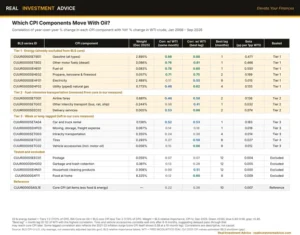
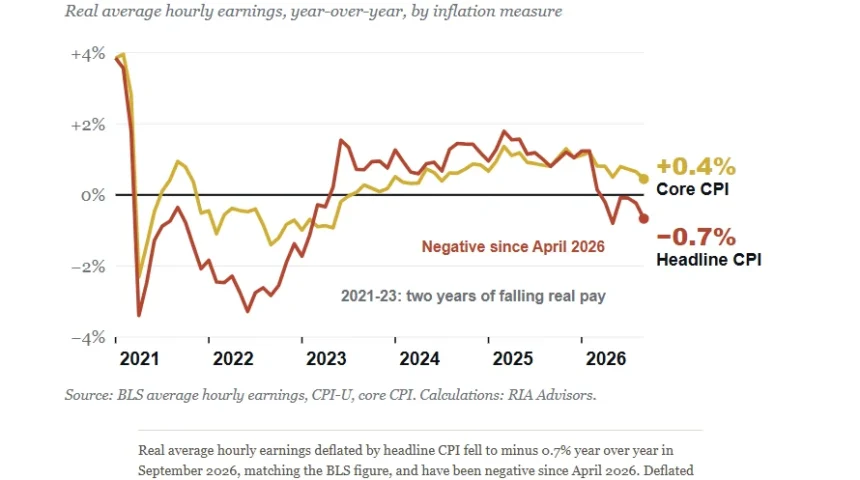
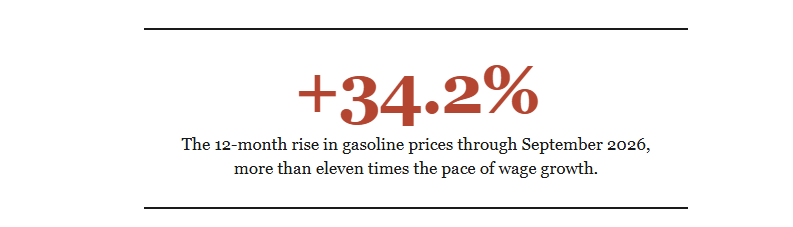
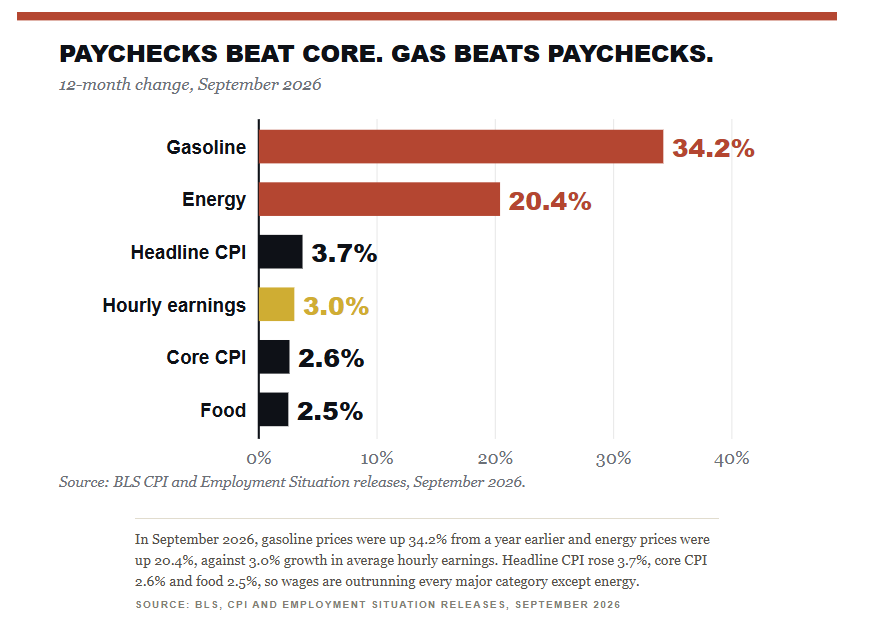
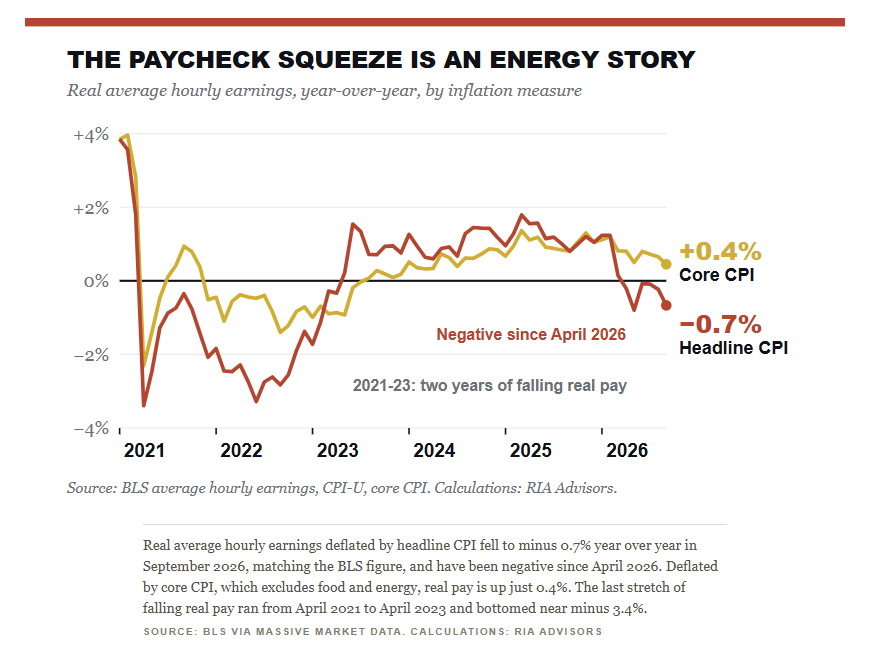
Average hourly earnings, adjusted for inflation, fell 0.7% over the twelve months leading through September, accelerating past August’s decline. While workers did receive nominal pay raises—with average hourly earnings rising roughly 3.0% over the past year—the surge at the fuel pump completely offset these gains. Gasoline prices have skyrocketed 34.2% from a year ago, while the broader energy index is up 20.4%. Meanwhile, food costs climbed 2.5%, and core Consumer Price Index (CPI) inflation, which strips out volatile food and energy costs, ran at a modest 2.6%.

This dichotomy explains why two different versions of real pay tell opposing stories. When wages are deflated by core CPI, real pay appears to be growing at a sluggish 0.4% annually. However, when deflated by headline CPI—representing the actual prices people pay at the grocery register and the fuel pump—real pay has registered as negative every single month since April.
The economic burden of this energy tax falls disproportionately on families with the least room in their household budgets. A worker commuting thirty miles each way daily, or heating an older, less energy-efficient home, devotes a vastly larger percentage of their income to energy expenses than a high-earning household. Consequently, aggregate real wage statistics likely understate the severe financial strain experienced by the bottom half of the income distribution.
Where Did the Paycheck Raise Go?
Consumers rarely slash their spending the exact moment real income turns negative. Instead, they typically implement workarounds, and current economic data highlights three primary methods households are using to bridge the gap.
First, workers are logging longer hours. The average workweek is currently 0.6% longer than it was a year ago, yet real weekly earnings still slipped by 0.1%. While these additional hours kept weekly pay ahead of inflation back in August, they failed to maintain that buffer by September.
Second, consumers are spending beyond their actual income. Recent data shows that real consumer spending rose 0.6% in August while real disposable income remained completely flat, leaving the personal saving rate languishing at 4.1%.
Third, households are increasingly relying on credit. Credit card balances climbed to $1.26 trillion in the second quarter, with serious delinquencies running near an annualized rate of 7%. This reliance on high-interest debt represents a dangerous vulnerability. Credit card debt at elevated interest rates turns a transient energy shock into a chronic drag on household finances, ensuring that families borrowing to fill their gas tanks today will still be servicing that high-cost debt long after fuel prices eventually normalize. New delinquencies across auto loans and credit cards remain stubbornly elevated, according to the Federal Reserve Bank of New York.
This dynamic addresses the frequent question of how spending continues to expand despite consumer strain. While financial media frequently lauds consumer "resilience," longer hours, thinner savings, and expanding credit can bridge financial gaps for only a few quarters. None of them can bridge it indefinitely.
Why the 2026 Squeeze Hurts More Than 2022
Skeptics often point out that real wages fell far more severely in 2022—dropping by more than 3% at their worst—yet consumers continued spending unabated. That observation is accurate, but it overlooks the critical economic cushions that supported households during that period. In 2022, job openings exceeded 11 million, allowing workers to rapidly increase their wages by switching jobs, and families were still cushioned by substantial pandemic-era savings.
Today’s economic landscape looks starkly different. Job openings hover near 7.1 million, the unemployment rate sits at 4.2%, and the economy added a paltry 29,000 jobs in September. The modern consumer faces a smaller inflation shock but possesses far fewer shock absorbers. In 2022, an employee could quit their job on Monday and secure higher pay by Friday. In 2026, trapped within what economists classify as a "low hire, low fire" labor market, workers lack that flexibility. Consequently, a modest drop in real wages today carries the potential to inflict significantly more economic damage than a larger decline did four years ago.
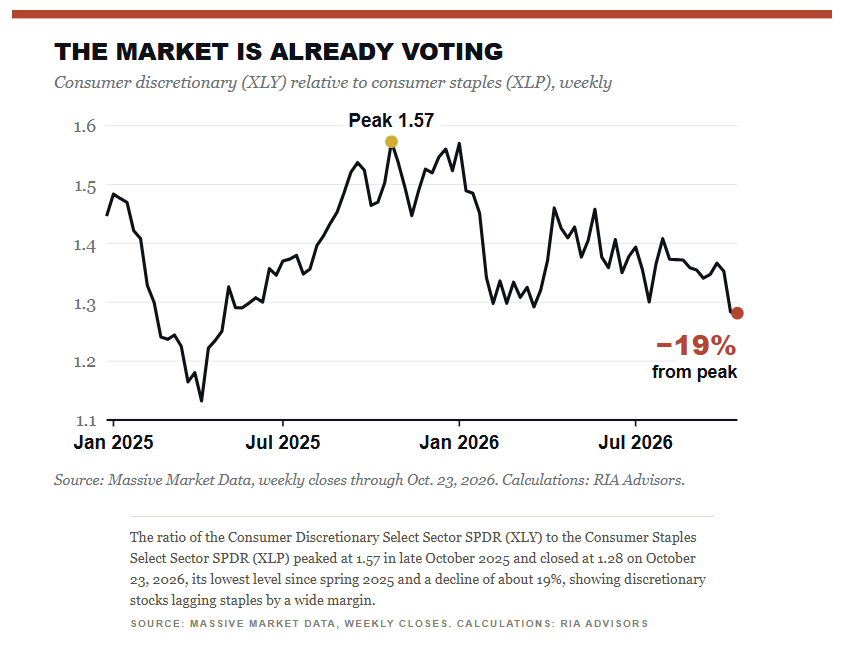
Consumer Stocks Are Already Voting
Financial markets rarely wait for official gross domestic product reports to signal trouble. The ratio of consumer discretionary stocks to consumer staples has declined approximately 19% from its late-2025 peak. This indicates that institutional capital has been quietly rotating away from discretionary goods and toward essential staples for the majority of the year. Notably, this market breakdown materialized in February, a full month before gasoline price spikes fully registered in the headline CPI data.
Third-quarter corporate earnings reports reflect this defensive rotation. Domino’s reported U.S. same-store sales up a mere 0.3%, accompanied by customers ordering fewer items per transaction. While September retail sales appeared robust on the surface with a 0.8% increase, stripping out gasoline sales reveals a meager 0.2% gain.
As major retailers report earnings over the coming weeks, key terminology will likely dominate executive commentary: "trading down," "choiceful consumer," and "smaller basket sizes." Management teams typically voice these observations on earnings calls a quarter or two before they formally materialize in top-line revenue declines.

Where the Bulls Find Argument
Market bulls present a valid counterargument: energy shocks eventually reverse, and when crude prices fall, the mathematical impact on inflation reverses just as quickly. Gasoline represents a relatively small slice of the overall CPI basket, and a sharp downturn in crude oil prices could push real wages back into positive territory within months. Gulf oil flows have shown signs of recovery toward prewar levels, and national average gasoline prices briefly eased earlier in the autumn before crude prices experienced renewed volatility. Furthermore, core real pay maintains positive growth, and historical unemployment levels remain low. If oil prices break downward, beaten-down consumer discretionary stocks could experience a sharp relief rally.
Relying on an oil price correction becomes hazardous, however, when geopolitical tensions persist in key shipping lanes and international benchmarks trade well above $100 a barrel. As investor Howard Marks famously noted, forecasting is difficult, but preparation is essential. Bad inflation ultimately cures itself, but that cure is achieved through demand destruction. That demand destruction manifests first in the earnings reports of companies selling non-essential goods and services.
Portfolio Strategy Amid Real Wage Pressures
Managing investment portfolios in this environment requires a deliberate reassessment of equity exposure. Investors must evaluate how heavily their holdings depend on the financial health of lower- and middle-income consumers, a demographic far broader than the consumer discretionary sector alone. Rallies in consumer stocks ahead of upcoming earnings reports should be approached with skepticism until corporate guidance confirms underlying strength. When consumers face financial compression, pricing power and pristine corporate balance sheets matter far more than speculative growth narratives.
Patience remains a strategic position. Monitoring monthly real earnings prints provides the ultimate signal for market positioning. The moment the Bureau of Labor Statistics reports that paychecks are once again outpacing headline inflation, investors will have the clear signal needed to lean back into consumer-facing equities. Until that threshold is crossed, the reality remains clear: real wages are compressed by energy costs, households are bridging the gap through extended hours and expensive debt, and consumer stocks are already pricing in the day that financial bridge finally gives way.

Related News