Strategy’s Q3 Earnings Call: Michael Saylor and Phong Le Break Down Digital Credit, STRC, and the Financialization of Bitcoin
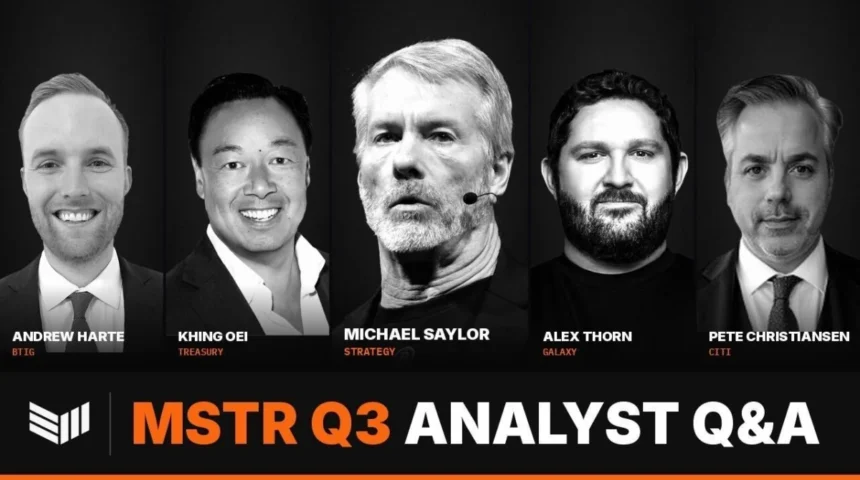
During Strategy’s Q3 2026 earnings call, executive leadership delivered a comprehensive deep-dive into the company’s evolving balance sheet strategies, addressing pressing questions from prominent institutional analysts. Chief Executive Officer Phong Le and Executive Chairman Michael Saylor took the floor to field inquiries from a high-profile lineup of financial professionals, including Andrew Harte of BTIG, Khing Oei of Treasury, Alex Thorn of Galaxy, Pete Christiansen of Citi, and independent market analyst Scott Melker. The conversation touched upon a wide array of sophisticated topics, ranging from digital credit creation and the mechanics of the Stretch (STRC) instrument returning to par to the performance of other preferred securities, the broader financialization of Bitcoin, and the long-term potential and regulatory hurdles surrounding tokenization.
The dialogue provided market observers with a rare window into how one of the corporate world’s most aggressive holders of digital assets manages its capital structure under varying market conditions. As Strategy continues to pioneer corporate treasury strategies centered around Bitcoin, the Q3 earnings call served as a crucial checkpoint for understanding how the firm balances equity dilution, debt issuance, and innovative financial engineering.
Strategy’s Balance Sheet Versus Past Bull Markets
The discussion opened with a critical examination of Strategy’s current balance sheet positioning compared to previous bull market cycles. Analysts were keen to understand how the firm’s capital allocation framework has matured since earlier iterations of crypto market surges. Leadership explained that the sheer scale of the enterprise today necessitates a far more sophisticated approach to risk management and capital deployment. Rather than relying solely on straightforward equity issuance, the company has increasingly leaned into complex financial instruments, structured credit, and preferred products to fund its ongoing accumulation strategy while protecting shareholder value.
This evolution reflects a maturing corporate treasury model. As Strategy has grown, its ability to tap into traditional capital markets has expanded significantly, allowing the firm to weather broader macroeconomic headwinds and crypto market volatility with greater resilience than it did in past cycles.
Capital Requirements for Digital Credit and the Equity ATM
A central theme of the analyst Q&A revolved around the mechanics of digital credit and the capital intensity required to scale such operations. Executives emphasized that creating a robust digital credit market requires massive amounts of capital up front. When pressed by analysts on when Strategy might turn its equity At-The-Market (ATM) facility back on, leadership provided insight into the strategic triggers that dictate equity issuance.
The decision to activate the ATM is never taken lightly and is closely tied to prevailing market premiums, capital demand, and the overall cost of capital. Executives explained that maintaining flexibility is paramount, allowing the company to capitalize on favorable market conditions to issue equity efficiently without placing undue pressure on existing shareholders. The delicate balance between issuing equity to acquire more underlying digital assets and managing dilution remains a core pillar of Strategy’s operational philosophy.
The Mechanics of Stretch (STRC) and the Preferred Suite
A significant portion of the call was dedicated to unpacking the performance and market dynamics of Strategy’s preferred and fixed-income offerings, most notably Stretch (STRC). Analysts questioned why it took four months for STRC to return to par following previous market fluctuations. Leadership addressed the structural and liquidity factors that influenced the recovery timeline, offering transparency into how these specialized financial products interact with broader market liquidity and investor demand.
In addition to STRC, the discussion broadened to encompass the wider suite of preferred instruments, including STRD, STRK, and STRE. Executives evaluated the performance and reception of each product, highlighting both the successes and the unique hurdles encountered along the way. For instance, the euro-listed STRE presented distinct operational and regulatory challenges compared to its domestic counterparts, underscoring the complexities of scaling structured financial products across international jurisdictions. Despite these hurdles, leadership reaffirmed their commitment to refining these instruments to better serve institutional and retail investors seeking diversified exposure to Strategy’s corporate ecosystem.
The Financialization and Tokenization of Bitcoin
As the conversation shifted toward macro themes, analysts probed the broader implications of Strategy’s operations on the financialization of Bitcoin. The panel debated whether Strategy is fundamentally financializing the asset, drawing fascinating historical parallels to industrial pioneers of the past. Michael Saylor likened the current institutional adoption and structuring of Bitcoin to the foundational contributions of historical figures like Thomas Edison and John D. Rockefeller, who built the infrastructure for electricity and oil that ultimately enabled mass commercialization.
Executives noted how institutional participation is actively damping Bitcoin’s historical volatility. As more sophisticated financial products, credit markets, and corporate treasuries integrate the asset, the market structure matures, smoothing out extreme price swings and paving the way for broader institutional adoption. This ongoing financialization transforms the digital asset from a speculative retail-driven commodity into a core pillar of modern global finance.
The final segments of the Q&A explored the frontier of tokenization. Analysts raised questions regarding the feasibility of issuing tokenized MSTR shares for U.S. investors and the broader promise of tokenization, which relies on the principles of an open and free market. However, executives did not shy away from addressing the elephant in the room: the absence of a unified U.S. token standard. Until regulatory clarity is established regarding tokenized securities and digital assets within the United States, the full potential of tokenized corporate equity will remain constrained, leaving market participants to navigate a patchwork of regulatory interpretations.
The comprehensive Q&A session underscored Strategy’s ongoing evolution from a traditional enterprise software firm into a pioneering financial institution bridging the gap between traditional capital markets and the emerging digital asset economy.
Disclaimer: The views and opinions expressed in this show are those of the participants and do not necessarily reflect the official policy or position of BTC Inc., Bitcoin Magazine, or any affiliated entities. This content is provided for informational and educational purposes only and should not be construed as investment, legal, tax, or accounting advice. Nothing contained in this show constitutes a solicitation, recommendation, endorsement, or offer to buy or sell any securities or financial instruments. Viewers should consult their own advisors before making financial or business decisions.

Related News