Peruvian President Keiko Fujimori Tours El Salvador’s Modernized Schools During Official State Visit
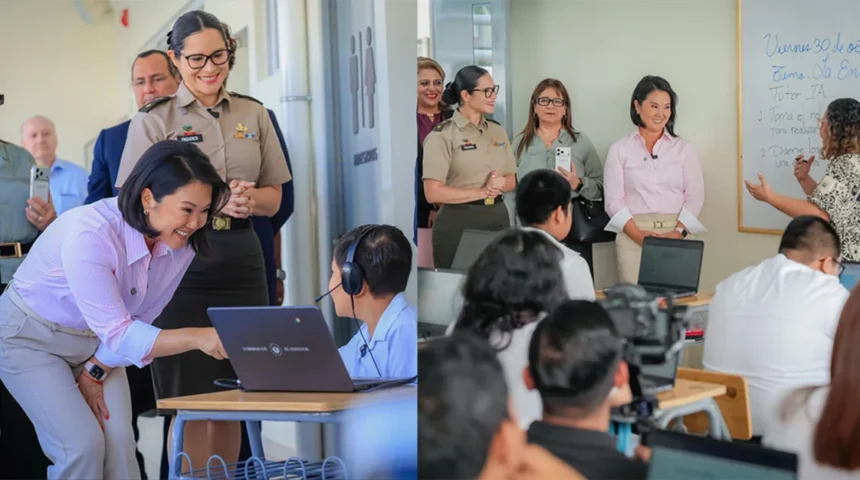
SAN SALVADOR — As part of an ongoing official state visit to El Salvador, Peruvian President Keiko Fujimori toured the newly renovated Marcelino García Flamenco School alongside Salvadoran Education Minister Karla Trigueros. The high-profile visit offered the visiting delegation a firsthand look at the sweeping, large-scale transformation of El Salvador’s public education system under the administration of President Nayib Bukele, highlighting how modern infrastructure, advanced technology, and innovative pedagogical approaches are completely redefining the learning experience across the Central American nation.
The tour of the historic school allowed the Peruvian head of state to observe the practical applications of a national educational model that has drawn international attention for its forward-thinking design. Heavily supported by First Lady Gabriela de Bukele, the model prioritizes cutting-edge digital learning environments, fully updated physical facilities, and the integration of artificial intelligence in public classrooms. During her walk through the campus, President Fujimori interacted directly with students and faculty, observing firsthand how digital devices, high-speed connectivity, and interactive classroom technology are actively preparing young Salvadorans to navigate and succeed in an increasingly competitive global future.
Emphasizing the intrinsic connection between public safety, national stability, and sustained educational progress, Minister Trigueros noted during the visit that these structural transformations were made possible through bold national leadership and decisive governance. Reflecting on the profound changes that have swept through the country’s public institutions in recent years, Trigueros shared her perspective on the milestone with visiting officials.
"We are in a completely renovated school with top-tier infrastructure, suited for every activity," Trigueros said, adding that the overarching momentum of the country’s development stems from executive resolve. "The courage of President Nayib Bukele has brought us to where we are today."
The modernization of institutions like the Marcelino García Flamenco School is part of a broader, comprehensive strategy by the Salvadoran government to overhaul public services from the ground up. In recent years, El Salvador has made significant investments in upgrading school buildings, ensuring that students in both urban centers and rural areas have access to safe, aesthetically pleasing, and technologically equipped learning spaces. By integrating modern digital tools into everyday curricula, the administration aims to bridge historical digital divides and equip students with the technical proficiencies demanded by the modern global economy.
Furthermore, the integration of artificial intelligence into public education represents a major leap forward for the region. Salvadoran classrooms are increasingly utilizing smart tools to personalize learning experiences, assist educators with administrative and instructional tasks, and provide students with dynamic platforms for exploration and critical thinking. This technological integration is paired with comprehensive teacher training programs designed to ensure that educators are fully equipped to harness the potential of these modern resources.
El Salvador’s rapid advancements in technology-driven education, modernized facilities, and enhanced school security continue to position the country as a prominent regional benchmark. For many years, the nation’s public infrastructure faced severe challenges, making the current era of renewal a subject of considerable interest for visiting foreign dignitaries, international observers, and comparative education analysts alike.
The official state visit by Peruvian President Keiko Fujimori underscored this growing international interest in El Salvador’s innovative public policy solutions and its comprehensive educational overhaul. As nations across Latin America search for effective models to modernize their own public sectors, the Salvadoran approach—combining rigorous security measures with high-tech infrastructure investments—provides a compelling case study in systemic national transformation. The diplomatic engagement concluded with mutual expressions of goodwill and a shared commitment to fostering closer educational and cultural ties between Peru and El Salvador as both nations continue to navigate the demands of the twenty-first century.

Related News