Salvadoran-Born Astronaut Frank Rubio Joins Artemis III Crew at the White House Ahead of 2027 Space Mission
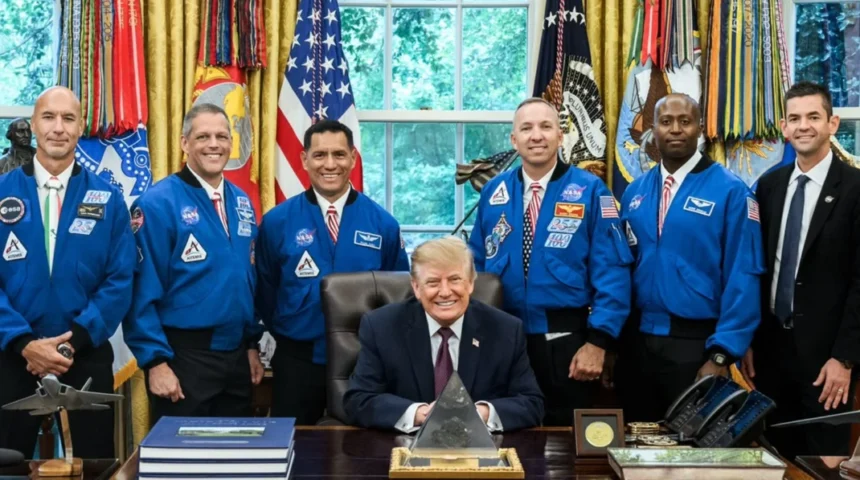
Salvadoran-born astronaut Frank Rubio recently stepped into the historic corridors of the White House alongside his fellow members of NASA’s Artemis III crew, marking a significant milestone as the United States continues to advance its ambitious plans for crewed space exploration. President Donald Trump welcomed the elite team of spacefarers into the Oval Office, offering a formal greeting and celebrating the milestones ahead of the mission currently planned for 2027.
The White House officially documented the momentous occasion, sharing a series of photographs from the meeting on October 28, accompanied by an official message of welcome and encouragement for the astronauts. Among the diverse and highly skilled crew, Rubio’s participation brought considerable attention and pride to El Salvador, underscoring the deep-rooted connections between the Central American nation and the United States’ renewed, collaborative efforts in aerospace exploration. His presence serves as a testament to the growing global nature of modern space missions, where international cooperation and diverse backgrounds converge to push the boundaries of human achievement beyond Earth.
Rubio’s journey to the Artemis III crew roster represents the continuation of an already distinguished career with the National Aeronautics and Space Administration. He was officially selected as an Artemis III mission specialist in June 2026, positioning himself at the forefront of NASA’s strategic roadmap to return human presence to the lunar vicinity and establish sustainable exploration capabilities. In this capacity, Rubio joins a select group of veteran and accomplished spacefarers, including fellow NASA astronauts Randy Bresnik and Andre Douglas, as well as European Space Agency astronaut Luca Parmitano.
Together, this international crew is actively engaged in rigorous preparations for a critical mission scheduled for 2027. Rather than an immediate lunar landing, this upcoming flight will serve as a vital stepping stone in the Artemis program, tasked with rigorously testing advanced spacecraft rendezvous and docking systems in low Earth orbit. These intricate tests are paramount, ensuring that future hardware, life support systems, and orbital maneuvers operate with absolute precision before crews attempt more complex journeys deeper into space and toward the lunar surface.
Born in the United States to Salvadoran parents, Rubio has long established a reputation for resilience, dedication, and historic achievements in the aerospace sector. Prior to his selection for the Artemis program, Rubio made international headlines and etched his name into the history books through an extended, record-breaking stay aboard the International Space Station. During that monumental assignment, he spent more than a continuous year in Earth orbit, shattering previous American records for single-duration spaceflight and cementing his status as one of the most enduring and reliable astronauts in the history of NASA’s active corps. His ability to adapt to the physiological and psychological rigors of long-duration spaceflight has provided invaluable data to researchers studying how the human body reacts to microgravity over extended periods.
His prominent presence at the White House event not only highlights the personal dedication and professional excellence required to reach the pinnacle of space exploration, but it also underscores the broader international and cultural dimensions behind NASA’s Artemis program. For the Salvadoran community both in the United States and abroad, Rubio’s continued prominence offers a powerful moment of recognition and inspiration. As one of their own takes a central role in what is widely regarded as a major new chapter in human space exploration, young people across generations are provided with a tangible example of what can be achieved through perseverance, education, and a commitment to scientific discovery. The gathering in the Oval Office ultimately captured a convergence of national leadership, international partnership, and individual excellence as the world looks toward the horizon of humanity’s next great leap into the cosmos.

Related News