Federal Judge Dismisses Donald Trump’s $10 Billion Defamation Lawsuit Against Rupert Murdoch and The Wall Street Journal
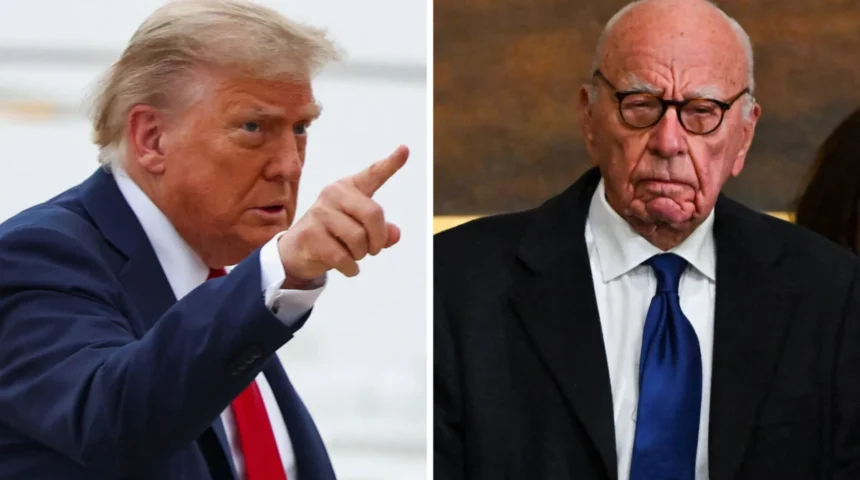
A federal judge in Miami on Saturday dismissed with prejudice President Donald Trump’s amended defamation lawsuit against media baron Rupert Murdoch and The Wall Street Journal, bringing a definitive end to the high-profile legal battle in federal court. The litigation stemmed from the newspaper’s investigative reporting on a purported 50th birthday letter allegedly sent by the president to the late, notorious sex offender Jeffrey Epstein.
U.S. District Court Judge Darrin Gayles ruled that Trump had once again failed to plausibly allege that the newspaper, its parent company, and other defendants acted with actual malice when they published the explosive story in July 2025.
"As with his first attempt, he has failed," Gayles wrote in his scathing 20-page ruling, which arrived more than six months after he initially dismissed the first iteration of the lawsuit. "Grasping at straws, the Amended Complaint attempts to manufacture flaws with the investigation."
By dismissing the lawsuit with prejudice, the judge barred Trump from filing another federal lawsuit alleging the same claims against Murdoch and the publication. Gayles noted that the Journal had conducted a "thoughtful and detailed investigation" prior to publication and squarely rejected the plaintiff’s argument that the media outlet should have withheld the story simply because Trump and his representatives adamantly denied authoring the document.
The court’s ruling did not make a definitive factual determination as to whether Trump actually authored the disputed birthday letter. Trump has consistently and forcefully denied writing the message or ever sending it to Epstein, who died in a federal jail cell in 2019 while awaiting sex trafficking charges.
When Judge Gayles first dismissed the suit in April, he granted Trump the procedural opportunity to file an amended version of the complaint to cure various legal defects identified by the bench. In his revised filing, Trump was seeking a staggering $10 billion in damages from Murdoch and the Journal, which operates under Murdoch’s News Corp conglomerate.
Following Saturday’s ruling, a spokesperson for the newspaper’s publisher, Dow Jones & Co., issued a brief statement to CNBC expressing satisfaction with the judicial outcome. "We’re pleased with the court’s decision," the spokesperson said.
Conversely, a representative for Trump’s legal team confirmed that the president intends to challenge the decision by filing an immediate appeal.
"President Trump will continue to press forward in his powerhouse lawsuit against the Wall Street Journal and all of the other defendants," a spokesman for Trump’s legal team said in a statement. "The President will continue to hold those who mislead the American People with Fake News and smears accountable for their actions."
Throughout his ruling, Judge Gayles reiterated a fundamental legal hurdle that public figures face when pursuing libel or defamation claims in the United States. Under landmark Supreme Court jurisprudence, plaintiffs who are public figures must demonstrate by clear and convincing evidence that a defendant acted with "actual malice"—meaning they published a statement knowing it was false or with reckless disregard for whether it was true or false. Gayles emphasized that Trump failed to meet this high legal threshold.
The amended lawsuit introduced several new details and evidentiary claims, including a private phone conversation between Trump and Murdoch. According to the revised filing, Murdoch allegedly told the president "I will handle it" when Trump contacted him regarding an upcoming article describing a birthday letter to Epstein that purportedly bore Trump’s signature.
Despite these additions, Judge Gayles systematically dismantled each of the arguments presented in the amended complaint. He rejected claims that the Journal had failed to conduct an adequate investigation, that it had deliberately omitted relevant context, and that the publication acted maliciously by proceeding with the story despite the president’s vehement denials.
Gayles reasoned that accepting Trump’s argument regarding pre-publication denials would effectively establish a dangerous precedent, enabling public figures to unilaterally block unfavorable or critical investigative reporting simply by denying its veracity. Such a standard, the judge noted, "runs afoul of the First Amendment" and the foundational constitutional protections guaranteed to freedom of speech and the press.
Saturday’s court decision marks merely the latest legal hurdle and setback in a broader wave of litigation initiated by Trump against various international media organizations. In a separate legal proceeding in Miami on Oct. 22, another federal judge ordered Trump to sit for a formal deposition by Dec. 11 in connection with his separate $10 billion defamation lawsuit against the BBC.
The underlying controversy began when The Wall Street Journal published its investigative article on July 17, 2025. The report detailed the discovery of a letter bearing Trump’s signature, which had been included inside a commemorative album of notes given to Epstein for his milestone 50th birthday.
According to the Journal’s reporting, Trump allegedly sent the letter at the explicit request of Epstein’s close associate, Ghislaine Maxwell. Two decades later, Maxwell was convicted in federal court for her role in procuring underage girls to be sexually abused by Epstein.
The newspaper’s reporters, Khadeeja Safdar and Joe Palazzolo, described the physical characteristics of the document in vivid detail. The article reported that the letter "contains several lines of typewritten text framed by the outline of a naked woman, which appears to be hand-drawn with a heavy marker."
"A pair of small arcs denotes the woman’s breasts, and the future president’s signature is a squiggly ‘Donald’ below her waist, mimicking pubic hair," the reporters wrote, adding that the message concluded with the sign-off: "Happy Birthday — and may every day be another wonderful secret."
The publication of the report triggered immediate and fierce pushback from the former president, who publicly denounced the claims as entirely fabricated.
"This is not me. This is a fake thing," Trump said at the time, vigorously defending himself against the allegations. "I never wrote a picture in my life. I don’t draw pictures of women."
The legal battle will now shift to the appellate court, where Trump’s legal team is expected to challenge the district judge’s interpretation of actual malice and the application of First Amendment protections to the investigative reporting.

Related News